
Quick answer: The best LMS in India depends on your use case. Zimyo is the strongest HRMS-integrated option, connecting training to onboarding, appraisals, and payroll. Disprz leads for frontline and distributed workforces. Zoho Learn is the lowest-cost route for small teams, Moodle the choice where self-hosted data control is required, and TalentLMS the fastest to deploy.
Most lists of the best learning management system in India are compiled based on their features alone. The things that are seldom mentioned include the cost of the platform in rupees, how soon it goes live, whether your learning management system stores user data on servers in India, and whether the “multilingual support” feature enables users to view content in Devanagari and Tamil or only translates the navigation menu. This is where the Indian buyers get stuck.
We have reviewed 28 platforms and selected the top ten, giving each of them a category and not ranking them because an LMS that suits a small firm consisting of 60 people will differ from one suitable for a large retail company with 12,000 employees. Each learning management software platform has been rated by users, and the number of reviews and capture date are provided.
Best Learning Management System in India: Quick Comparison
| Platform | Category | Starting price | Billed in | G2 Rating |
|---|---|---|---|---|
| Zimyo | Best HRMS-Integrated LMS | From ≈₹80/user/mo | INR | 4.5 |
| HowNow | Best Skills-First Learning Platform | Custom pricing, quoted per organisation | Custom | 4.5 |
| Disprz | Best for Frontline Workforces | Starts at $2 per learner / month | USD | 4.5 |
| Zoho Learn | Best Value for Small Teams | Free plan for up to 5 users, Express plan – ₹60/user/month | INR | 4.5 |
| TalentLMS | Best for Fastest Deployment | $119 /month up to 40 users | USD | 4.6 |
| Moodle | Best for Self-Hosted Control | Free to self-host | — | 4.1 |
| Docebo | Best for Enterprise Analytics | Custom quote | USD | 4.3 |
| iSpring Learn | Best for PowerPoint Libraries | 100 users — $6.91 USD per user/month | USD | 4.5 |
| Litmos | Best for Ready-Made Compliance Training | Custom quote | USD | 4.3 |
| 360Learning | Best for Expert-Authored Content | $8 / user per month up to 100 users | USD | 4.6 |
Ratings from G2 and Capterra India, captured in August 2026.
How We Evaluated These Platforms?
We started with 28 platforms drawn from three independent sources: vendors named on four or more top-ranking “best LMS in India” pages, listings on G2, Capterra India, and SoftwareSuggest, and India-built platforms that global software directories under-index.
To qualify, a platform needed at least 20 verified reviews, a demonstrable India presence (Indian entity, INR pricing, or named Indian customers), genuine LMS functionality covering authoring, delivery, assessment, tracking and reporting, and a product update within twelve months. Content marketplaces, authoring tools, course-delivery platforms and education-first systems were excluded, this guide covers corporate training only.
Fourteen platforms cleared every condition. We assessed each against five criteria:
Blended learning and delivery depth
SCORM 1.2 and 2004, xAPI, native course authoring, blended and instructor-led training, mobile offline access, and assessment capability. A platform that cannot deliver and track structured learning is not an LMS, no matter what else it offers.
Commercially available to Indian companies
Meaning the platform sells into India and is in documented use by Indian organiZations, whether or not it has an Indian entity or bills in rupees. How well a platform actually serves Indian requirements is scored separately under India readiness below, and several platforms here score poorly on it.
Verified ratings
Ratings and review counts from G2, Capterra India and SoftwareSuggest, captured August 2026. Raw scores reward thin review bases, so we discounted small samples toward the category average; a 4.8 from eleven reviews is not equivalent to a 4.6 from eight hundred. Every figure is displayed so you can check it.
Advanced analytics and skill intelligence
Completion tracking, skill-gap mapping, manager dashboards, compliance audit exports, and predictive insight. Completion rates alone tell you almost nothing about whether training worked.
Implementation and total cost of ownership
Documented go-live time, published pricing, availability of a free trial or tier, whether an implementation fee is mandatory, and whether billing is monthly without a long lock-in.
Ratings and pricing were captured in August 2026 and change frequently. Verify with the vendor before committing.
Why We Have Not Ranked These One to Ten
A single ordering assumes every reader is solving the same problem. A 60-person services firm buying its first LMS and a 12,000-person retail chain training deskless staff across four states have almost nothing in common in what they need, can implement, or can afford. Any list that ranks one platform above another for both is making a claim it cannot support.
So each platform below wins a category. Categories are ordered by how commonly the need appears among Indian companies, not by platform quality; the order is not a disguised ranking.
Disclosure
Zimyo publishes this guide and appears first as the winner of the HRMS-integrated category, a genuine category with a genuine answer, and also the category we are in.
What Zimyo does not win: pure learning-delivery depth. Its LMS is a module inside an HRMS, and dedicated platforms, Disprz and Docebo in particular, offer more in course authoring, skill intelligence, and enterprise analytics.
If L&D is a standalone function with its own budget and headcount, buy a dedicated platform. If training is one of several things a small HR team runs, read on.
What The Evaluation Showed?
- The platform with the most features is almost never the one Indian buyers pick. The deciding factors across this evaluation were implementation speed, mobile-first design, and support in Indian time zones, not feature count.
- “Multilingual” is the most oversold claim in the category. Most platforms marketed as multilingual translate their interface and stop. Far fewer let you author and deliver course content in Hindi, Tamil, Bengali, or Marathi.
- Cloud is not automatically cheaper. Self-hosted Moodle carries a one-time cost and modest maintenance; cloud bills every year indefinitely. Total cost of ownership can invert in year two or three at scale.
- Global platforms lead on review volume and lag badly on India readiness. Absorb, TalentLMS and 360Learning carry the largest verified review bases here and the thinnest Indian coverage – no POSH content, no INR billing, no India-based support.
- Very few vendors publish real pricing – four of the ten here are quote-only. Budget for at least two rounds of negotiation, and price three years rather than one.
Top 10 LMS Platforms for Online Learning in India (by Category
The best LMS platforms in India for corporate training, each assessed against the criteria above and assigned the category it genuinely wins.
1. Zimyo - Best HRMS-Integrated LMS
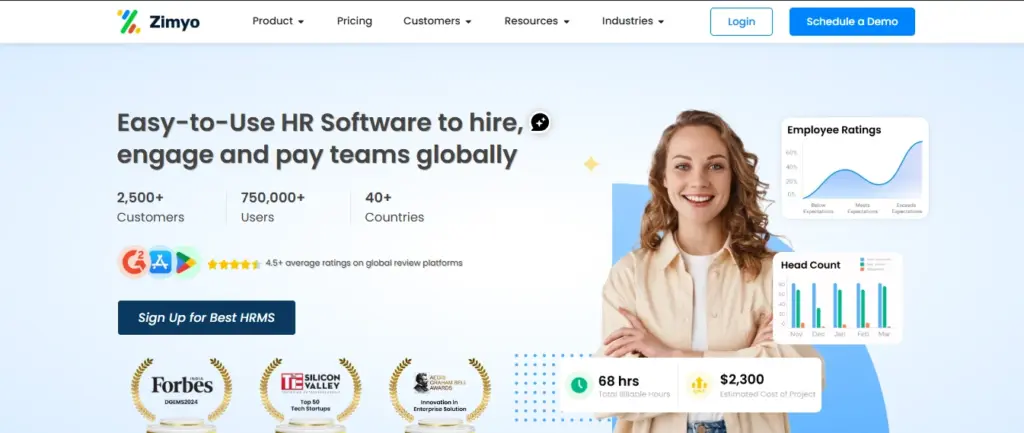
Best for: Zimyo LMS is suited for Indian companies of 50–2,000 employees where HR runs training alongside onboarding, attendance, payroll, and appraisals.
Verified rating: 4.5 (G2 and Capterra India, August 2026)
Key features
- Course creation with video, documents, quizzes, and SCORM content
- Competency mapping and skill-gap identification tied to role definitions
- Native connection to attendance, payroll, and performance modules
- Certificates, badges, and gamified completion tracking
- Can create personalized learning paths based on roles and requirements
Strengths
- Training and HR data live in one system, so a completed compliance online course feeds straight into an appraisal cycle with no manual export.
- Built in India – statutory coverage, INR billing, IST support – with no second procurement cycle, security review, or renewal to negotiate.
Limitations
- The LMS is a module, not a dedicated platform. Course authoring is less deep than Disprz or Docebo.
- Learning analytics cover completion and scores rather than predictive skill modeling.
- The verified review base is smaller than those of the global platforms in this list.
Verdict: Right when learning is one of several things your HR team runs and a second system would create more work than it saves. Wrong if L&D is a standalone function with its own budget; start with Disprz instead.
2. HowNow - Best Skills-First Learning Platform
Best for: HowNow is suited for mid-market and enterprise companies that want to bring learning, skills management, knowledge sharing, and AI coaching into one platform rather than running a traditional LMS alongside separate skills and content tools. It is particularly strong for L&D teams focused on onboarding, upskilling, role-readiness, and learning in the flow of work.
Verified rating: 4.5/5 (G2, 54 reviews, October 2026)
Key features
- Skills Intelligence and AI Skill Graph that map employee skills, roles, learning content, and skill gaps
- AI-powered personalised learning pathways based on roles, skills, progress, and business goals
- Guru AI Coach for teaching, coaching, scenario practice, reinforcement, and feedback using organisational knowledge
- Learning content creation with videos, documents, quizzes, SCORM files, and other mixed media
- Unified search, knowledge sharing, and content curation across internal and external learning sources
- Learning delivered directly through Slack, Microsoft Teams, the browser extension, and mobile app
- HowNow+ content library with curated resources from providers such as Skillsoft and MindTools
Strengths
- Learning and skills sit in the same platform, so L&D can connect a skill gap to the learning designed to close it instead of managing separate systems.
- Strong “in the flow of work” delivery through Slack, Teams, browser, and other integrations reduces the need for employees to leave the tools they already use.
- AI is built into the learning experience rather than limited to course recommendations: Guru can coach learners, run realistic scenarios, provide feedback, and adapt to individual skill gap.
Limitations
- Custom pricing makes it harder to compare costs upfront.
- Its advanced skills and AI features may be more than smaller teams need.
Buyers should check integrations and regional compliance requirements before choosing it.
Verdict
HowNow is a strong option for organisations focused on skills-based learning, AI coaching, and learning in the flow of work. It is best suited to mid-market and enterprise teams rather than businesses looking for a simple, traditional LMS.
3. Disprz - Best for Frontline and Distributed Workforces
Best for: Large Indian enterprises training field, retail, factory, or multi-location teams – BFSI, distribution, retail, manufacturing, and logistics.
Verified rating: 4.5 (G2 and Capterra India, August 2026)
Key features
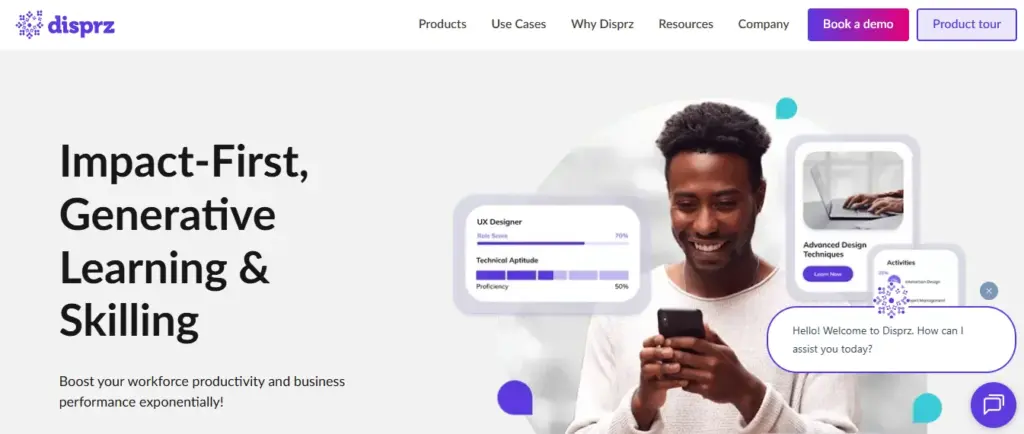
- Mobile-first delivery designed for low-bandwidth conditions
- Microlearning modules built for short attention windows
- Skill intelligence linking training programs to role competency and business KPIs
- Blended delivery combining classroom and online sessions
Strengths
- The strongest skill-intelligence layer of any India-built platform here; it maps what people can actually do, not just what they have completed.
- Genuinely mobile-first rather than a desktop product with a phone app bolted on, backed by Indian implementation teams and a substantial domestic enterprise base.
Limitations
- Feature depth creates a steeper learning curve for administrators and content designers.
- Premium capabilities sit behind higher tiers, and full deployments are priced for enterprise budgets.
- Implementation runs months rather than weeks.
Verdict: If your training problem is frontline capability at scale, start here. It is the most capable dedicated learning platform on this list for Indian conditions.
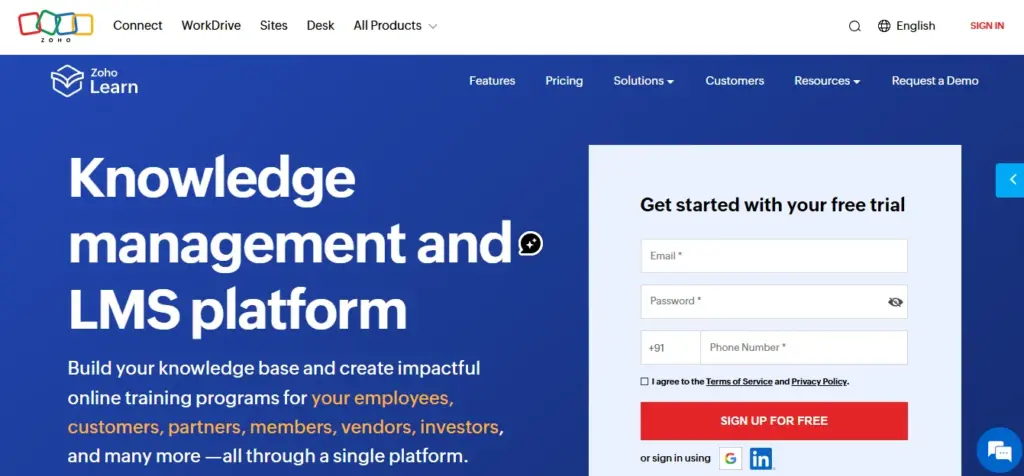
4. Zoho Learn - Best Value for Small Teams
Best for: Small and mid-sized Indian companies, particularly those already running other Zoho applications.
Verified rating: 4.5 (G2, August 2026)
Key features
- Combined knowledge base and course builder in one product
- Multimedia course creation with text, video, files, and quizzes
- Assessments with multiple question formats
- Progress reporting and learner analytics
Strengths
- Costs a fraction of anything else here, with no meaningful compromise for straightforward internal training.
- Indian company with INR billing and GST-compliant invoicing; setup is near-instant if you already use Zoho.
Limitations
- Blended learning delivery is shallow next to dedicated platforms; this is a knowledge base with training courses attached.
- Analytics stop at completion and scores, with no skill mapping.
- Limited value if you are not otherwise in the Zoho ecosystem.
Verdict: Right for a 30-person company that needs structured, trackable training and cannot justify a five-figure contract. Wrong for regulated programs where audit evidence matters.
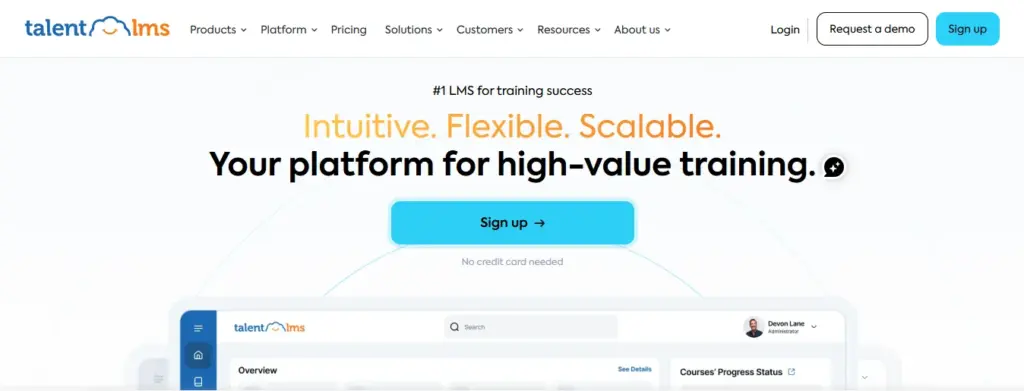
5. TalentLMS - Best for Fastest Deployment
Best for: Indian companies of 50–500 employees that need training running in weeks and have no dedicated L&D team.
Verified rating: 4.6 (G2, August 2026)
Key features
- Course creation from video, PDFs, slides, and SCORM files
- AI-assisted course authoring
- Learning paths and branching content by learner group
- Reporting and completion analytics
Strengths
- Teams commonly go live within a fortnight, nothing else here is close.
- Transparent public pricing and a genuine free tier, both rare in this category, on one of the largest review bases here.
Limitations
- Thin on India readiness: no POSH templates, no Indian statutory framing, and USD pricing with the forex exposure that implies.
- Support runs on a global queue rather than an India-based team.
- Feature depth caps out for complex compliance workflows and large-scale user management.
Verdict: The right pick when speed matters more than localization, it will be live before most alternatives finish scoping. Budget for handling Indian statutory training elsewhere.
6. Moodle - Best for Self-Hosted Control and Data Ownership
Best for: Regulated industries with strict data-residency requirements, and organizations with in-house technical capability or an implementation partner.
Verified rating: 4.1 (G2, August 2026)
Key features
- Open-source core with no license fee
- Extensive plugin ecosystem for themes and added functionality
- SCORM and xAPI support as standard
- Flexible roles and granular permissions
Strengths
- Complete data ownership: you decide which server in which city holds your learner records, which resolves most DPDP Act questions outright.
- No vendor lock-in or renewal risk, strong Unicode handling for Indian scripts, and the widest install base of any LMS globally.
Limitations
- Requires technical staff or an implementation partner. The license is free; the deployment is not.
- Interface feels dated without customization investment.
- Corporate features such as gamification and advanced analytics need plugins or custom development.
Verdict: The most economically rational choice at scale if you have the technical capability. Total cost of ownership frequently beats cloud from year two or three, and the data-residency question answers itself.
7. Docebo - Best for Enterprise Analytics
Best for: Indian arms of multinationals and large domestic enterprises running training across employees, partners and customers.
Verified rating: 4.3 (G2, August 2026)
Key features
- AI-driven content recommendations and learning automation
- Learning paths, content management, and social learning
- Extended enterprise delivery for partners and customers
- Detailed behavioral reporting beyond completion rates
Strengths
- Reporting tells you why completion is failing, not just that it is- the difference between a dashboard and a diagnosis.
- AI automation meaningfully reduces administrative load, and it handles internal, partner, and customer training from one platform.
Limitations
- Cost is high and rises quickly with scale and add-ons.
- Implementation and configuration require real effort and usually a dedicated administrator.
- Substantially over-specified for organizations under a few thousand learners.
Verdict: Justifiable when collaborative learning is a strategic function with a matching budget. If you cannot name the person whose full-time job is running the LMS, this is not your platform.
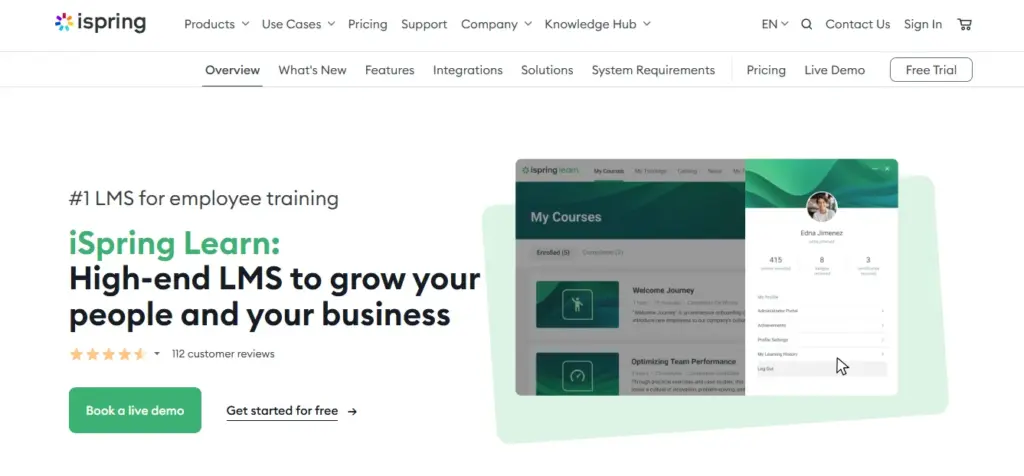
8. iSpring Learn - Best for Existing PowerPoint Libraries
Best for: Organizations sitting on large libraries of slide-based training material that need it delivered and tracked without rebuilding it.
Verified rating: 4.5 (G2, August 2026)
Key features
- Direct conversion of PowerPoint decks into trackable courses
- Quizzes, interactions, and assessments
- Learning paths with learner progress tracking
- Mobile apps with responsive delivery
Strengths
- Nothing else converts existing slide content this cleanly.
- Straightforward interface with transparent per-user pricing that scales down sensibly with volume.
Limitations
- Limited India-specific capability – no statutory training templates, no INR billing.
- Lighter on gamification and social learning than comparable platforms.
- Enterprise-grade analytics and complex integrations need additional work.
Verdict: A narrow category but a real one. If your training library is honestly several hundred slide decks, this is the fastest way to make them countable.
9. Litmos - Best for Ready-Made Compliance Content
Best for: Regulated Indian businesses that need certification tracking running quickly and would rather license content than write it.
Verified rating: 4.3 (G2, August 2026)
Key features
- Pre-built course library covering common compliance topics
- Course creation, quizzes, and assessments
- Mobile learning with offline access
- Reporting and certification tracking
Strengths
- The out-of-the-box content library removes the single biggest delay in most compliance rollouts.
- Fast deployment for a platform of this depth, and backed by SAP, which matters for procurement in SAP shops.
Limitations
- The bundled library is written for Western regulatory contexts and needs supplementing for Indian statutory training.
- Advanced features frequently require add-ons.
- Custom reporting is weaker than dedicated enterprise platforms.
Verdict: Strong if your compliance requirements map to standard corporate topics. Weaker if you need POSH or Indian labor-law content, which you will source separately regardless.
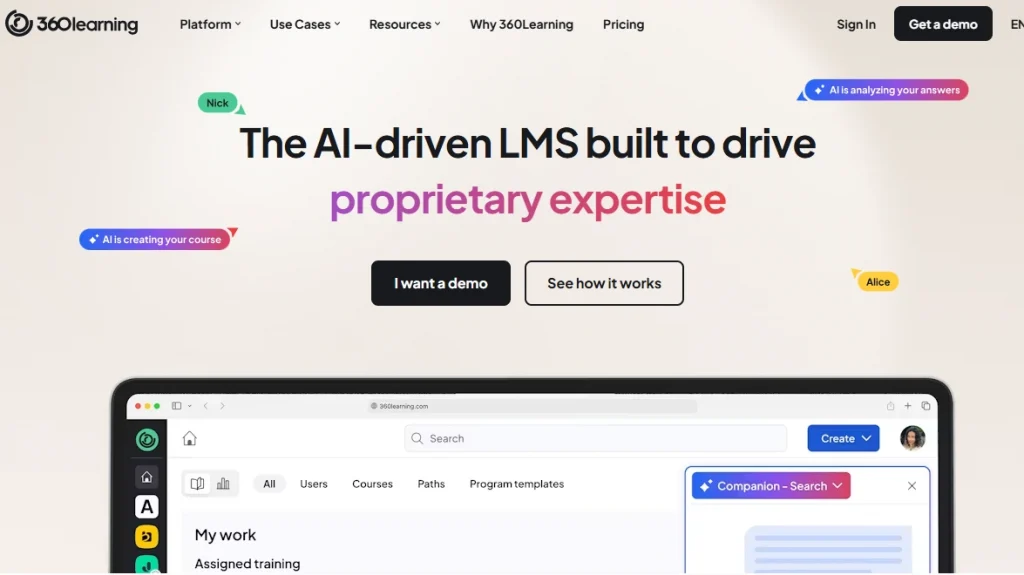
10. 360Learning - Best for Expert-Authored Content
Best for: Companies where subject-matter experts should be building the training, and where training culture is genuinely peer-led.
Verified rating: 4.6 (G2, August 2026)
Key features
- Collaborative authoring, letting any expert build and publish courses.
- AI-assisted multimodal content creation
- Adaptive coaching and automated learning paths
- Blended delivery with strong mobile support
Strengths
- The best collaborative authoring model here; it scales content creation instead of bottlenecking it in one team.
- Highly rated mobile experience and a large verified review base for a platform of its age.
Limitations
- Very limited India presence: no Indian statutory content, no INR pricing, no local support team.
- Per-user pricing becomes expensive as learner numbers grow relative to author numbers.
- Less suited to rigid compliance workflows than to an open, culture-driven learning environment.
Verdict: An excellent product with an awkward fit for India-first requirements. Worth considering if your training culture is genuinely collaborative and compliance is handled elsewhere.
Also considered
These platforms were evaluated but did not win a category. Each is a legitimate option for the right buyer.
11 – SAP SuccessFactors Learning – Deep enterprise capability, but implementation runs six to eighteen months with cost scaling accordingly. Sensible only if you already run SAP.
12 – Cornerstone Learning – Robust for regulated industries and complex certification management. Held back by an aging interface and high implementation cost.
13 – Adobe Learning Manager – Polished learner engagement experience; enterprise pricing and limited India capability keep it out.
14 – Cipher Learning – AI-powered course generation with solid ratings, but almost no Indian market presence or localization.
15 – Abara LMS – India-built, mobile-first and well regarded, but the verified review base is too small to assess against platforms with hundreds.
16 – Paradiso LMS – Long-standing Moodle-based platform, but a thin verified review base for a vendor of its age.
17 – UpsideLMS – Established Indian corporate LMS with real presence in BFSI, retail, and telecom. Excluded pending verified review data.
18 – Mercer Mettl – Bangalore-built, strong on assessment. Excluded pending verified review data.
What We Excluded, And Why
- Learnyst, Classplus, Graphy and Edmingle – built for coaching institutes and course creators, not corporate L&D.
- Camu, Canvas and Blackboard – education-first platforms designed around academic terms, accreditation reporting and student information systems.
- Coursera, Udemy Business and Simplilearn- content marketplaces. Articulate 360 – an authoring tool that pairs with an LMS rather than replacing one.
- KREDO, Invince, Skills Caravan and SincX Learn – India-built and legitimate, but below the verified review threshold set for this evaluation.
What Actually Matters When Buying An LMS in India
Tier 1 — deal-breakers
Data residency inside India. Regional-language content creation, not just interface translation. Mobile-first architecture. Statutory training coverage for POSH and Indian labour law. Missing any one of these eliminates a platform for most Indian buyers, regardless of what else it does well.
Tier 2 — genuine differentiators
Implementation under sixty days. A support team operating in Indian time zones. Pre-built compliance modules mapped to Indian regulations. Offline content delivery for smaller cities and low-connectivity sites. These separate the serious options from the merely adequate.
Tier 3 — nice to have
AI proctoring, advanced analytics dashboards, gamification, social learning. Heavily marketed, used by a minority of Indian organizations in practice, and a poor basis for a primary selection decision.
LMS Software Pricing in India: What to Expect
Published LMS pricing in India is unreliable, and the headline number is rarely what you pay. Four of the ten platforms above publish no list price at all.
Three models dominate. Per-user-per-month is easiest to budget but scales linearly and gets expensive as headcount grows. Tiered banding charges a flat rate across a user range, cheaper at the top of a band, wasteful at the bottom. Perpetual license plus maintenance is rare outside self-hosted deployments but produces the lowest cost at very large scale.
Costs that rarely appear on the pricing page: implementation fees, data migration, integration work to connect the LMS to your HRMS or payroll, content authoring or licensing, storage overages on video-heavy courses, and administrator seats billed separately from learners.
Two complications specific to India: most global platforms price in USD, so your annual cost moves with the exchange rate, and several vendors quote an India-specific rate on request that is materially below published international pricing. If you do not ask, you will not be offered it.
Price a three-year total, not a monthly rate. Ask every vendor for year-one, two, and three totals including implementation, and ask in writing what happens at renewal. Vendors who will not answer are telling you something.
DPDP Act 2023, Data Residency And Compliance
The Digital Personal Data Protection Act 2023 changed the calculation for anyone storing employee learning records. An LMS holds names, employment details, assessment scores, and completion histories – all personal data under the Act, and you stay accountable even when a vendor does the processing.
Three questions decide whether a platform is workable. Where are the servers physically located, and can the vendor name the city? What are the retention and deletion procedures when an employee leaves? And what is the breach notification timeline?
Ask for these in writing during evaluation, not after signing. A vendor who can produce a data-residency statement naming Indian data centre locations has thought about it; one who sends a link to a generic security page has not.
This is also the strongest argument for self-hosted Moodle in regulated sectors: when the server is yours, the residency question answers itself.
Regional Language Support: What "Multilingual" Actually Means.
“Multilingual support” in LMS marketing almost always means the interface has been translated; buttons and menus appear in Hindi. That is not the same as building and delivering a course in Hindi, and the difference decides whether your frontline team in Coimbatore or Indore can complete the training.
There are three distinct levels, and vendors rarely distinguish between them.
Interface translation localizes menus. Content delivery means the platform correctly renders course material in Indian scripts – Devanagari, Tamil, Telugu, Bengali, and Gujarati all have rendering requirements that break poorly built systems, and conjunct characters are where failures show up. Content authoring means your team can create, edit, and assess in those languages, including quiz questions and free-text answers.
Test level three during the demo. Ask the vendor to display a course page in Tamil and build a quiz question in Hindi, live on the call. It takes four minutes and eliminates a substantial share of most shortlists.
LMS Implementation Timelines By Organization size
Implementation timelines vary more by organization size and integration complexity than by platform, and vendor estimates are consistently optimistic.
Under 200 users on a cloud platform with no integrations: two to four weeks, assuming you already have content, one administrator, and no HRMS connection.
200 to 2,000 users with HRMS integration and content migration: six to twelve weeks. The integration work, not the platform setup, is what consumes the time.
Above 2,000 users with multiple integrations, legacy records to migrate, and phased regional rollout: three to six months, and longer on the heaviest enterprise platforms.
Two things reliably cause overrun: data migration, which requires custom work and rarely transfers cleanly, and change management, which project plans consistently under-resource. A platform nobody logs into has not been implemented, whatever the Gantt chart says.
Migrating From Your Existing System
Most Indian organizations buying an LMS are moving off a mix of Google Classroom, Microsoft Teams, shared drives, a legacy on-premise system, or spreadsheets. Migration is where implementation projects overrun, and almost no vendor scopes it honestly during the sales cycle.
Three things have to move, at different speeds. Course content is easy if SCORM-packaged and hard if not – decks and videos scattered across drives have to be found, cataloged, and re-uploaded, which is manual work nobody budgets for. Learner records are the difficult part: completion histories, assessment scores and certification dates rarely map cleanly, and some loss is normal. User accounts are straightforward if your HRMS is the source of truth and painful if it is not.
Two decisions make this manageable. Decide early how much history you actually need; many organizations find they need certification status and expiry dates but not five years of quiz scores. And run both systems in parallel for one full training cycle rather than cutting over in a weekend.
Ask every vendor what migration support is included, what is chargeable, and whether they have done it before from your source system. Answers vary enormously, and the difference shows up in the invoice.
Cloud, Self-Hosted or Hybrid?
Cloud is the default and right for most Indian companies: no infrastructure, predictable billing, vendor-managed uptime. The trade-offs are recurring cost that never ends, limited control over where data sits, and dependence on the vendor’s continued India operation.
Self-hosted suits organizations with technical capability and strict data requirements: you control the infrastructure, residency resolves itself, and there is no license renewal – in exchange for owning hosting, patching, upgrades, and backups.
Hybrid arrangements appear in large deployments but add integration complexity most mid-sized organizations should avoid.
The decision comes down to one question: do you have, or will you pay for, technical capability? If yes and you are in a regulated sector, self-hosted Moodle is likely the lowest-cost and lowest-risk option over five years. If no, cloud is not a compromise – it is correct, and pretending otherwise produces the under-resourced Moodle deployments that drag down its ratings.
When An HRMS-Integrated LMS Makes More Sense Than A Standalone One
There is a category question underneath the platform question that most LMS comparisons skip: should learning be a separate system at all?
For organizations with a dedicated L&D function and complex requirements, yes – a specialist platform does things an HRMS module cannot, and the overhead is worth paying.
For many Indian companies in the 50 to 2,000 employee range, no – and the reasons are practical rather than technical.
Training data is only useful in context. A completion record matters because it feeds an appraisal, unlocks a role change, or satisfies an audit. When the LMS is separate, connecting those means an integration project — or in practice a monthly CSV export someone eventually stops doing.
Onboarding shows this most clearly. A new hire’s first fortnight involves document collection, policy acknowledgment, asset assignment and role training. Split across two systems, that becomes two logins, two progress trackers, and two people chasing completion, and the joiner experiences it as disorganization.
There is also procurement reality: a second vendor means a second contract, security review, renewal negotiation and integration to maintain, and it recurs annually.
If you are an educational institution
This article covers corporate and employee training only. Schools, colleges, and coaching institutes need accreditation reporting and student information system integration, which none of the platforms above are built for; Moodle and Camu are the usual starting points there. We will cover that market separately.
How to Choose The Right LMS for Employee Training
- Define the training you are actually buying for – Compliance, onboarding, upskilling and customer training have different requirements. Most organizations need two done well, not four done adequately.
- Set a three-year budget, not a monthly one – Include implementation, integration, migration, and content. This alone removes most of the shortlist.
- Check the Tier 1 deal-breakers – Data residency, regional-language content, mobile-first, Indian statutory coverage. Four questions that eliminate faster than any feature comparison.
- Decide deployment before you talk to vendors – Cloud or self-hosted is a decision about your technical capability, not a vendor decision. Letting a salesperson make it produces bad outcomes.
- Run a two-week pilot, not a demo – Give twenty actual employees real course content and measure whether they finish it. Pilot completion predicts production completion better than any feature list.
- Negotiate the renewal, not just year one – Vendors compete on the first-year price. The renewal is where the cost lives, and it is only negotiable before you sign.
Seven questions to ask in every vendor demo
- Show me your data residency statement and name the Indian city where our data would be stored.
- Display a course page and build a quiz question in Tamil, now, on this call.
- What POSH Act training content ships with the platform, and how is completion evidenced for an audit?
- Give me year-one, year-two, and year-three total cost, including implementation, in writing.
- Who supports us, in which time zone, and what is the contracted response time for a critical issue?
- Show me the completion report a line manager sees, not the admin dashboard.
- Have you migrated a customer off our current system before, and what did it cost?
Conclusion
The role of an LMS has changed a lot. It’s not just about training anymore, companies now look for the Best Learning Management System in India to support continuous learning and skill growth.
In this guide, we covered what an LMS is, its benefits, and some of the top LMS platforms in India available today. We also looked at how tools like Zimyo combine HR and learning, which can be useful for businesses exploring LMS software for companies in India.
Choosing the right platform really depends on your needs. With so many learning management solutions for organizations, it’s better to pick something that fits your workflow instead of just going for features.
In the end, choosing the best learning management system in India comes down to what works best for your team and long-term goals. The best LMS software in India is the one that actually helps your team learn and grow consistently.
Frequently Asked Questions (FAQs)
Which is the best learning management system in India?
There isn’t one LMS that works for everyone. It mostly depends on what your organization needs and how training is handled.
For corporate training, platforms like Docebo and TalentLMS are often preferred. Some companies also choose Zimyo because it connects learning with HR, onboarding, and performance, which makes things easier to manage in one place.
Which learning management system is best?
The best LMS depends on the need. For companies that want automation, analytics and skill mapping Docebo, TalentLMS and Zimyo’s LMS module are strong options.
Which is the No 1 learning platform in India?
Moodle and SWAYAM are quite commonly used in India, especially in education.
In corporate setups, teams often prefer tools like Zimyo when they want both HR and learning in one place instead of using separate systems.
What is the LMS system in India?
An LMS in India is a digital platform that helps educational institutions and companies create, deliver, and manage training programs. It supports online courses, assessments, progress tracking and certification.