
Zimyo 3.0 is Live!
Experience the future of HR, powered by Zim AI.
Become an early customer
Sign up now25% Off on All ProductsZimyo 2.0
A limited-time offer on every Zimyo 2.0 plan.
Upgrade your HR for less
Claim 25% offFree Webinar Webinar 28 Oct
The Future of Hiring Is AI-Native · 3:00 PM IST
Watch Zim AI hire, live
Sign up nowCalculate your leave encashment in seconds!
Find out how much your unused leaves are worth. Get instant clarity on taxable and exempt amounts as per Indian payroll rules.
Home / Calculators / Leave Encashment Calculator: Know Your Leave Salary (India 2026)
| Particulars | Amount |
|---|---|
| Last drawn Basic Salary + DA | ₹ 0 |
| Unutilised leave after retirement | 0 leave |
| Leave Encashment recieved | ₹ 0 |
A leave encashment calculator is an online tool that helps you find out how much money you will receive for your unused leaves. If you are planning to resign, retire, or are simply curious about the value of your saved leaves, this tool makes things easy for you.
Instead of manually doing complex math or worrying about tax rules, the calculator instantly shows you the exempted and taxable portion of your leave salary. Zimyo’s calculator is designed to give you quick, accurate, and compliant results as per leave encashment calculation in India.
Leave encashment is the payment an employee receives for earned or privilege leave they did not use, converted to cash at resignation, retirement, or, where policy allows, during service. The amount is based on basic salary plus dearness allowance, not full CTC. In case of death, the encashment is paid to the nominee or legal heir.
Zimyo Payroll software handles leave encashment, gratuity, FnF, and TDS in one settlement flow.
Leave type | Encashable? |
Earned / privilege leave (EL/PL) | Yes, the standard encashable leave across organizations |
Casual leave (CL) | Rarely; usually lapses at year-end unless policy states otherwise |
Sick leave (SL) | Only if company policy explicitly permits it |
Maternity, paternity, bereavement, floater leave | No, these cannot be accrued or encashed |
Encashment of earned leave is the default across Indian organizations; everything else is policy-dependent. Check your leave policy before counting other leave types in the calculator.
The standard leave encashment calculation used by most Indian companies:
Leave Encashment = (Basic Salary + Dearness Allowance) ÷ 30 × Number of unused leave days
Basic + DA of ₹30,000/month, 20 days of unused earned leave:
Encashment = (30,000 ÷ 30) × 20 = ₹20,000
Received during service, this amount is fully taxable as salary – no exemption applies (see tax section).
Leave Encashment on Retirement: How the Tax Exemption Works
At retirement or resignation, leave encashment for non-government employees is exempt under Section 10(10AA) up to the least of four amounts:
Meera retires after 20 years. Average Basic + DA over her last 10 months: ₹60,000/month. Her company grants 30 days of earned leave per year; she used 250 days over her career, leaving 350 unused.
Step | Calculation | Amount |
Encashment received | (60,000 ÷ 30) × 350 | ₹7,00,000 |
Limit (a): actual received | — | ₹7,00,000 |
Limit (b): statutory cap | — | ₹25,00,000 |
Limit (c): 10 months’ average salary | 60,000 × 10 | ₹6,00,000 |
Limit (d): cash equivalent of unavailed leave | (20 yrs × 30 days − 250 used) = 350 days → (60,000 ÷ 30) × 350 | ₹7,00,000 |
Exempt (least of the four) | — | ₹6,00,000 |
Taxable leave salary | 7,00,000 − 6,00,000 | ₹1,00,000 |
Zimyo’s calculator runs this exact calculation for you and shows the exempt and taxable split, the part that most manual calculations get wrong.
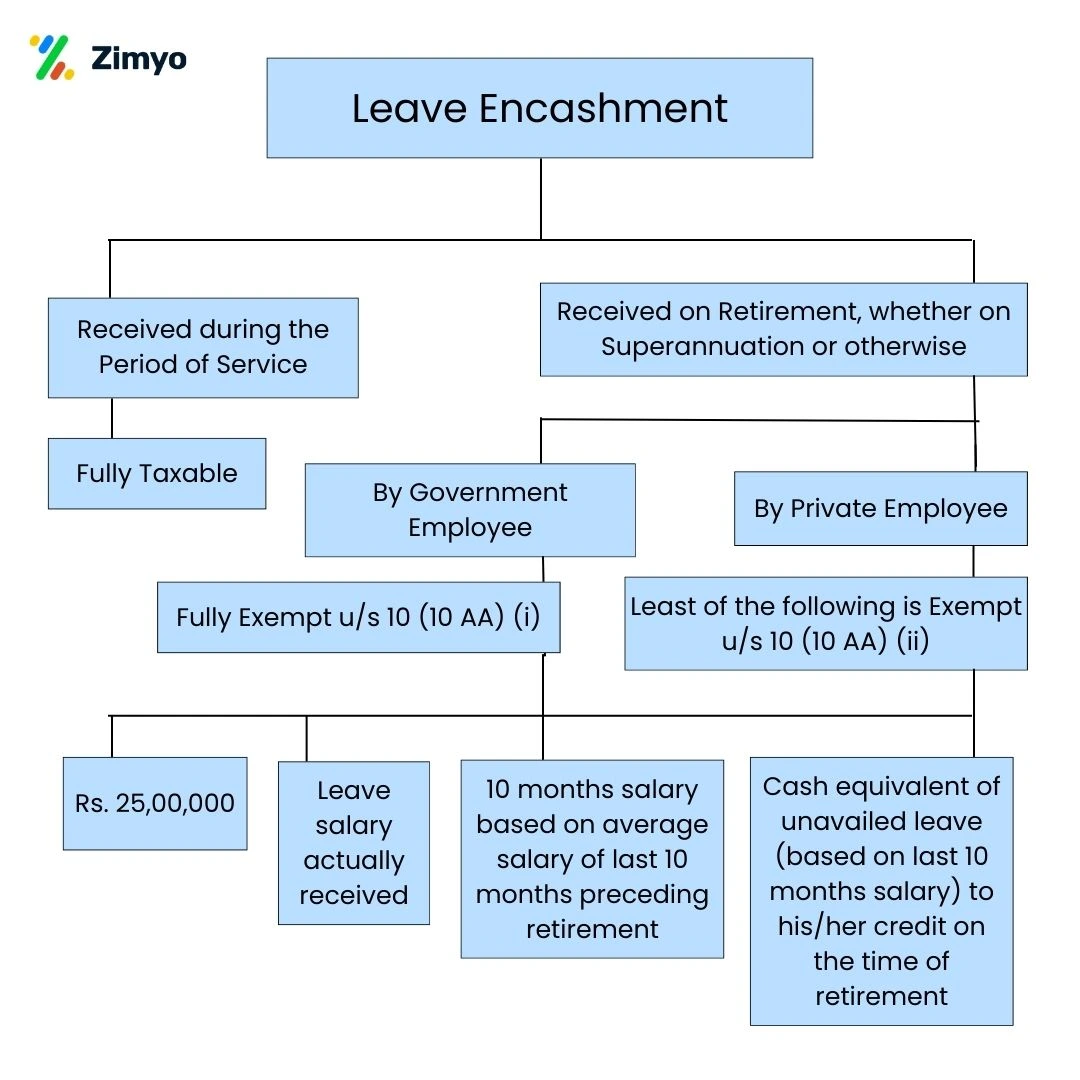
Scenario | Tax treatment |
Government employee – at retirement | Fully exempt under Section 10(10AA)(i) |
Non-government employee – at retirement or resignation | Exempt up to the least-of-four limit above; balance taxed as salary with TDS in the final settlement |
Any employee – during service | Fully taxable as salary income; no Section 10(10AA) exemption |
Paid to nominee/legal heir on death of employee | Not taxable in the hands of the nominee or legal heirs |
The exemption at exit applies identically under both the old and new tax regimes; regime choice affects only the tax rate on the taxable balance, not the exempt amount. The ₹25 lakh cap is a lifetime aggregate across employers.
You can calculate your leave encashment using Zimyo’s Leave Encashment Calculator by following these steps:
Leave encashment is more than just an HR process. It is money you have earned by saving your leaves. With Zimyo’s leave encashment calculator, you can quickly understand the value of your unused leaves, plan your finances better, and stay confident about tax compliance.
Whether you are an employee planning your next move or an HR professional handling settlements, this tool gives you clarity when you need it most.
Encashment of leave = (Basic Salary + Dearness Allowance) ÷ 30 × number of unused leave days. Only basic salary and DA are included, while other components like HRA and bonus are not taken into account. The divisor is sometimes taken to be 26 rather than 30.
The formula remains (Basic + DA) ÷ 30 × unused days. The tax exemption on exiting employment is the minimum of the actual amount received, ₹25 lakh, 10 months’ average salary, or the money value of unused leave, restricted to 30 days per year of service.
During the course of service, it is fully taxable. Upon retirement or resignation, it is tax-free up to the Section 10(10AA) least-of-four limit for non-government employees, and fully tax-free for government employees. On payment to the nominee upon death, the benefit is not taxable.
₹25 lakh, as a lifetime aggregate across all employers, for non-government employees under Section 10(10AA). CBDT raised this limit from ₹3 lakh with effect from AY 2024-25.
Yes. Unused earned leave is encashed in the FnF settlement at exit, alongside pending salary and gratuity. Under the Code on Wages, wage dues must be paid within two working days of the last working day.
No. The Section 10(10AA) exemption at retirement or resignation applies under both regimes. Only the tax rate on the taxable balance depends on your regime and slab.