
What is In-Hand Salary?
The term in-hand salary is synonymous with take-home salary or net salary. The sum total of money deposited into your bank account after all the deductions like TDS, PF, professional tax, and others is referred to as in-hand salary. In-hand salary will definitely be less than the Cost to Company (CTC) because CTC contains expenses that will not come to your pocket as money.
CTC vs Gross Salary vs In-Hand Salary
Term | What it means |
CTC (Cost to Company) | Everything the employer spends on you in a year: basic, allowances, bonus, employer PF, gratuity provision, insurance. The offer-letter number. |
Gross salary | CTC minus the employer-side costs (employer PF, gratuity provision). What accrues to you before your own deductions. |
In-hand / take-home salary | Gross minus employee PF, professional tax, and income tax (TDS). What actually hits your bank account. |
As a rule of thumb, take-home is roughly 70–85% of CTC - higher at incomes below the tax threshold, lower at senior levels where the 25–30% slabs apply. The gap is not money lost: employer PF and gratuity accrue to you later; tax and your own PF account for the rest.
Zimyo Payroll gives every employee a self-serve salary breakdown - CTC structure, deductions, TDS projection - inside the ESS portal and automates the payroll math behind it.
CTC to In-Hand Salary: The Formula
The full chain from CTC to in-hand salary:
- Gross salary = CTC − Employer PF contribution − Gratuity provision (≈4.81% of basic)
- Taxable income = Gross − Standard deduction (₹75,000, new regime) − applicable exemptions/deductions
- In-hand salary = Gross − Employee PF − Professional tax − Income tax (TDS)
Worked Example: ₹12 Lakh CTC (New Regime, FY 2026-27)
Assumptions: basic = 50% of CTC (₹6,00,000), the minimum share the Labour Codes count as wages; PF computed on the new ₹25,000 statutory wage ceiling in force from 17 September 2026 (₹3,000/month each side); new tax regime; professional tax ₹2,400/year; no variable pay.
Step | Calculation | Amount |
Employer PF (annual) | ₹3,000 × 12 | ₹36,000 |
Gratuity provision | 4.81% × 6,00,000 | ₹28,860 |
Gross salary | 12,00,000 − 36,000 − 28,860 | ₹11,35,140 |
Taxable income | 11,35,140 − 75,000 (standard deduction) | ₹10,60,140 |
Income tax | Below ₹12 lakh → Section 87A rebate | ₹0 |
Employee PF + professional tax | 36,000 + 2,400 | ₹38,400 |
Annual in-hand salary | 11,35,140 − 38,400 | ₹10,96,740 |
Monthly in-hand salary | 10,96,740 ÷ 12 | ₹91,395 |
If your employer computes PF on full basic (₹50,000/month here, so ₹6,000 each side) instead of the ₹25,000 ceiling, both PF lines rise and take-home falls to about ₹85,395 a month, which is why two people with identical CTCs can have different in-hand salaries. Zimyo’s calculator lets you enter your actual PF amounts from your payslip.
In Hand Salary After Tax: FY 2026-27 Rules
New Tax Regime (default)
Taxable income slab | Rate |
Up to ₹4,00,000 | Nil |
₹4,00,001 – ₹8,00,000 | 5% |
₹8,00,001 – ₹12,00,000 | 10% |
₹12,00,001 – ₹16,00,000 | 15% |
₹16,00,001 – ₹20,00,000 | 20% |
₹20,00,001 – ₹24,00,000 | 25% |
Above ₹24,00,000 | 30% |
- Standard deduction: ₹75,000 for salaried individuals.
- Section 87A rebate: taxable income up to ₹12 lakh pays zero tax, with the standard deduction, gross salary up to ₹12.75 lakh is effectively tax-free. Zero tax does not mean gross equals in-hand: PF and professional tax still apply.
- Cess: 4% health and education cess applies on the computed tax.
Old Tax Regime (Optional)
The old regime keeps the ₹2.5 lakh exemption limit with 5%/20%/30% slabs, a ₹50,000 standard deduction, and the full menu of exemptions - HRA under Section 10(13A), 80C up to ₹1.5 lakh, 80D, and home loan interest. It usually wins only when your total exemptions and deductions are substantial (metro HRA plus full 80C plus home loan interest). With few deductions, the new regime almost always yields a higher in-hand salary. Run both before choosing, you pick a regime each financial year.
What Gets Deducted from CTC
Deduction | Rate / amount | Notes |
Employee Provident Fund (EPF) | 12% of Basic + DA | Statutory computation on a ₹25,000/month wage ceiling from 17 September 2026 (was ₹15,000) = ₹3,000/month; under the Labour Codes, allowances above 50% of pay are added to wages; many employers deduct 12% of full basic instead — check your payslip |
Employer PF (inside CTC) | 12% of Basic + DA | Part of CTC but never paid as monthly cash; 8.33% goes to EPS (pension), 3.67% to EPF |
Gratuity provision (inside CTC) | ≈4.81% of basic | Provisioned in CTC; paid on exit after 5 years of service, or after 1 year for fixed-term employees under the Labour Codes |
Professional tax | State-specific | Maharashtra ₹2,500/yr; Karnataka and West Bengal ₹2,400/yr; Delhi, UP, Haryana and Rajasthan levy none |
ESI | 0.75% of gross (employee) | Applies only if gross salary is ₹21,000/month or less; employer pays 3.25% |
Income tax (TDS) | Per regime slabs | Deducted monthly by the employer against your projected annual tax |
Other recoveries | Actuals | Loan EMIs routed via payroll, insurance premiums, advances, LWF |
A Note on Variable Pay
Variable pay and bonuses sit inside your CTC but are paid quarterly or annually, if at all. A 15% variable component means your fixed monthly salary is built on only 85% of CTC. Enter the variable portion in the calculator’s bonus field to see your true fixed monthly take-home, and treat payouts as a bonus when they arrive, not as budgetable income.
Key Components in an In Hand Salary Calculator
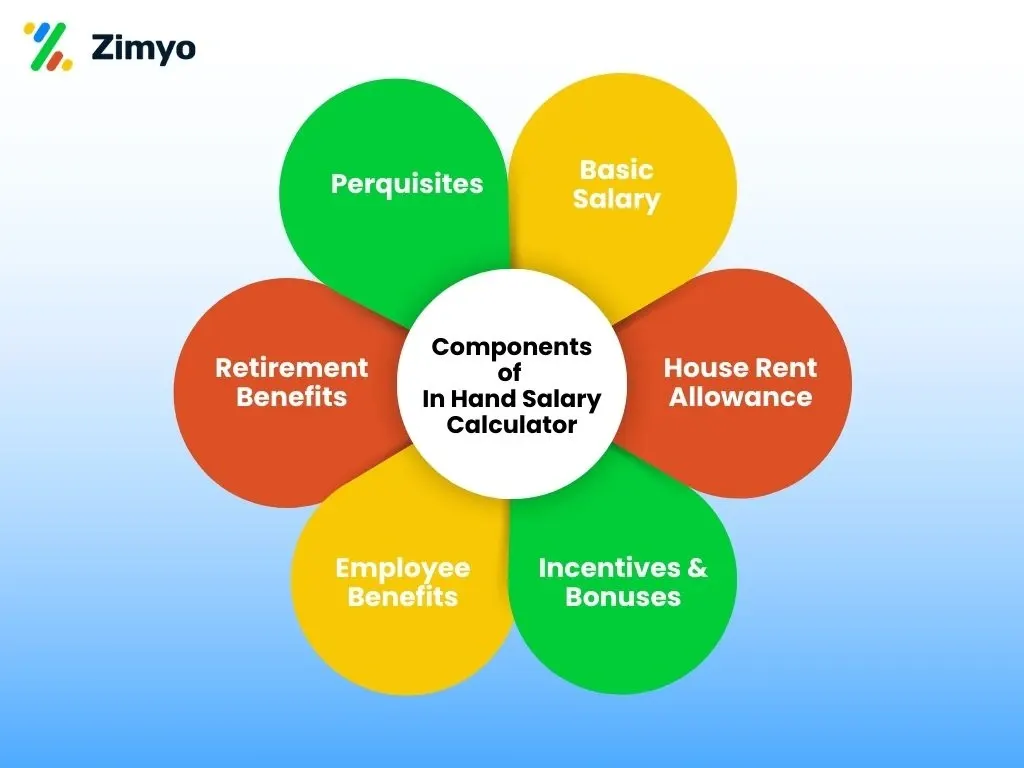
Let’s break down the components used in an in hand salary calculator to help you understand the figures:
1. Basic Salary
Your basic salary is the fundamental pay you receive for your work. It typically accounts for 50% of your CTC. For example, if your CTC is ₹5,00,000, your basic salary might be ₹2,50,000 annually.
2. House Rent Allowance
HRA or House Rent Allowance is an allowance given to employees to help with living expenses. It’s usually calculated as 40% or 50% of your basic salary, depending on your company’s policies.
3. Incentives and Bonuses
Some companies provide incentives and bonuses based on performance. These payments can be added to your salary, though they might not be guaranteed every month.
4. Employee Benefits
Employee benefits may include health insurance, life insurance, or other perks offered by the company. These are deducted from your CTC and contribute to your overall compensation.
5. Retirement Benefits
Provident Fund (PF) contributions are part of your retirement benefits. Employees contribute 12% of their basic salary to the PF, which is matched by the employer.
6. Perquisites
Perquisites are additional benefits provided by the company, such as company cars, phone bills, or housing.
Quick Reference: In-Hand Salary by CTC (New Regime, FY 2026-27)
Annual CTC | Approx. monthly in-hand | Effective tax |
₹6 lakh | ≈₹42,600 | Nil (87A rebate) |
₹10 lakh | ₹71,000 – 75,000 | Nil (87A rebate) |
₹12 lakh | ₹85,000 – 91,000 | Nil (87A rebate) |
₹16 lakh | ₹1,06,000 – 1,15,000 | ≈₹92,000 – 1,01,000/yr |
₹20 lakh | ₹1,29,000 – 1,42,000 | ≈₹1,57,000 – 1,75,000/yr |
Ranges reflect the two common PF conventions (the statutory ₹25,000 wage ceiling from 17 September 2026 vs full basic) at a 50% basic split, as the Labour Codes require; new tax regime, no variable pay assumed. Your exact figure depends on your salary structure; use the calculator above with your payslip values.
How to Use Zimyo’s In-Hand Salary Calculator
- Enter your annual CTC.
- If your CTC includes variable pay or bonus, enter it as a percentage or amount — the calculator excludes it from fixed monthly pay.
- Enter monthly deductions from your payslip: employee PF, employer PF, professional tax, ESIC, LWF, and any other recoveries. Enter 0 for those that don’t apply.
- Read the result: monthly and annual take-home, plus total monthly and annual deductions.
Conclusion
An in hand salary calculator is an essential tool for both employees and employers. It helps to understand salary breakdowns and estimate take-home pay, while also ensuring compliance with tax laws.
By using a salary and take home salary calculator, you can make informed decisions—whether it's about your finances, salary negotiations, or budgeting. So, next time you wonder about your in-hand salary, simply use a CTC to in hand salary calculator to get a clearer picture of your take-home amount!
Now that you know how an in hand salary calculator works, have you tried using a take home salary calculator to calculate your salary yet?