
Getting the right person is only the beginning. Whether they will be a long-term contributor or a costly early exit depends on what happens after they accept the offer. That handoff is the employee onboarding process.
For many years, “onboarding” and “orientation” were interchangeable terms: a day of paperwork and a tour of the office. No longer. Orientation is one event. Onboarding is a structured journey from offer letter to confident, fully productive employee. That journey can take anywhere from the first 90 days to a year.
The stakes are high. About one-third of new hires quit within the first 90 days, but just about 12% of employees report that their company does a good job of onboarding them. Today’s employees also expect more: role clarity from day one, early connection with their team, and quick access to the tools they need. Remote and hybrid work raises the bar further, since nothing can be left to chance anymore.
This guide covers what onboarding is, why it matters, the step-by-step process, a ready-to-use checklist, best practices, mistakes to avoid, and how employee onboarding software ties it all together.
What Is Employee Onboarding?
Employee onboarding is the structured process of integrating a new hire into a company, from offer acceptance to documentation, role clarity, training, and early performance support. This typically starts before day one and persists for months. What’s the goal? Help the new employee feel welcome, know what they’re supposed to do, connect with others, and get to work quickly.
A strong employee onboarding experience builds trust, boosts productivity, and reduces early turnover. It goes beyond just paperwork—it’s about helping the new hire feel like they belong. By using tools like employee onboarding software, HR teams can create personalized journeys that guide employees step by step, making them feel valued and supported throughout their first days and beyond.
Onboarding vs. Orientation
Aspect | Orientation | Onboarding |
Duration | One day or session | Weeks to months |
Focus | Paperwork and logistics | Role, culture, performance |
Nature | One-time event | Ongoing process |
Goal | Complete formalities | Turn a hire into a productive employee |
Orientation is one part of onboarding, not a replacement for it.
Check Out Our Expert Blog on Top Employee Onboarding Software
Why Employee Onboarding Is Important?
A good onboarding process delivers real business results:
- Improved retention- Effective onboarding can boost new hire retention by as much as 82% (Brandon Hall Group).
- Higher productivity- A standardized process allows new hires to ramp up much faster.
- More involvement- Early cultural affinity increases employee motivation and loyalty.
- Improved employer brand- What a new hire says about your company is influenced by their experience.
- Reduced turnover costs- Less turnover in first-year staff means big savings in rehiring.
- Adherence – Documentation, policies, and role-specific training are done well.
Stronger culture: Every hire reinforces or dilutes your values, and onboarding sets the tone.
The Employee Onboarding Process: Step-by-Step

A great onboarding experience follows a clear sequence.
- Preboarding-Between offer and day one, keep the excitement alive. Send a welcome email or video, share the handbook, collect documents digitally, and trigger IT setup early.
- Documentation-Handle contracts, verification, tax forms, and policy sign-offs digitally, so day one isn’t buried in paperwork. Electronic signature software handles the signing itself, so contracts and policy acknowledgements come back completed and filed before the start date rather than on it.
- IT and workspace setup-Prepare the laptop, logins, and tools before arrival. For remote hires, ship equipment early and test it.
- First-day experience-Keep it welcoming, not overwhelming. Greet the hire, share the day’s plan, and give a tour.
- Team introductions-Introduce the immediate team, key partners, and leadership. Share an org chart.
- Role clarity-Explain responsibilities, how success is measured, and how the work connects to company goals.
- Training-Combine role-specific training, tool walkthroughs, and self-paced LMS content. Start with a small task to build confidence.
- Goal setting-Set clear 30-, 60-, and 90-day goals so the hire has direction.
- Regular feedback-Check in often, and ask the new hire what’s working and what’s confusing.
- 30-60-90-daycheck-ins- Confirm role clarity at 30 days, review goals at 60, and hold a first performance review at 90. This rhythm is what turns a warm welcome into lasting retention.
Employee Onboarding Checklist
Stage | Task | Owner |
Preboarding | Send welcome email/video | HR |
Preboarding | Collect and verify documents | HR |
Preboarding | Send contract for e-signature | HR |
Preboarding | Trigger IT setup | IT |
Day 1 | Share the day’s plan and tour | Manager/HR |
Day 1 | Confirm laptop and logins work | IT |
Day 1 | Assign an onboarding buddy | Manager |
Week 1 | Schedule 1:1s and explain 30-day goals | Manager |
Week 1 | Grant LMS access and a starter task | HR |
Month 1 | Weekly check-ins and first feedback | Manager |
Day 30 | Review progress, remove blockers | Manager |
Day 60 | Review goals, discuss development | Manager |
Day 90 | First performance review and growth plan | Manager/HR |
Employee Onboarding Best Practices
- Make it personal- A developer needs a different onboarding than a sales rep.
- Become digital- Digital onboarding automates the paperwork and standardizes the experience.
- Establish a buddy program- A peer buddy helps to integrate culturally faster.
- Automate your workflows- Reminders, tasks and approvals shouldn’t need chasing.
- Keep talking- Don’t go silent before day one or after week one.
- Involve the manager- In fact, when managers get involved, the odds of successful onboarding are much greater.
- Gather feedback- Survey new hires at each milestone and do something with what you learn.
Common Onboarding Mistakes (and Fixes)
Mistake | Fix |
Too much day-one paperwork | Digitise it during preboarding |
Poor communication | Set a cadence from offer to day 90 |
No onboarding plan | Build a documented, repeatable process |
No follow-up after week one | Use 30-60-90 day check-ins |
Information overload | Sequence learning gradually |
Unclear roles | Define responsibilities early |
Latest Onboarding Trends
- AI onboarding answers FAQs and automates repetitive steps.
- Digital platforms replace fragmented spreadsheets with a single system that can be tracked.
- Self-service onboarding allows new hires to fill out forms and track their progress themselves.
- All one-size-fits-all programs are replaced by personalised journeys.
- Mobile onboarding for deskless and distributed teams.
- Automation of learning means that no training module is missed.
- Onboarding: Where do new hires get stuck? HR analytics can help HR improve.
Employee Onboarding Software: What It Automates
Manual onboarding doesn’t scale. Employee onboarding software centralizes the process into one system and automates:
- Document collection & e-signatures.
- Welcome e-mails and communications.
- HR, IT and managers assignments to tasks.
- Asset and equipment tracking.
- Delivery of training and monitoring progress.
- Policy Acknowledgements and Record of Compliance.
The upshot: a faster, more consistent experience and a lot less admin for HR.
Why Choose Zimyo for Employee Onboarding?
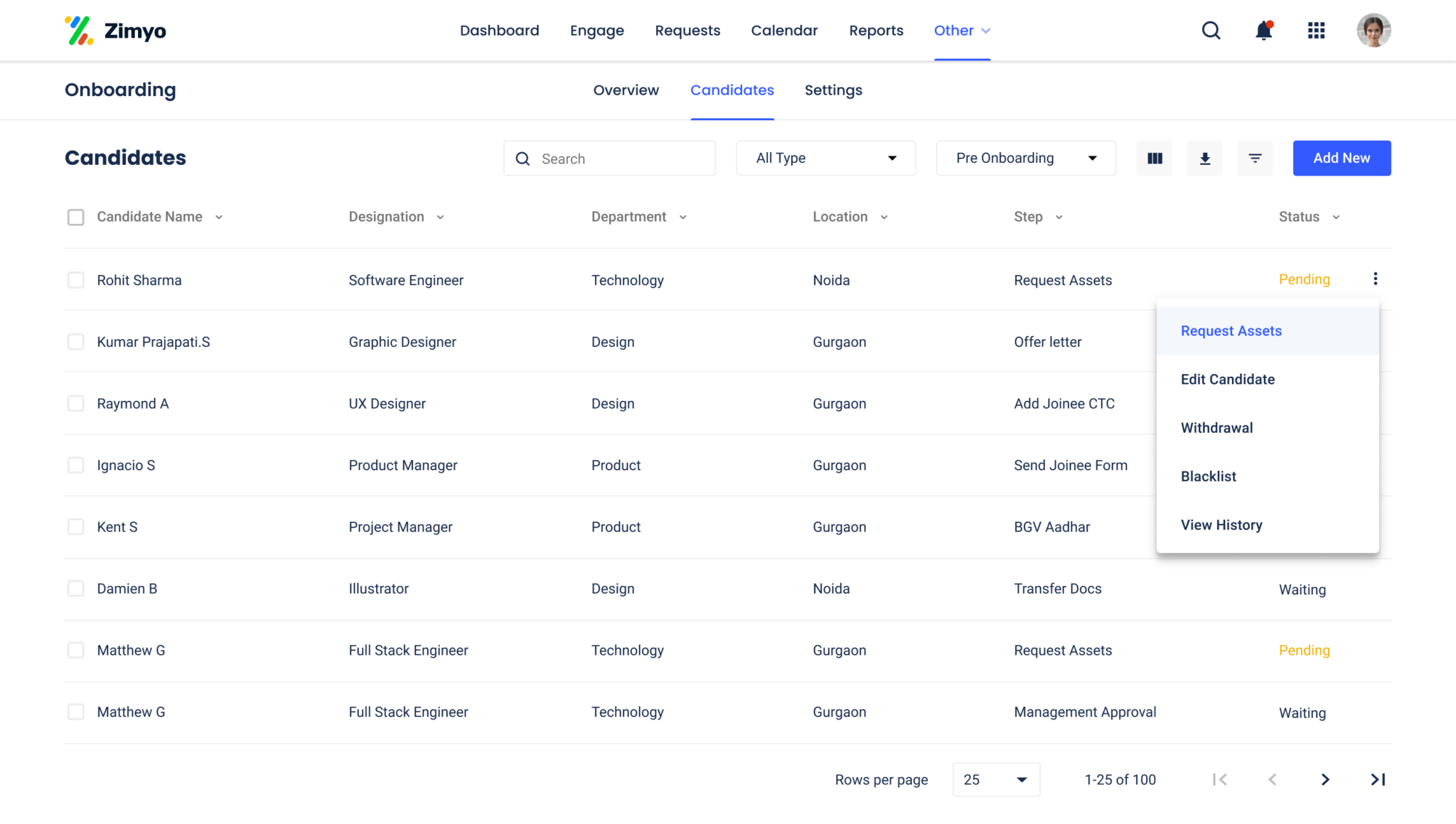
Zimyo makes the entire process of onboarding employees streamlined and paperless from pre-onboarding to post-joining engagement of the employees. With Zimyo, HR professionals can:
- Streamline processes with role-based workflows and candidate view based on Kanban methodology.
- Self-serve using joinee forms and document upload facility.
- Digital management of all documents in one-click facility.
- Go paperless with digital forms and electronic signature options.
- Pre-onboard with background verification, letter of intent, and DigiLocker checkup facility.
- Monitor everything with live dashboards and analytics.
Onboarding is only the first part of the lifecycle of an employee and therefore Zimyo integrates onboarding seamlessly with attendance, payroll management, performance management, and lifecycle management of employees.
Conclusion
Your onboarding process is what will confirm or disprove everything that your new recruit thought before joining your firm. If executed successfully, it will make the recruits productive faster, make them more engaged, and also safeguard your hiring efforts. Otherwise, it will make them silently leave your company.
You need to create a structured strategy, personalize it, communicate regularly, involve managers, and leave the rest to automation. Employee onboarding software from Zimyo is one of the best ways of giving your employees a head starts upon joining your firm.
Want to Upgrade Your Onboarding Process?
In today’s fast-paced work culture, a great onboarding process needs the right tech to back it up and that’s where Zimyo Employee Onboarding Software comes in. Designed to shape a powerful first impression, Zimyo helps HR teams create easy, paperless, and personalized onboarding journeys.
From pre onboarding to post-joining engagement, Zimyo’s intuitive onboarding software offers everything you need, customized workflows, candidate Live Dashboard views, background verification, e-joinee forms, and detailed analytics… everything in one place.
With powerful onboarding tools like automated profile creation, e-signatures, onboarding kits, and real-time dashboards, you can increase the productivity of the new hire by over 70% and improve engagement by 82%.
Provide your team with smart data, eliminate human errors, and give your new employees the warm, digital welcome they deserve, only with Zimyo employee onboarding software.
Schedule a demo today and reimagine onboarding the modern way.
Frequently Asked Questions (FAQs)
What is the employee onboarding process?
Onboarding is an organized process that assists employees in getting acquainted with their new surroundings and the organizational culture. Onboarding involves such phases as preboarding, paperwork, orientation, training, goal setting, and other measures aimed at ensuring that the employee is productive and culturally fit.
What's the difference between onboarding and orientation?
Orientation refers to a one-time activity in which employees are oriented to the company’s policies and culture. Onboarding is a thorough process that takes several weeks or even months in which new employees acquire the knowledge and skills necessary to become productive employees.
What is an employee onboarding checklist?
A new employee checklist is a tool designed to walk you through the process of bringing a new employee into your business. It will include everything that needs to be done in order to have a successful onboarding, such as document check, IT setup, orientation, training, etc.
Why is employee onboarding important?
The significance of onboarding employees is that it facilitates easy adaptation to the new role of the employee and helps him/her get familiar with his/her position within the organization. A good onboarding process will lead to higher levels of employee engagement, productivity, retention, and compliance.
What does employee onboarding software do?
On-boarding software for employees makes on-boarding process automated and easier with the help of documentation management, filling of electronic forms, signing, assigning tasks, training, policy acknowledgement, and progress monitoring. It guarantees uniformity of on-boarding process, saves time, increases productivity of new employees, and enhances engagement of employees.