
For most US companies, the “top-rated HR system” question splits by size and by how much of the stack you want in one place. The HR tech market will undergo significant changes in 2025 as human resource tech companies adapt to new human-technology collaboration models. (Deloitte, 2025)
Here’s the catch with most “top rated” lists: they call everything top rated without showing a single rating. Vendor-published roundups quietly rank themselves first. This guide does the opposite: every item includes core HR functions, its true G2 rating, and review count; items are sorted by rating and then reviews; and if a software has a better rating than ours, we highlight it in the table. Ratings are verified against G2 ratings in 2026 and are dynamic, so check the live site before making a list. Browse the category yourself on G2’s Core HR listing.
Quick picks: Who Should Choose What HR Management Systems
Here is the list of the 14 Top Rated HR Systems For Companies:
- Zimyo – Best overall HRMS solution with payroll in the same package and covering the whole lifecycle in a single record.
- Rippling – Best fit where HR, IT, and payroll need to run on one system.
- Deel – Best option for globally dispersed teams, freelancers, and international hiring.
- Gusto – Best payroll-first solution for small US-based teams.
- Paycom – Best option for employees who need self-service.
- HiBob – Best solution for internationally dispersed mid-market companies where engagement is key.
- Paylocity – Best workforce management solution with native reporting.
- BambooHR – Best solution for easy out-of-the-box use and implementation.
- UKG Pro – Best solution for hourly, shift-driven, and complex payroll processing workforces.
- ADP Workforce Now – Best solution for payroll expertise and multi-state compliance.
- Dayforce – Best solution for continuously integrated HCM.
- Workday – Best enterprise solution with one record.
- SAP SuccessFactors – Best global enterprise solution for those using SAP.
- Paycor – Best mid-market payroll and HR solution.
Our Research Methodology
We evaluated all platforms on the criteria an buyer truly that comes up with facing these problems after signing:
- Actual ratings – G2 score and number of reviews on the day we assessed, not “Top Rated” fluff.
- Price transparency – Posted employee pricing or quote only.
- Payroll and taxes – Whether the provider handles and possesses the multi-state payroll tax, or relies on partners for this.
- Scalability – At which headcount level the functionality ceiling is reached.
- Implementation and support – Actual time to go live, and whether you get human support or helpdesk tickets.
- Employee experience – Because adoption, not administrative features, repays the investment; it motivates employee engagement.
The ranking is by G2 rating, then by number of reviews; an item with a high rating but few reviews ranks below a somewhat lower-rated one with thousands of reviews. Entries with less than 50 reviews rank at the bottom (nobody here has less).
Comparison table: 14 top-rated HR Systems
# | Tool | Best for | G2 rating (reviews) | Entry price | Free trial |
1 | Zimyo | Value all-in-one HRMS + payroll | 4.5/5 | from $4/user/mo | No (30-day money-back) |
2 | Rippling | HR + IT + payroll on one system | 4.8/5 | Not published | No |
3 | Deel | Global teams and contractors | 4.8/5 | Free HR tier; from ~$20/emp/mo | Yes |
4 | Gusto | Payroll-first small teams | 4.6/5 | $49/mo + $6/person | Free to sign up |
5 | Paycom | Employee self-service | 4.6/5 | Not published | No |
6 | HiBob | Engagement-led mid-market | 4.5/5 | ~$18–25 PEPM (quote) | No |
7 | Paylocity | Workforce management + reporting | 4.4/5 | ~$38–48 PEPM all-in | No |
8 | BambooHR | Ease of use, fast setup | 4.4/5 | from $10/emp/mo | Yes |
9 | UKG Pro | Hourly and complex payroll | 4.3/5 | Not published | No |
10 | ADP Workforce Now | Payroll + multi-state compliance | 4.2/5 | Not published | Yes |
11 | Dayforce | Continuous, unified HCM | 4.2/5 | Not published | No |
12 | Workday | Large enterprises | 4.1/5 | Not published | No |
13 | SAP SuccessFactors | Global SAP enterprises | 3.9/5 | ~$18–38/user/mo | Yes |
14 | Paycor | Mid-market payroll + HR bundles | 3.9/5 | Not published | Yes |
What "Top Rated" Actually Hides
Before the list, three things worth knowing. First, ratings are segment-specific: Forbes’ testing team rated BambooHR 4.9 for ease of use, but the same platform strains past a few hundred employees — a “top” score in one band is a mismatch in another. Second, the number of reviews matters. Fourth, the biggest and best-rated are two separate sets; the largest core-HR vendors, being Workday, SAP SuccessFactors, and Oracle, have not even made it into the top 10 of G2 satisfaction ratings. Use the rating results to meet your organization’s needs with HR professionals.
Detailed reviews of the 14 Top Rated HR Software Solutions
1. Zimyo
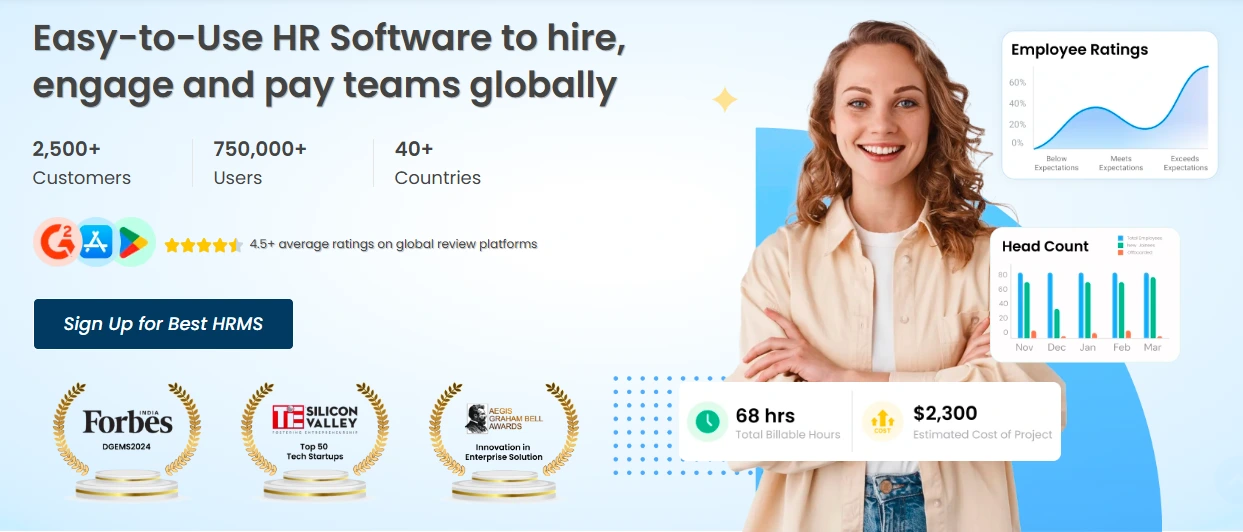
The reason why Zimyo brings core HR Software processes, attendance, leave management, payroll, and performance management onto one employee profile is that once a candidate is onboarded, this data goes all the way to exit from the same database. In other words, Zimyo offers an end-to-end solution without needing another third-party tool.
Best for: Companies of 10 to 500 employees wanting HR and payroll in one record.
Rating: 4.5/5 on G2
Entry price: from $4/user/mo
Free trial: no timed trial; annual plans carry a 30-day money-back guarantee



Key Features
- Core HR, attendance, and shift tracking on one record
- Payroll tied to attendance, with full & final settlement built in
- Leave management, self-service, and performance
- Multi-country payroll and statutory compliance
- Live dashboards and reporting
Pros and Cons
Pros | Cons |
Lowest published entry price here | Smaller G2 review base than the incumbents |
Genuinely all-in-one | Not a US 50-state tax-filing service |
Quick setup with a dedicated relationship manager | Mobile app trails desktop in places |
Strong fit for India, APAC, and GCC teams |
|
Verdict: Zimyo is the value pick when your goal is one system for HR and payroll rather than a US enterprise core-HR suite. At $4 per user per month, it undercuts every quote-only tool on this list, and the single-record design removes the export-and-reconcile gaps where errors hide. Validate it against your region’s compliance needs, and if your priority is US federal/state tax filing, look at the payroll-first names below.
2. Rippling
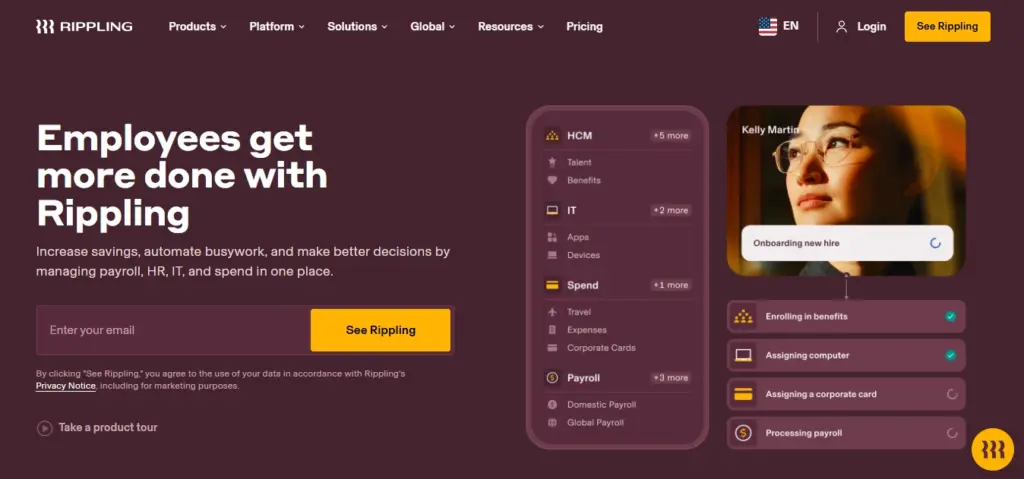
Rippling ties HR, IT, and finance to one employee record, so onboarding a hire can set up payroll, benefits, a laptop, and app access in a single workflow,, and offboarding reverses it all at once.
Best for: Tech-forward companies of 100 to 500 that want deep automation across HR and IT.
Rating: 4.8/5 on G2
Entry price: not published (quote-based)
Free trial: no
Key Features
- Payroll with in-house 50-state tax filing
- Native IT and device provisioning/deprovisioning
- Deep workflow automation and approvals
- Strong reporting with unlimited API calls
- Large integration library
Pros and Cons
Pros | Cons |
Highest-rated large platform here | Quote-based pricing |
Strong automation capabilities | Longer sales process |
| Full value may require multiple modules |
| Costs can increase as modules are added |
| Support primarily through chat/email |
Verdict: If payroll is one piece of a system you want automated end-to-end, Rippling is the most capable option on the list. For a team that only needs core HR, it’s more machine than the job requires.
3. Deel
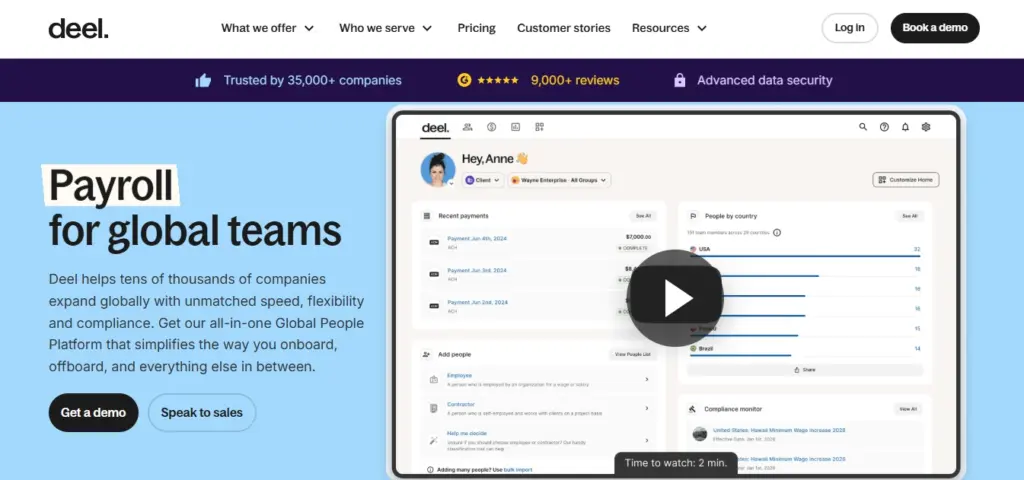
Deel runs HR, payroll, and compliance across 150+ countries, making it the pick the moment your team crosses borders with full-time staff, EOR workers, or contractors.
Best for: US companies that also employ or contract people internationally.
Rating: 4.8/5 on G2
Entry price: free HR tier; paid from ~$20/employee/mo
Free trial: yes (Deel HR)
Key Features
- Offboarding and hiring across 150+ countries with local compliance
- Global and US payroll, contractor management
- Integrated HRIS with IT device management
- Audit-ready employee data documentation and automated compliance updates
Pros and Cons
Pros | Cons |
Exceptionally easy to use | Per-worker pricing can add up |
Consolidates HR, payroll, and IT for distributed teams | Admin documentation can skew toward contractors |
| May be overkill for purely domestic teams |
| Costs can increase as the workforce grows |
| Broader feature set may require more setup |
Verdict: Deel is the global specialist. Domestic-only companies will pay for reach they don’t use, but for cross-border hiring, nothing here is smoother.
4. Gusto
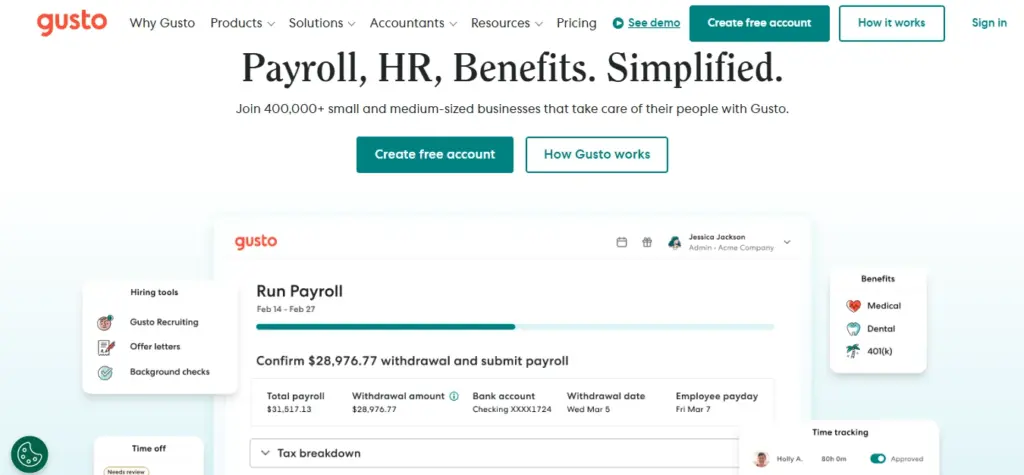
Gusto handles full-service payroll and tax filing, plus benefits and PTO, in an interface a first-timer can run on a Sunday night, and its pricing is public, which is rarer than it should be. Equipped with generative AI tools, this HR technology enables organizations to optimize workforce analytics, compliance, and productivity. Oracle stands out as a talent management system trusted by global enterprises.
Best for: Small US teams whose HR is mostly clean payroll, PTO, and benefits.
Rating: 4.6/5 on G2
Entry price: $49/mo + $6/person (Simple)
Free trial: free to sign up; billing starts when you run payroll.
Key Features
- Full-service payroll and automatic tax filing
- Benefits administration and PTO
- Onboarding, offer letters, self-service
- Clean accounting integrations
Pros and Cons
Pros | Cons |
Easiest to learn | Single-state on the entry plan |
Transparent pricing | Lighter workforce management features |
| Larger teams may outgrow it |
| Limited scalability for complex HR needs |
Verdict: For a small, mostly single-state team, Gusto is the safe default. Its ceiling shows as you add states and shift complexity.
5. Paycom
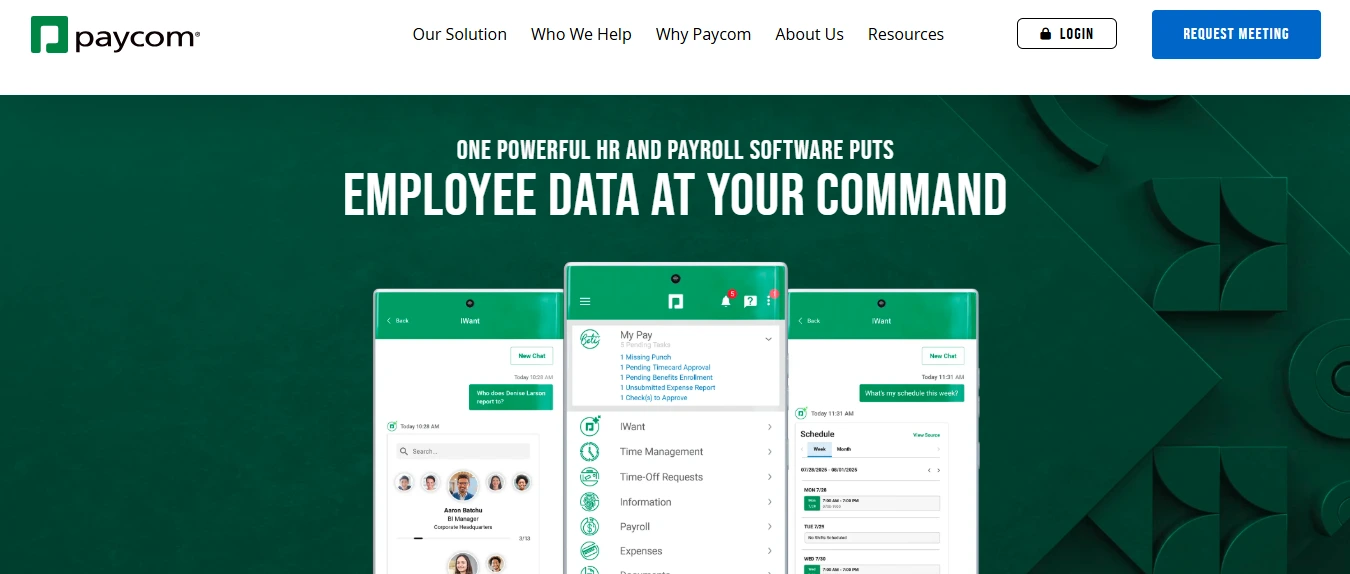
Paycom’s design pushes data ownership to employees, who manage their own time, schedules, and pay information in one portal, which cuts HR’s ticket volume once adoption lands.
Best for: Mid-market US employers that want employees to own their own data.
Rating: 4.6/5 on G2
Entry price: not published
Free trial: no
Key Features
- Self-service time, scheduling, and payroll
- Full-service payroll with tax liability
- Expense management and talent tools
- Single-database architecture
Pros and Cons
Pros | Cons |
Strong all-in-one self-service | Quote-based pricing |
Broad HR and workforce coverage | Depth can overwhelm small teams |
| Demo-led buying process |
| May require more setup and configuration |
| Can be more than smaller teams need |
Verdict: A solid mid-market pick if you genuinely want employees running their own transactions. Weigh workforce tech comfort before committing.
6. HiBob
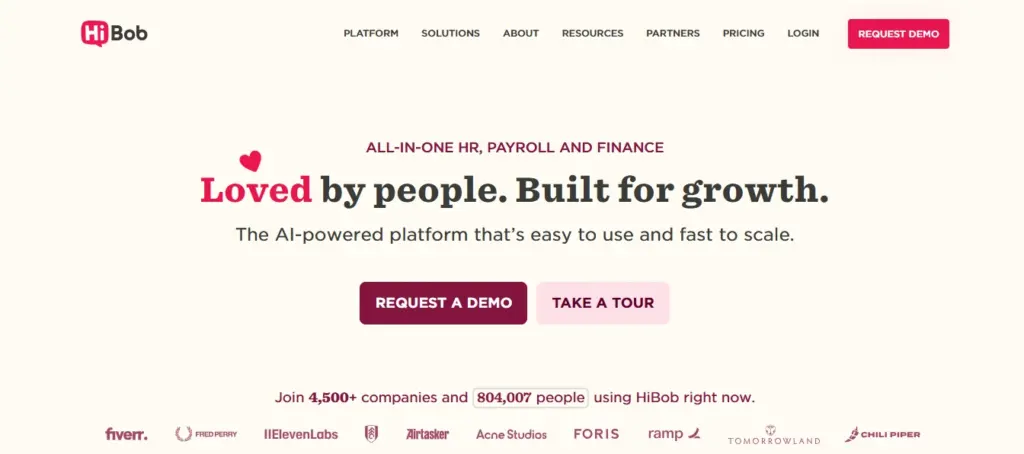
HiBob (Bob) wraps core HR inside a modern people-management and engagement platform with genuinely strong multi-country support. Further, talent management system that ensures smooth workforce planning and employee growth, making it a highly effective human resource management system.
Best for: Mid-market companies with 150 to 400 employees, especially with international headcount.
Rating: 4.5/5 on G2
Entry price: ~$18–25 PEPM (quote)
Free trial: no
Key Features
- Core HR with engagement and culture tools
- Time and attendance, workflows, approvals
- People analytics
- Strong native multi-country support
Pros and Cons
Pros | Cons |
Polished, intuitive admin experience | Relies on partners for US payroll |
Strong global payroll partnerships | Tax updates may sometimes lag |
Strong fit for scaling teams | Feature ceiling around 500–750 employees |
| Quote-based pricing |
| May require additional setup for complex payroll needs |
Verdict: The right call when culture and engagement matter and a chunk of your team sits outside the US. US-only, deskless teams will pay for scope they won’t use.
7. Paylocity
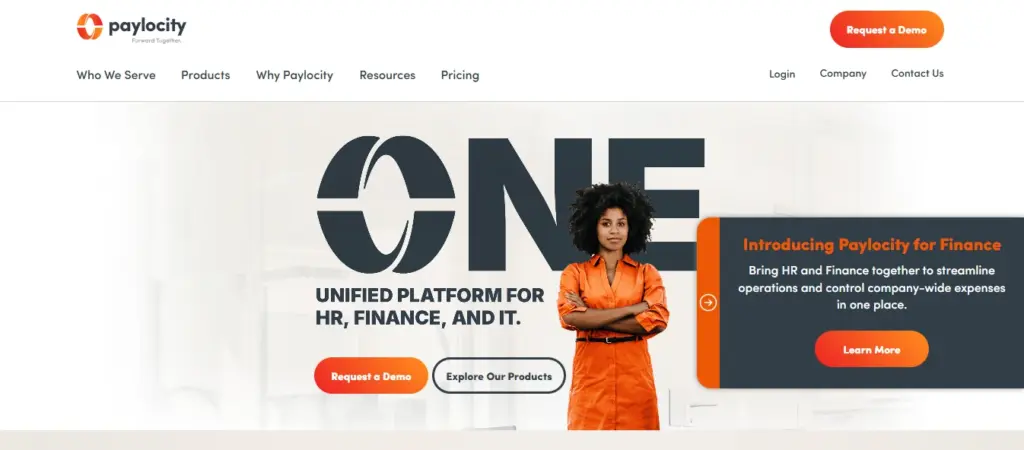
Paylocity pairs modern payroll with real workforce management — scheduling, labor forecasting and reporting strong enough that finance builds dashboards inside it. It is unique among Top Rated HR Systems For Companies as it automates both employee onboarding and device provisioning.
Best for: Companies with 150 to 500 employees that need workforce management plus responsive support.
Rating: 4.4/5 on G2
Entry price: ~$38–48 PEPM all-in
Free trial: no
Key Features
- Full-service payroll and tax (all 50 states)
- Scheduling and labor forecasting
- Native reporting and headcount analytics
- Mobile clock-in with tight geofencing
Pros and Cons
Pros | Cons |
Strong balance of workforce management and reporting | Premium pricing |
Native reporting reduces reliance on Excel exports | Support is limited to business hours |
Tax-liability transfer | Learning curve for new users |
| More suited to organisations needing advanced workforce management |
| May require additional setup and training |
Verdict: Buy it when you need genuine workforce management. For complex mid-market needs, the feature-to-service balance justifies the premium.
8. BambooHR
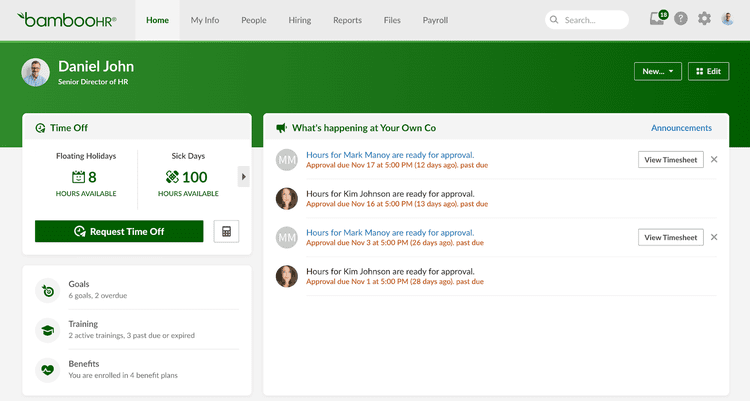
BambooHR is the usability benchmark: a clean core-HR platform a small team deploys in weeks, covering records, time off, onboarding, and performance. As a cloud-based HR software, it helps businesses with onboarding, employee data, and reporting, providing reliable HRMS management without overwhelming complexity.
Best for: Companies of 100 to 300 prioritizing day-one usability.
Rating: 4.4/5 on G2
Entry price: from $10/employee/mo
Free trial: yes
Key Features
- Core HR, records, time off, onboarding
- Performance management and reporting
- Payroll and time-tracking add-ons
- Employee self-service
Pros and Cons
Pros | Cons |
Easy to learn with minimal training | Feature ceiling around 500–750 employees |
Fast implementation | Payroll runs through partners |
Published pricing | API rate limits can affect reporting at scale |
| May require workarounds for complex workflows |
| Limited flexibility for highly customised requirements |
Verdict: The friendliest on-ramp here. Buy it for speed-to-live and employee experience now, accepting you may outgrow it near 500.
9. UKG Pro
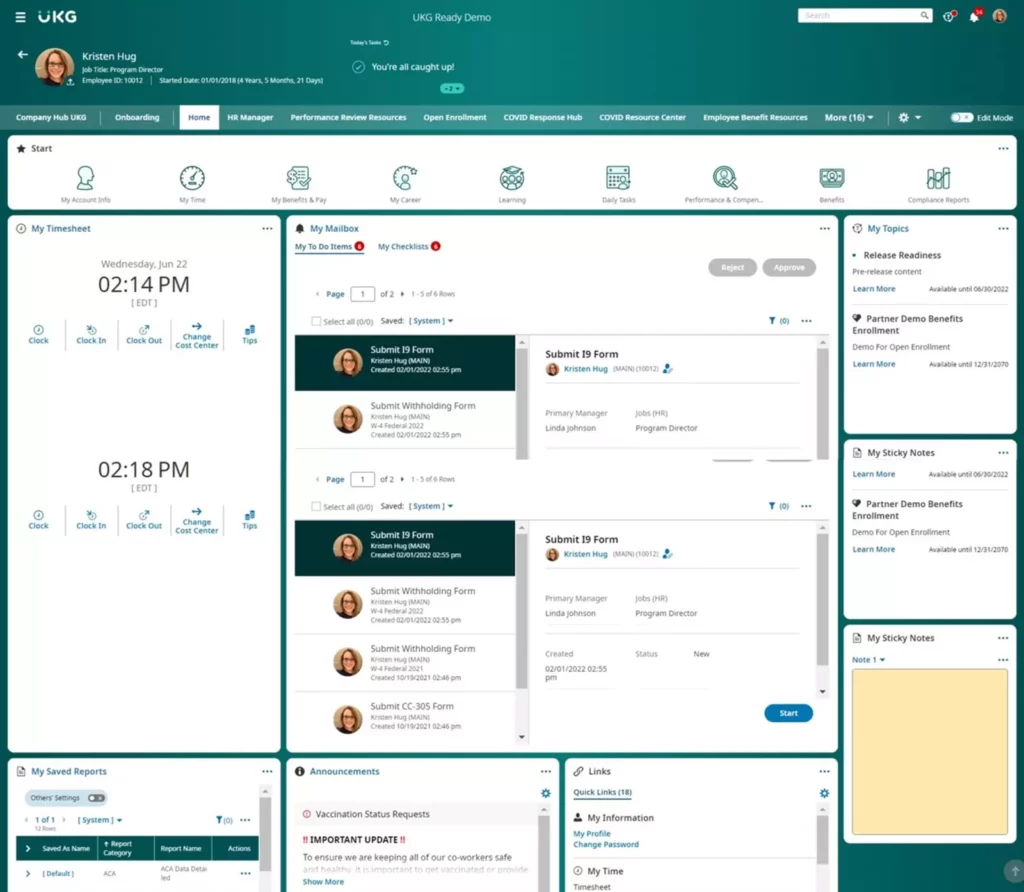
UKG Pro is HCM-grade, built for organizations with complex payroll, multiple entities, and demanding scheduling.
Best for: Employers with hourly, shift-based, or multi-entity structures.
Rating: 4.3/5 on G2
Entry price: not published
Free trial: no
Key Features
- Complex payroll and tax
- Workforce management and scheduling
- Talent and onboarding
- People analytics
Pros and Cons
Pros | Cons |
Deep customization options | Enterprise-focused implementation |
Strong for multi-entity teams | Not self-serve |
Robust workforce management | Interface can feel dated |
| Quote-based pricing |
| Longer implementation process |
Verdict: Worth it when your payroll and scheduling are genuinely complex; more system than a straightforward team needs.Verdict: Worth it when your payroll and scheduling are genuinely complex; more system than a straightforward team needs.
10. ADP Workforce Now
ADP brings decades of payroll and compliance infrastructure to the mid-market, with in-house tax filing across all 50 states. It is a trusted HR system offering payroll, compliance, and benefits management.
Best for: Companies of 200+ across multiple states that want lowest-risk compliance.
Rating: 4.2/5 on G2
Entry price: not published
Free trial: yes
Key Features
- Full-service payroll and tax in all 50 states
- Smart Compliance and benefits administration
- Talent and time modules
- Workforce analytics
Pros and Cons
Pros | Cons |
Deep multi-state compliance coverage | Interface can feel dated |
Assumes filing liability | Support quality varies by division |
Proven at scale | Quote-based pricing |
| Can be complex for smaller teams |
| May require more implementation support |
Verdict: When payroll accuracy and compliance are the priority, ADP’s track record is hard to beat. Expect a modular quote rather than a sticker price.
11. Dayforce
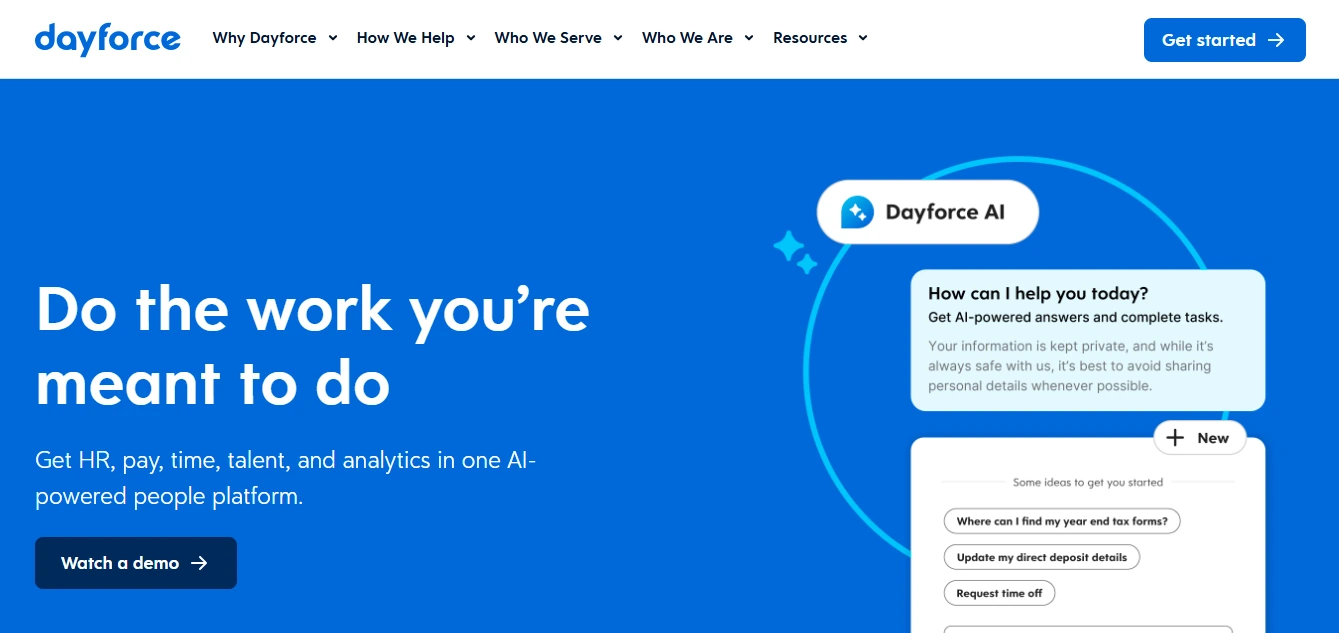
Dayforce runs HR, payroll, benefits, and workforce management on a single continuous-calculation engine, so payroll stays current rather than being batch-processed at period end.
Best for: Mid-to-large organizations wanting one unified HCM with real-time payroll.
Rating: 4.2/5 on G2
Entry price: not published
Free trial: no
Key Features
- Continuous payroll calculation
- Workforce management and scheduling
- Benefits, talent, and compliance
- Unified single-application data model
Pros & Cons
Pros | Cons |
Payroll always stays current | Heavier setup |
Strong for upper mid-market organisations | Smaller review base |
Unified HR and payroll data | Quote-based pricing |
Verdict: The continuous engine is the differentiator. It fits companies growing into complex operations that want everything in one application.
12. Workday
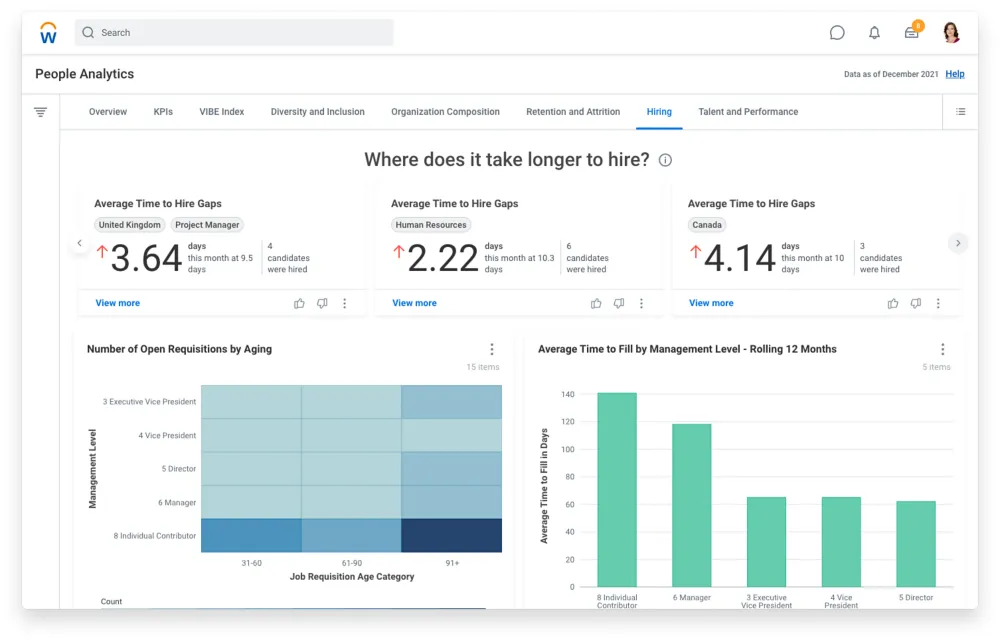
Workday HCM is a single, unified system of record for HR, talent, analytics, and optionally finance built to serve a company well past 1,000 employees.
Best for: Enterprises with complex org structures and global operations.
Rating: 4.1/5 on G2
Entry price: not published
Free trial: no
Key Features
- Unified core HR, talent, and succession
- Advanced workforce planning and analytics
- Optional finance suite
- Enterprise-grade security and controls
Pros & Cons
Pros | Cons |
Scales seamlessly into large enterprises | Long, resource-intensive implementation |
Strong planning and analytics capabilities | Premium cost |
Strong ROI at scale | May be excessive for organisations below ~1,000 employees |
| Requires significant implementation resources |
| Higher total cost of ownership |
Verdict: The right system of record for a global enterprise, and too much platform for a smaller US company. Buy it for where you’re going.
13. SAP SuccessFactors
SuccessFactors is a comprehensive, deeply configurable HCM suite that fits enterprises already standardized on SAP.
Best for: Large, global organizations in the SAP ecosystem.
Rating: 3.9/5 on G2
Entry price: ~$18–38/user/mo (quote in practice)
Free trial: yes
Key features:
- End-to-end core HR, talent, and performance
- Deep configurability and global localization
- Tight SAP back-end integration
- Enterprise analytics
Pros & Cons
Pros | Cons |
Comprehensive and scalable | Complex setup |
Strong multinational compliance capabilities | Interface can be less intuitive than newer platforms |
Integrates with SAP finance | Configuration may require specialists |
| Longer implementation process |
| Higher administrative complexity |
Verdict: A logical choice if you’re already on SAP and operate globally. Outside that context, the complexity outweighs the benefit for most.
14. Paycor
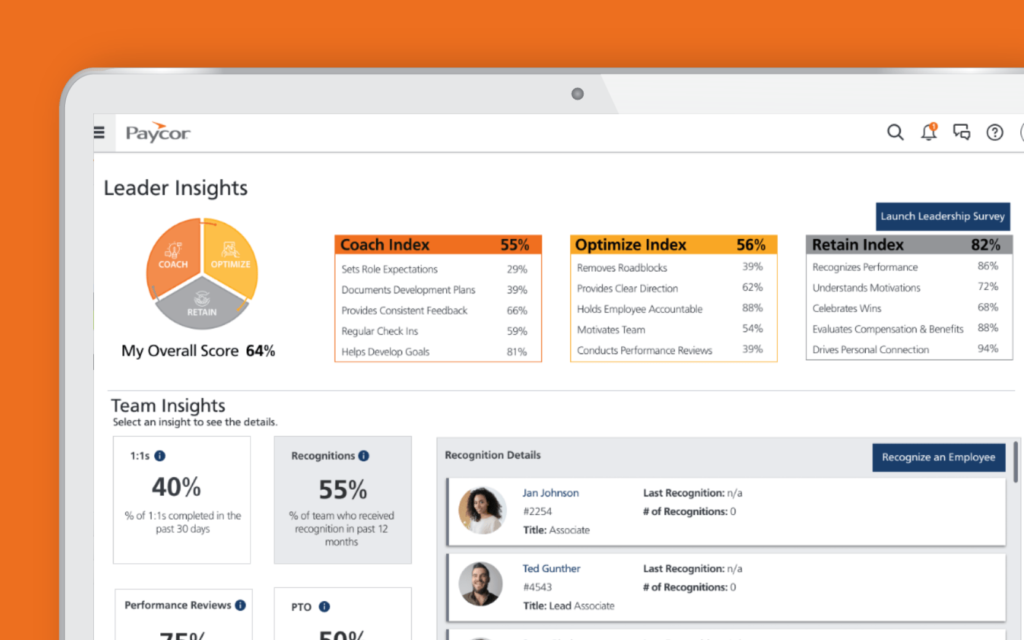
Paycor sells HR and payroll as size-based bundles with notable post-processing payroll flexibility.
Best for: US mid-market companies wanting payroll, HR, and reporting in one bundle.
Rating: 3.9/5 on G2
Entry price: not published
Free trial: yes (first month free on some plans)
Key features:
- Payroll with post-processing adjustments
- Core HR, onboarding, and time
- Talent and LMS modules
- Reporting
Pros & Cons:
Pros | Cons |
Flexible payroll options | Lowest G2 rating here |
Strong mid-market fit | Reported ~22% price increase in 2024 |
Bundled HR modules | Navigation can frustrate some users |
| Pricing changes may affect long-term budgeting |
| May require time to learn the interface |
Verdict: Capable for mid-market HR and payroll; confirm which bundle includes the features you need, and factor in recent price increases.
Which one for your requirement HR management System
Most purchasers have one deciding factor. This is the same 14 translated to what Americans ask most often.
Requirement | Tools that serve it |
Value all-in-one HR + payroll | Zimyo, Rippling, Gusto |
HR + IT on one system | Rippling |
Global teams and contractors | Zzimyo, Deel, HiBob |
Multi-state / 50-state tax filing | ADP Workforce Now, Paylocity, Rippling, Gusto |
Hourly and complex payroll | UKG Pro, Dayforce, Paylocity |
Fastest, easiest setup | BambooHR, Zimyo, Gusto |
Large enterprise system of record | Workday, SAP SuccessFactors, Oracle HCM |
Employee self-service | Paycom, Rippling |
Suite vs. standalone: The First Real Decision
Once you’ve decided what you need, choose whether to go with one suite or best-of-breed products cobbled together; this will narrow your choices faster than any other criteria. The rule of thumb is about 100 people. Surveys show between 20 and 40 percent of workers are using AI in the workplace, with much higher rates in computer programming occupations. (Federal Reserve, 2025)
For those below it, standalone solutions (payroll software and a lightweight HRIS) generally make more sense in terms of cost and ease of use; Capterra research finds that about 53% of small firms use standalone solutions. Above it, however, pains of integration outweigh best-of-breed advantages, with roughly 67% of firms using suites. Growth businesses will increasingly want the suite regardless. Deloitte’s 2026 HR tech report on HR technology sees consolidation systems finally breaking out of their silos, while its statistics show that workforce-intelligence technology reduced manager turnover by 17% by identifying burnout at an early stage. If you are buying a system you’ll use for years, go for the suite; if you are trying to solve an urgent problem and your headcount is small, a standalone tool is fine.
The Costs a Sticker Price Hides
Budgeting doesn’t end at the PEPM number; the gap between budget and reality often shows up there.
1. Implementation and failure
The cost of setting up ranges from about $3,000 to $75,000, depending on tier and the complexity of the data being worked with. Even more alarming, industry analysis by Software Path shows that more than 50% of HR systems do not meet requirements and about 40% go over budget. In comparison, Gartner reports an average adoption rate of about 32%.
2. Total Cost of Ownership
Multiply PEPM by headcount and 36 months, then add implementation, integration, and the 3-7% escalation, which is tucked into most deals. The escalation alone will make the third-year cost exceed your quoted cost, but in any case, the sticker price is usually off by 30-40% versus the real three-year cost.
3. Compliance Risk
For distributed workforces, multi-state payroll registration and pay transparency are no-nos – mistakes have penalties, and this one’s right up there in your top three requirements, not at the bottom of your list.
The pragmatic approach: Get a three-year quote that includes implementation, additional modules, and escalation, not the headline PEPM.
Case study: William Reed replaces a bespoke system
William Reed is a global business-to-business digital media company with 330+ staff members. The organization has found itself constrained by a legacy bespoke HR system that was outdated and UK-specific. The HR system could not manage complex absence policies, resulting in excessive administrative work for the HR team and little to no visibility for managers into their teams.
The organization decided to implement a cloud-based Human Resource Information System called Cezanne HR. The new HR system includes core people management functions, absences, onboarding, and performance reviews. The organization implemented it as a single integrated system with self-service functionality for employees and managers. As a result, the organization moved from a fragmented to a centralized solution, and managers gained access to team data. In contrast, the HR team regained time to focus on strategic activities. You can read the full William Reed case study here.
The lesson extends beyond one vendor because the return on a modern HR system won’t come from some spectacular feature. It comes from consolidating scattered data and giving managers self-service capability, which frees HR staff from administration and shifts them to planning.
Key Features to Look for in a Top HR System
Identify those elements which will help cut costs and risks separately from the other marketing bells and whistles:
- Full-service payroll with tax liability transfer – Ensure the provider files in 50 states in-house and takes responsibility for its mistakes.
- True two-way integrations – Make sure the integration with your accounting system, ATS, and benefits software is a live sync, not an overnight batch.
- Report generation that you can control yourself – Headcount reporting, turnover, and compensation data in dashboards, not just an Excel file download.
- Mobile-first self-service that people will use – Adoption equals ROI, and it exists on your smartphone.
Standable support system – Account manager versus ticketing system and operating hours. AI is part of the conversation because SHRM’s 2026 research shows AI is mostly used in recruiting (27%) and HR technology (21%), so understand how AI works on the platform before investing.
The ROI of a Modern HR system
If implemented properly, an up-to-date HR system delivers tangible payback: saving hours of manual data entry, reducing costly payroll errors, producing tamper-proof compliance reports, and turning personnel information into planning inputs instead of filing clutter. The figures are stark at the enterprise level – the IDC study on Workday showed a 358% three-year ROI with 36% lower platform and infrastructure costs. Everything rides on implementation, hence why the cheapest HR system your team will use always beats the most highly rated one they won’t.
Conclusion
The landscape of HR technology in 2026 proves that organizations can no longer rely on outdated methods. The top-rated HR system will be the one that suits you well based on your size, your compliance issues, and the way things work in your environment, not the one with the largest “Top Rated” tagline. Regardless of which systems make it to your short list, ensure that they have true ratings, do the cost of ownership model for three years, and put it to the test before you commit.
Frequently Asked Questions (FAQs)
What is the most popular and best HR system?
It all depends on what criteria you use. By market share, the most popular HR software is Zimyo, Workday, SAP SuccessFactors, and Oracle, in that order. In terms of actual users who have left verified feedback in their thousands, the top vendors are Rippling/Deel/Gusto and Workday. For small and medium-sized businesses, BambooHR comes out on top because of its simplicity.
What are the top 20 HRIS systems?
Top-20 HR management software solutions across Small business owners and enterprise companies: Zimyo, Rippling, Deel, Gusto, Paycom, HiBob, Paylocity, BambooHR, UKG Pro, ADP Workforce Now, Dayforce, Workday, SAP SuccessFactors, Oracle Fusion HCM, Paycor, Namely, Personio, Zoho People, Keka, and Justworks. There is no best HR solution for all businesses — the proper HR solution shortlist would be those three to four HR systems that fit your company’s employee size range, payroll requirements, and budget. Size is the key filter as per workforce data and trends.
How much do the most popular HRMS systems cost?
Expect wide variation based on tiers and modules. The pricing for starter-level and small to mid-sized business solutions management system hrms is approximately $4–15 per employee per month ($4 for Zimyo, $10 for BambooHR, and $49 plus $6 per person for Gusto). Midmarket HRIS systems are priced around $15–30 PEPM (approximately $18–25 for HiBob, and $38–48 all-inclusive for Paylocity). Enterprise-level solutions (Workday, SAP SuccessFactors, Oracle) are quoted only and typically range from $30–100+ PEPM. Add the implementation cost of $3,000–$75,000 and an annual escalation of 3–7%.
How do the Big 4 HR systems compare to each other?
Enterprise HR platforms include Workday, Zimyo, SAP SuccessFactors, Oracle Fusion HCM, and ADP. Workday focuses on HR and workforce planning, Zimyo brings HR, payroll, attendance, and other core HR processes together, SAP SuccessFactors offers deep customization for global organizations, Oracle Fusion HCM integrates closely with the Oracle ecosystem, and ADP focuses strongly on payroll and compliance.
How do you choose between the 3 types of Human resource management systems?
You can classify systems as HRIS (system of record—records, PTO, onboarding, basic reporting), HRMS (HRIS + payroll and time), and HCM (HRMS + talent management, workforce management, and analytics). Estimate needs for three years out rather than now: under-buying can require a tough migration, and over-buying can overload a small team.