
In recent years, Employee Self-Service (ESS) portals have emerged as one of the key elements of a contemporary HR technology suite. Instead of forwarding each payslip query, vacation request, and address update to the overwhelmed HR mailbox, an ESS portal enables workers to handle their HR needs directly, from any device laptop, tablet or smartphone and allows HR to focus on its strategy.
Not all ESS portals, however, live up to the full potential of self-service. Some are sophisticated tools and true mobile-first centers that workers regularly engage with on their smartphones. Others are desktop-based dashboards that simply plug into outdated HRIS solutions and ensure that no employee adopts them. This review compares ESS portals for 2026 in terms of price, mobile capabilities, level of integration, and, most importantly, impact.
The following comparison was made based on pricing transparency, mobile usability, automation, level of integration, and compliance preparedness of top ESS and HRMS solutions, combined with independent market research and customer case studies.
What Is an Employee Self-Service Portal?
An Employee Self-Service (ESS) system is an electronic platform that enables employees to conduct routine activities related to Human Resources without having to rely on HR. The system uses computers, tablets, and smartphones, thus always allowing access and from any location.
The benefits for employees include independence and timely responses. The benefits for HR personnel include less manual labor, fewer repetitive questions, more accurate information, and availability to focus on strategic tasks. According to a peer-reviewed paper in the East African Journal of Business and Economics published in 2025, ESS has a significant positive correlation with employee performance due to increased task independence and decreased delays in accessing HR-related services.
Research Methodology: How We Evaluated These ESS Portals
To maintain the credibility of the comparison and make sure that we had a proper benchmark for all the platforms, we reviewed each ESS portal based on standardized criteria and not just features mentioned by the vendors. The main idea was to judge how each platform would fare in practical Human Resources and employee situations.
What we evaluated. Every platform was scored across seven axes:
- Mobile experience — whether self-service is built for the phone or a desktop portal squeezed onto a small screen (the single biggest predictor of adoption).
- Feature depth — coverage of payslips, leave, attendance, expenses, documents, performance, and engagement.
- Integration ecosystem — how natively ESS connects to payroll, attendance, performance, and third-party systems.
- Automation & AI — workflow automation, conversational self-service, and AI-driven insights.
- Pricing transparency — availability of public pricing, free tiers/trials, and total cost of ownership including implementation.
- Compliance & security — encryption, access controls, audit trails, and labor-law/GDPR readiness.
- Scalability — suitability across company sizes, from startups to multinational enterprises.
Where our evidence came from. We drew on multiple independent and primary sources rather than any single vendor’s marketing:
- Verified user reviews from G2, Capterra, and Gartner Peer Insights for ratings, strengths, and recurring complaints.
- Certified market and industry research, including Fortune Business Insights (HR software market sizing), the 2026 State of HR Service Report, SHRM technology surveys, Deloitte’s HR/payroll ROI framework, and Gallup engagement research.
- Peer-reviewed academic research, including a 2025 study in the East African Journal of Business and Economics on ESS and employee performance.
- Documented customer case studies with measurable outcomes (e.g., payroll-cost and processing-time reductions), rather than unquantified testimonials.
- Public product documentation and hands-on assessment of feature sets and mobile behavior.
How to read the results. No one ESS platform can be considered “the best” for everyone; suitability will depend on your organization’s demographics, degree of desklessness, budget constraints, and whether you need an ESS module integrated into a comprehensive HR software suite or a standalone solution. Numbers are constantly changing, so consider this information to be a rough guideline only and check out current pricing yourself before buying anything.
Key Findings from Our Research
Self-service has hit a “maturity ceiling.” Based on the findings of the 2026 State of HR Service Report, self-service is no longer increasing. A quarter of the total number of employees can only serve themselves for 0-25% of what they need, while only one-fifth say that they can serve themselves “almost everything.” Those portals which overcome this barrier are those which were designed based on how employees actually operate.
Mobile is no longer optional. SHRM technology surveys report that 67% of employees prefer to access HR information from a mobile device — rising to 82% for employees under 35, and effectively 100% for frontline and deskless workers. A desktop portal “that also works on mobile” is a common adoption killer.
The ROI is measurable and fast. “Independent companies have noted that ESS portals have led to saving 40-60% of the HR administrative time while others have reported 60-70% decrease in HR tickets in only 6 months since implementation. It is important to note here that Deloitte’s ROI analysis suggests that the number of HR hours saved, risk of non-compliance reduced, and errors avoided should be counted.”
Data accuracy improves when employees own their records. When employees update their own information, data errors drop by up to 50%, according to operator benchmarks.
Integrated ecosystems outperform standalone tools. Businesses increasingly prefer platforms that combine ESS with payroll, attendance, performance, and recruitment in a single system rather than stitching point solutions together.
Demand is backed by a fast-growing market. The international market for HR software is expected to expand from $26.21 billion in 2026 to $66.70 billion in 2034 at a CAGR of 12.38%, with AI-enabled ESS chatbots that can extract salary data, download pay stubs and deduct payments without any involvement of HR being one of the significant growth drivers.
“A well-designed self-service portal can prevent 30–50% of HR inquiries by deflecting them from the HR department altogether. The important part is the implementation: a poorly designed solution will make life harder for HR.”
Quick Results: Top Picks for ESS Portals
If you need an answer fast, here’s where each tool wins. Full reviews follow below:
- Best Overall / Best for SMEs & Growing Teams — Zimyo ESS. An all-in-one, mobile-first HRMS with 40+ modules covering ESS, payroll, attendance, performance, and recruitment in one ecosystem.
- Best for Large Enterprises — SAP SuccessFactors and Oracle HCM Cloud, for enterprise-grade HCM depth and multi-country workforce management.
- Best for Mid-to-Large Enterprises Wanting AI — Darwinbox, for AI-powered HR with advanced workforce analytics.
- Best for Small & Medium Businesses — Zoho People and BambooHR, for ease of use, quick setup, and clean employee experience.
- Best for Payroll-Heavy / Compliance-First Teams — greytHR, for strong payroll processing and statutory compliance.
- Best for Growing Businesses — Keka HR, for an approachable ESS with engagement tools built in.
- Best Budget / Payroll-Integration ESS — InStaff, for lightweight payslip access and ERP/payroll integration.
Complete Comparison: Leading ESS Portals for 2026
| ESS Portal | G2 Rating | Best Company Size | Pricing (Entry) | Mobile App | Standout Strength |
|---|---|---|---|---|---|
| Zimyo | 4.5/5 | 10–500+ (Startups → Enterprise) | Quote-based (from ~₹60/user/mo) | Yes (iOS + Android) | 40+ module HRMS: ESS, payroll, attendance, and performance management |
| Keka HR | 4.4/5 | Growing businesses | Quote-based | Yes | Easy-to-use ESS portal with employee engagement tools |
| greytHR | 4.4/5 | Payroll-focused organizations | Free basic tier available | Yes | Strong payroll management and statutory compliance features |
| BambooHR | 4.4/5 | Global SMBs (10–500 employees) | Quote-based | Yes | Clean user experience with seamless onboarding and ESS integration |
| Darwinbox | 4.3/5 | Mid-sized and large enterprises | Quote-based | Yes | AI-powered HR platform with advanced workforce analytics |
| Zoho People | 4.1/5 | Small and medium businesses | From ~$1.50/user/mo | Yes | Cloud-based HR software with workflow automation |
| SAP SuccessFactors | 4.1/5 | Large enterprises | From ~$6.30/user/mo | Yes | Enterprise-grade HCM and talent management capabilities |
| Oracle HCM Cloud | 3.8/5 | Multinational organizations | Quote-based | Yes | Multi-country payroll support and workforce analytics |
| InStaff | — | Small businesses | From ~$20/month | Web | Payslip access with payroll and ERP integration |
Ratings reflect publicly available G2/Capterra data at time of writing and change over time; verify current figures before purchasing.
Detailed Reviews: The Best ESS Portals for 2026
1. Zimyo
Best all-in-one, mobile-first ESS for startups, SMEs, and enterprises
G2 Rating: 4.5/5 | Best for: Companies 10–500+ wanting ESS as part of a broader HR suite
Zimyo’s Employee Self Service portal allows the employees to manage applications for leave, attendance, download of pay slip, claims processing and many other functions without relying on the HR department. The ESS portal is based on cloud HRMS which offers over 60+ modules, thus allowing ESS to integrate seamlessly with Payroll, Performance Management and Workforce Management through a common platform.
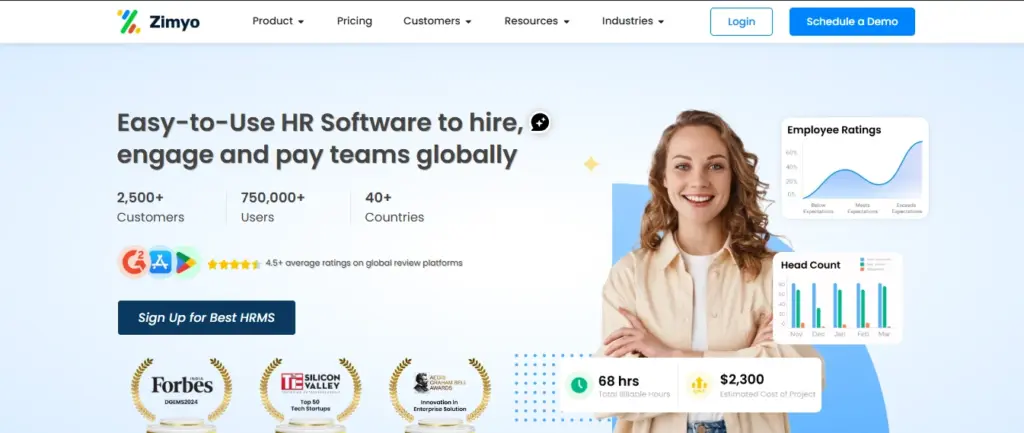
Key ESS capabilities:
- Clock-in/out, leave balances, holiday calendar, and attendance regularization
- View and download salary slips; manage tax and deductions
- Expense management and salary-advance/loan requests
- View and download policies; raise requisitions, tickets, and requests
- OKR/KPI tracking, self-assessments, peer ratings, and feedback
- Engagement via Tribe (communication) and Feed (updates), plus timesheets
Pros:
- Comprehensive suite — ESS, payroll, attendance, performance, and recruitment in one login, avoiding tool sprawl
- Strong mobile app (iOS + Android), which directly supports adoption
- Dedicated onboarding specialist configures payroll rules, attendance, and leave structures before go-live
- Trusted by organizations including Bajaj Capital, Yash Raj Films, and Amity University Online
Cons:
- Some advanced modules (e.g., timesheets) can be add-ons depending on plan
- Best value realized at 50+ employees; very small startups may not use every module
- Less global brand recognition than SAP or Oracle in enterprise procurement
Verdict: Zimyo fills the gap between lightweight standalone ESS tools and heavy enterprise HCM suites — offering integrated HR-suite depth at an SME-friendly price. If you’re choosing between a point-solution ESS and an integrated platform, it’s worth a demo. Request a quote and compare all-in cost including setup.
2. Keka HR
Best approachable ESS for growing businesses
G2 Rating: 4.4/5 | Pricing: Quote-based | Best for: Growing businesses
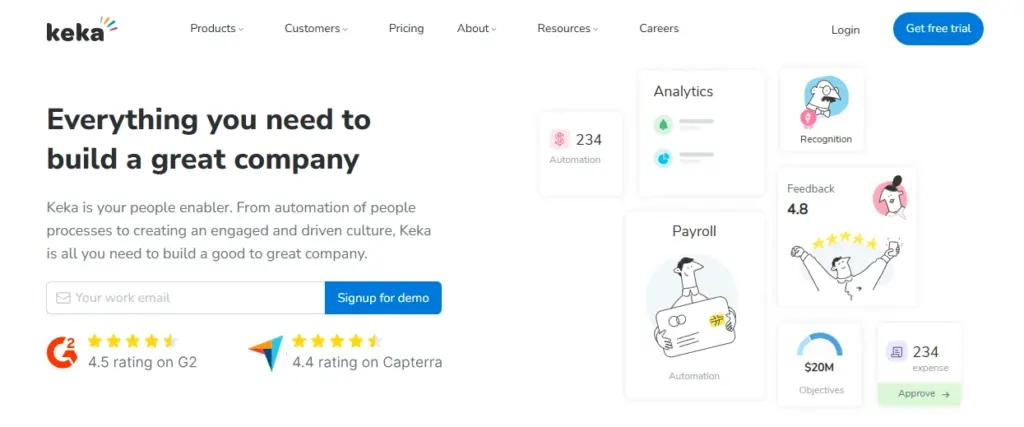
Keka HR provides a simple-to-use ESS portal that integrates payroll, leave management, attendance tracking, and engagement tools. The product is user-friendly for organizations that implement HR software for the very first time.
Pros:
- Intuitive, easy-to-adopt interface
- Employee engagement features built in
- Strong fit for scaling teams
Cons:
- Advanced customization is more limited than enterprise suites
- Pricing is not fully transparent
Verdict: A solid middle-ground for growing companies that want ESS plus engagement without enterprise complexity.
3. greytHR
Best payroll- and compliance-focused ESS
G2 Rating: 4.4/5 | Pricing: Free basic tier available | Best for: Payroll-focused organizations
The greytHR’s ESS portal simplifies processes, increases transparency, and improves employee engagement. The strength of the ESS portal is quick and precise payroll processing. The employees get access to payslips, make leave applications, check information about their teams, and more.
Pros:
- Strong payroll processing and statutory compliance
- Genuinely usable free basic tier
- Good fit for compliance-heavy teams
Cons:
- Engagement and performance features are lighter than broader suites
- UI is less modern than newer entrants
Verdict: A strong choice where payroll accuracy and statutory compliance are the priorities.
4.BambooHR
Best clean UX and onboarding-to-ESS continuity for global SMBs
G2 Rating: 4.4/5 | Pricing: Quote-based | Best for: Global small & medium businesses
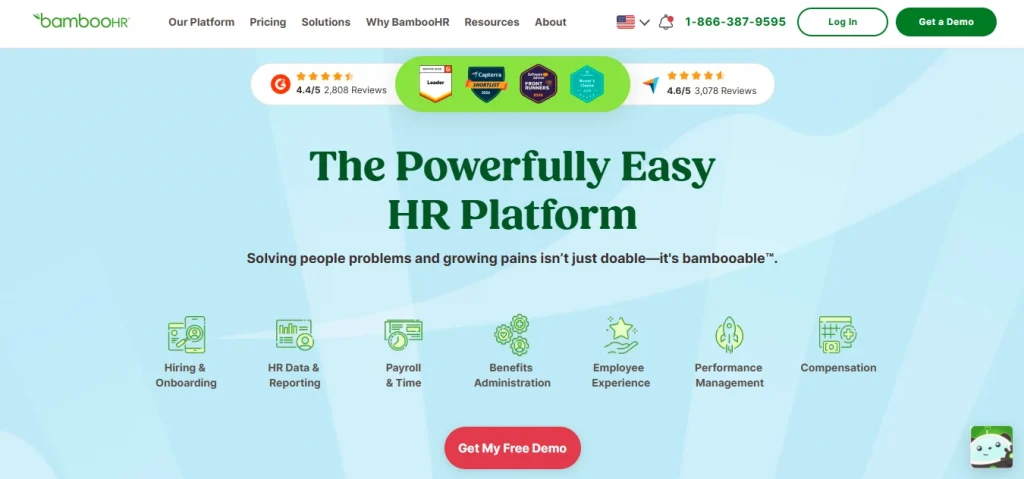
The ESS portal from BambooHR makes work easier for both HR and employees because of the sleek and easy-to-use interface. Employees can view their information, make requests, take care of training and development, while HR gets detailed and customizable reporting. Forbes Advisor gave BambooHR a rating of 4.9 out of 5 for its user-friendliness.
Pros:
- Best-in-class ease of use
- Seamless onboarding-to-ESS handoff
- ~150 integration partners
Cons:
- Quote-based pricing complicates budgeting
- Some advanced features gated to higher plans
- Fewer native AI features than some rivals
Verdict: A top pick for SMBs prioritizing a frictionless employee experience — particularly across distributed teams.
5. Darwinbox
Best AI-powered, mobile-first ESS for mid-to-large enterprises
G2 Rating: 4.3/5 | Pricing: Quote-based (no public pricing, no free trial) | Best for: Mid-sized and large enterprises
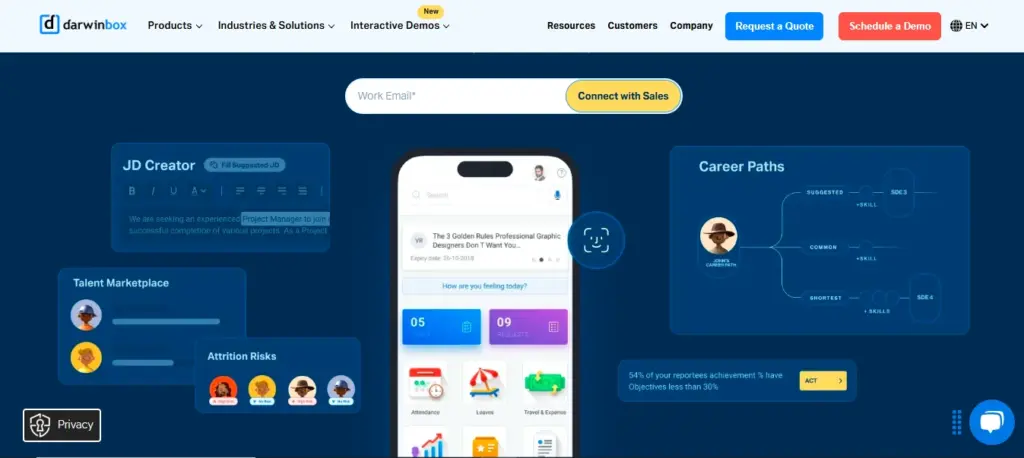
The product Darwinbox is a next-generation, holistic HCM platform that centers on a mobile-first employee experience. The self-service capability of this product is not something that has been modified to fit in the phone but is inherently designed keeping in mind the mobile experience of the employees. Through one application, employees are able to access their payslips, request for leave, maintain their data, file their claims, on-board, and make other kinds of requests. This platform is used by over 850 companies, as well as 2.2 million plus employees in over 110 countries. These include the likes of Mahindra, Tata AIA, Adani, Starbucks, and Nivea.
Pros:
- Genuinely mobile-first design that drives adoption across distributed and deskless workforces
- Comprehensive HCM breadth — core HR, payroll, talent, and analytics in one platform
- Strong AI and analytics for data-driven workforce decisions
Cons:
- Fully quote-based pricing with no free trial makes budgeting and evaluation harder
- Reviewers report performance dips (slower navigation, responsiveness) under peak or bulk-sync loads
- Some modules feel less mature than specialized competitors; support responsiveness occasionally cited as inconsistent
Verdict: Darwinbox is a strong choice for mid-to-large enterprises that want an AI-powered, mobile-first ESS as part of a full HCM suite — particularly those with distributed or deskless teams.
6. Zoho People
Best clean, affordable ESS for SMBs
G2 Rating: 4.1/5 | Pricing: From ~$1.50/user/month | Best for: Small & medium businesses
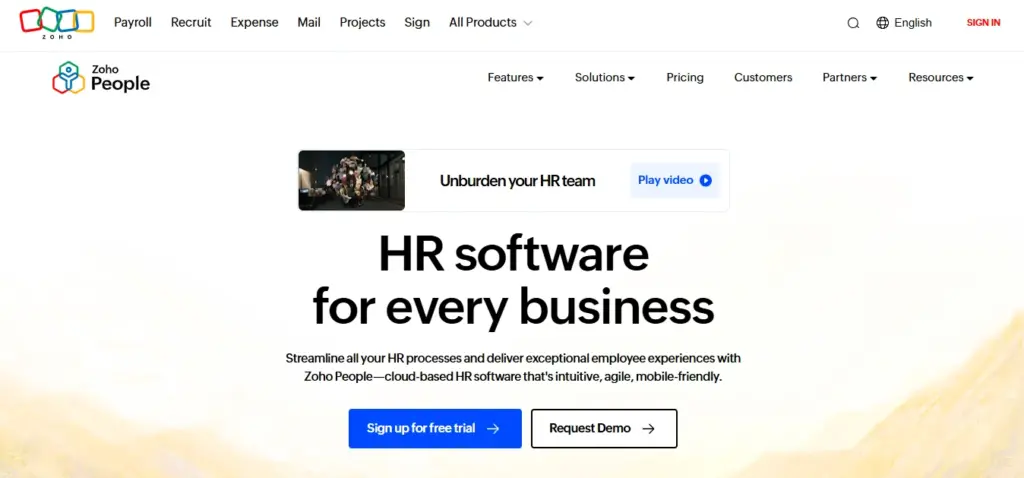
Zoho People offers a user-friendly ESS portal that lets employees manage personal information, apply for leave, track attendance, and monitor performance independently. Its cloud platform streamlines HR processes and scales with growing teams, with tight integration across the Zoho ecosystem.
Pros:
- Very affordable
- Easy to adopt
- Strong Zoho ecosystem integration
Cons:
- Deeper functionality requires higher tiers
- Best value for teams already using Zoho apps
Verdict: Excellent value for SMBs — especially those already in the Zoho ecosystem.
7. SAP SuccessFactors
Best enterprise-grade ESS within a full HCM suite
G2 Rating: 4.1/5 | Pricing: From ~$6.30/user/month | Best for: Large enterprises
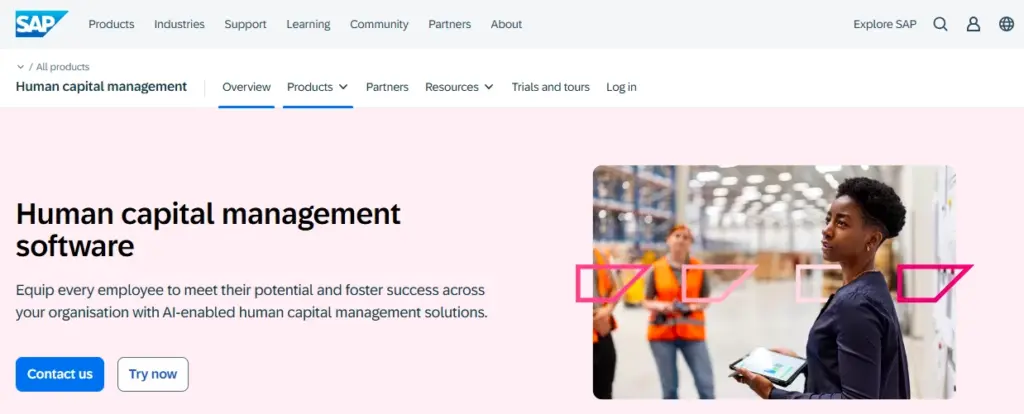
SAP SuccessFactors is a cloud-based HCM platform with a powerful ESS portal that lets employees manage leave, access payroll, update personal details, and view benefits from a single place. Automating routine tasks and improving accessibility reduces HR’s administrative load at enterprise scale.
Pros:
- Deep enterprise functionality
- Strong global compliance
- Part of a broader SAP ecosystem
Cons:
- Complex and costly to implement
- Overkill for smaller teams
- Steeper learning curve
Verdict: The right fit for large, multinational enterprises already invested in SAP — less suited to SMEs prioritizing speed and simplicity.
8. Oracle HCM Cloud
Best for multinational, multi-country workforces
G2 Rating: 3.8/5 | Pricing: Quote-based | Best for: Multinational organizations
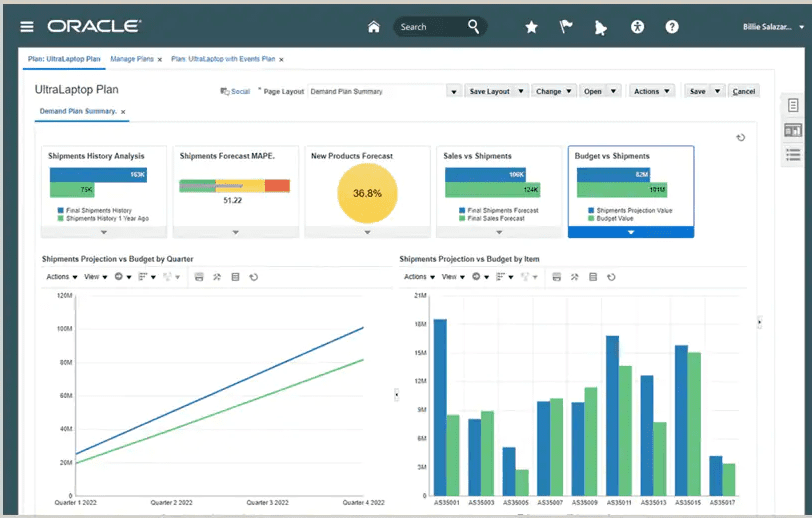
Oracle HCM Cloud offers a comprehensive ESS portal spanning the full employee lifecycle. Employees manage personal information, payroll, and leave through one platform, while HR benefits from integrated Human Resources, Talent, Workforce Management, and Payroll modules — including multi-country payroll support.
Pros:
- Enterprise depth
- Strong analytics
- Excellent for complex global operations
Cons:
- No public pricing
- Significant implementation effort
- Best value only at large scale
Verdict: A strong enterprise choice where multi-country payroll and analytics are decisive not aimed at small or mid-sized buyers.
9. InStaff
Best lightweight, payroll-integrated ESS
Pricing: From ~$20/month | Best for: Small businesses
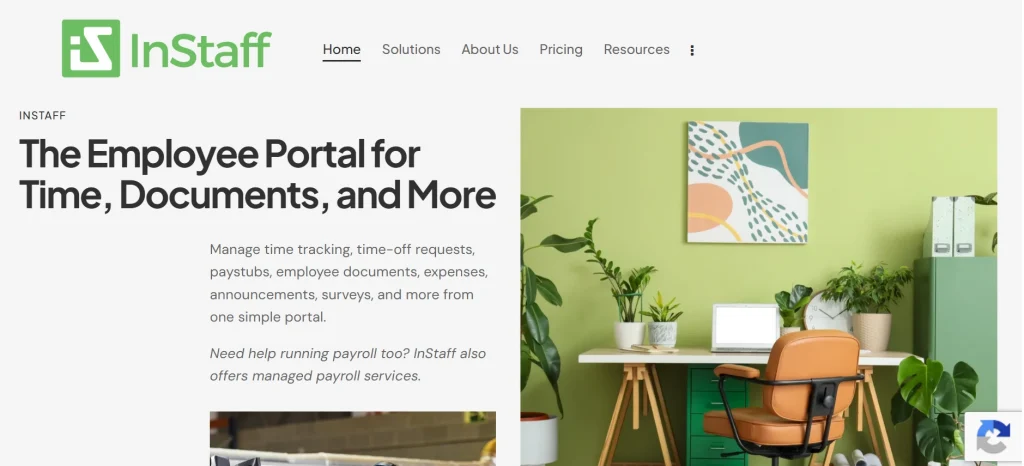
InStaff is a focused ESS portal that integrates with payroll and ERP systems. Employees securely view payslips, update information, and access HR documents anytime, reducing paperwork and administrative costs.
Pros:
- Inexpensive and simple
- Strong for payslip distribution and document access
Cons:
- Narrow scope — not a full HR suite
- Limited engagement, performance, and analytics
Verdict: Ideal for small businesses that mainly want to digitize payslips and documents rather than run a full HRMS.
Case Studies: Documented Zimyo Outcomes
- Hillson Shoes reported an 80% reduction in payroll cost after implementing Zimyo’s payroll and HRMS, describing payroll processing as smooth and efficient.
- Apex Digital (Series B, 180 employees) cut payroll processing time by over 60% after consolidating multiple tools into one platform, with the People VP noting the HR team “actually enjoys using it.”
- TVG Realtors eliminated manual payroll and attendance processes, gaining automation-driven efficiency, higher accuracy, and built-in compliance (including WPS and SIF-file generation).
- Chintan (NGO) streamlined attendance and payroll and gained detailed payroll analytics, with a marked improvement in recruitment and productivity.
Core Features to Look for in an ESS Portal
- Understand what drives user adoption and return on investment, and what just happens to be a nice-to-have in terms of feature marketing.
- Time and Attendance Management allows users to clock in/out, see leave balances, and check the holiday calendar while regularizing their attendance from anywhere using any device.
- Payroll and Payslip Access gives employees immediate access to downloading salary slip information, tax and deduction details, and manages income-tax declarations without contacting HR by email.
- Leave Lifecycle Management covers the entire process from making a request to have the request approved/rejected and tracking leave balance.
- Expense and Reimbursement Management lets employees submit, track and get approvals for expense reimbursements digitally.
- Document Management is a secure place to access and download policies, letters, and personal documents.
- Performance Management covers goal setting, tracking of OKRs/KPIs, self-assessment, and peer feedback.
- Communication and Engagement – company feeds, announcements, surveys, and employee recognition.
- Mobile Accessibility is the greatest predictor of user adoption. Try your demo on a mobile phone anytime.
- Integration & Security – deep integration with payroll, attendance and performance systems, along with encryption, multifactor authentication and audit trails for compliance (labour laws, GDPR).
Benefits of an ESS Portal (Backed by Data)
- Lower HR workload: 40–60% reduction in HR admin time; 30–50% of routine inquiries deflected; some deployments see 60–70% fewer HR tickets within six months.
- Higher data accuracy: Employee-owned records cut data errors by up to 50%.
- Stronger engagement and performance: Peer-reviewed research links ESS to measurable gains in task independence and productivity; Gallup finds highly engaged organizations see ~21% higher profitability.
- Better employee experience: 73% of full-time US employees believe their company should offer a self-service HR platform.
- Compliance and security: Encrypted, audit-trailed digital records support labor-law and GDPR adherence.
- Scalability: ESS absorbs rising workload as headcount grows without proportional HR hiring.
- Transparency and speed: Paperless workflows and instant approvals improve trust and decision-making.
How to Choose the Right ESS Portal
Match the portal to your company size and hiring/HR complexity, not to the longest feature list. A 30-person startup and a 5,000-person multinational have very different needs.
- Prioritize mobile-first design. Given that 67%+ of employees prefer mobile access and effectively all frontline workers insist on testing the portal on a real phone during the demo.
- Value integration depth. Integrated suites (like Zimyo, BambooHR, or Rippling-style platforms) reduce data re-entry and tool sprawl versus standalone ESS bolt-ons.
- Run the real ROI math. Utilize the Deloitte formula: (HR time savings x average cost per hour for HR) + risk reduction in compliance + error prevention − total annual software cost. ESS costs are recovered by most groups in months.
- Plan the rollout. The biggest driver of ESS success isn’t the software it’s designating an internal “champion” and investing in change management, so adoption clears the maturity ceiling.
Conclusion
With ESS portal technology, employees can handle routine HR transactions independently while greatly decreasing HR administration efforts. This trend is supported by figures: 40-60% less HR administration time, 50% less data errors, faster approvals, and improved overall experience in the market which will reach around $66 billion by 2034.
Your decision will depend on your company size and needs. Big multinationals prefer SAP SuccessFactors or Oracle HCM; for SMBs, it is easier to choose between Zoho People, BambooHR, or Keka; payroll-driven companies will like greytHR. However, in most cases of startups, SMEs, and fast-growing enterprises looking for an ESS portal with payroll, attendance, and performance management solutions in mobile-first platform backed by proven results like 80% reduction of payroll costs at Hillson Shoes and 60% faster payroll processing at Apex Digital, Zimyo is the most advanced and cost-effective choice.
Adjust the portal to your company’s processes, test it on mobile devices, and track the before and after. If the ESS portal is chosen wisely, it will pay off in no time, bringing productivity and efficiency to your organization.
Frequently Asked Questions
What is the best employee self-service portal in 2026?
It depends on the size of the business and its requirements. For a comprehensive solution like an ESS, Payroll, Attendance, and Performance Management solution in one mobile-friendly solution, Zimyo could be considered an excellent choice. For multinational firms, SAP SuccessFactors and Oracle HCM are preferred.
How much does an ESS portal reduce HR workload?
Operator benchmarks show 40–60% less HR admin time, with 30–50% of routine inquiries deflected. Some deployments report 60–70% fewer HR service tickets within six months.
Do ESS portals need to be mobile?
Yes. SHRM surveys show 67% of employees prefer mobile HR access — 82% for under-35s and effectively 100% for frontline workers. Mobile experience is the strongest predictor of adoption.
What features do most companies actually need?
Payslip access, leave and attendance management, expense claims, document access, and basic performance/feedback — all mobile-accessible. Advanced analytics and AI matter more as you scale.
What is the ROI of an ESS portal?
Beyond license fees, ROI comes from HR hours saved, up to 50% fewer data errors, faster approvals, and reduced compliance risk. Most companies recover the cost within a few months.