But this was mostly true up till the previous decade. The deal has been slowly changing. The best way to see this change is through Sill based hiring.
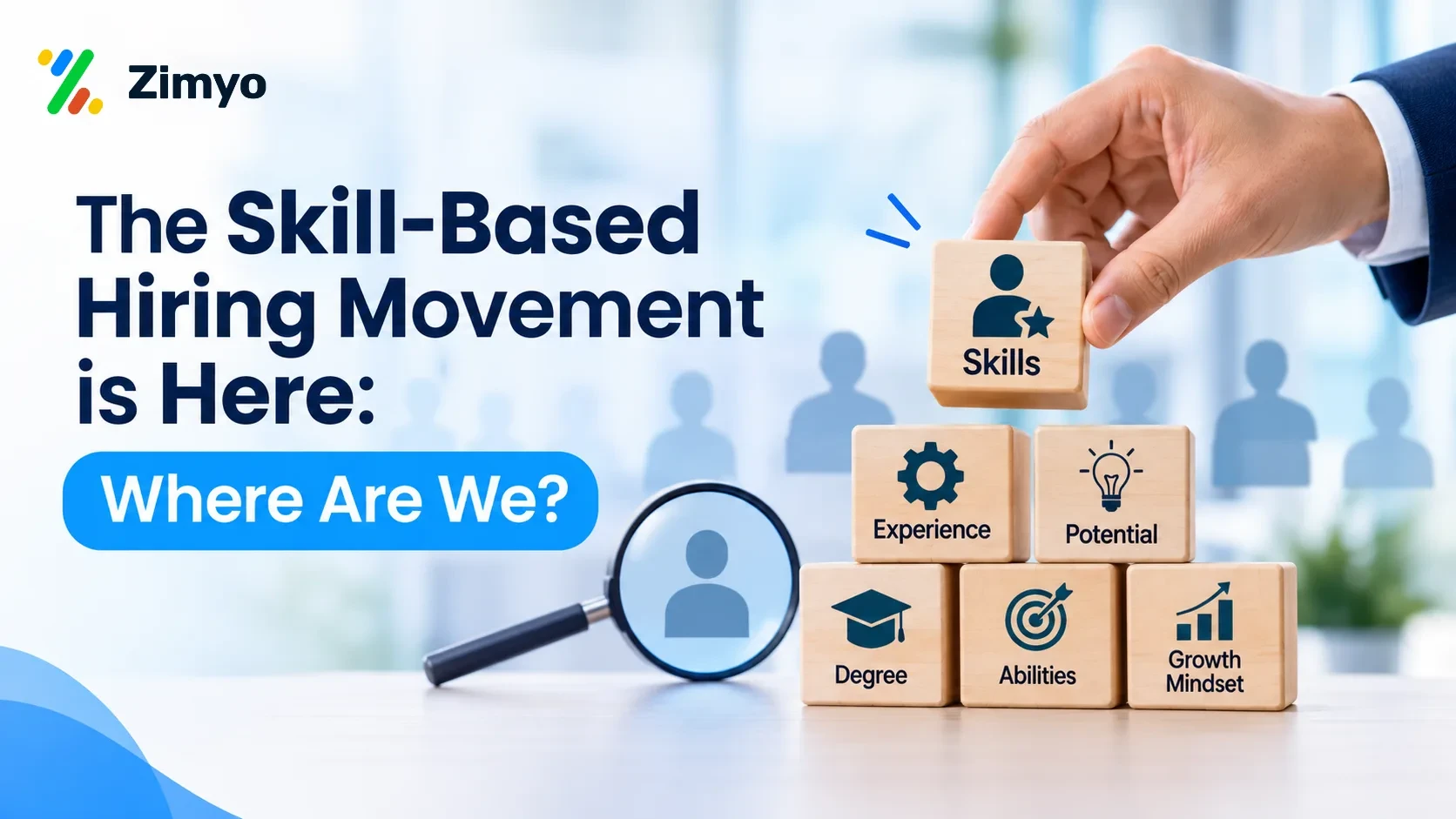
The concept behind this change is basic. Hire people based on their ability, not their degree or any certification. Select based on skills, work evidence, and behavior, not just degrees and resumes. This concept is called skills-based hiring, and in 2026 it became a movement.
So, while we look towards 2027, we should ask ourselves whether skills-based hiring is still on its way. No, it has arrived already. The question is how far India has come in this process, and why the rest has remained unaccomplished.
Key Takeaways
- The shift is genuine, and India is ahead of the global trend: nearly 30% of Indian employers are moving toward skills-based hiring, compared with only 19% worldwide.
- Blue-collar and GCCs are leading the pack: 65% of blue-collar employers and about 48% of GCCs prioritize skills over degrees.
- However, full adoption is premature: only about 21% of corporates have adopted skills-first hiring, while 51% still consider CGPA.
- The skills gap is the real issue: 9% of corporates find graduates fully ready for work, so testing skills is crucial.
- The perception gap remains: 67% of job seekers still believe a degree is imperative, while only 32% of hiring managers share that view.
- Intentions are ahead of execution: it’s easy to decide to hire on skills, but the challenge lies in how to execute it.
India Is Moving Faster Than Most
What's striking is that India isn't just following a global trend; it's ahead of it. The World Economic Forum has noted that around 30% of Indian employers are looking to drop degree requirements and hire on skills, against a global figure closer to 19%. In fresher hiring, employers are shifting from "degree and resume filters" to "skills, proof-of-work and behavior."
The change is sharpest where ability is easiest to demonstrate. In blue-collar and frontline sectors- logistics, manufacturing, quick-commerce- a "skill-first" revolution is well underway. Global Capability Centers are moving quickly too, with a large share now prioritizing proven skills over credentials. Even India's AI and digital roles are increasingly won on demonstrable, hands-on ability rather than pedigree.
The direction of travel is unmistakable. But the picture isn't all momentum.
What Is Skill-Based Hiring?
Skill-based hiring is a method organizations use to hire people based on their skills and abilities rather than their degree or years of experience. Organizations judge candidates based on their skills, not just their resume and educational qualifications.
In India, skill-based hiring has become an important aspect as organizations seek employees having practical knowledge, digital skills, problem-solving skills, and adaptability. Organizations use skill assessments, practical tasks, interviews, and competency assessments to choose the right candidates.
This allows organizations to hire candidates from varied educational backgrounds, including fresh graduates, career changers, and professionals who have developed skills through certification and training.
Benefits of Skill-Based Hiring
The rise of skill-based hiring in India offers several benefits to both employers and employees. Let's explore them in detail.
1. Benefits for Employers
Access to a Larger Talent Pool
Skill-based hiring lets Indian organizations tap a wider talent pool beyond candidates with specific degrees or traditional career paths. Employers can identify candidates based on their actual capabilities, making it easier to find suitable talent across diverse educational and professional backgrounds.
Quicker and More Efficient Hiring Process
By focusing on the skills required for a role, recruiters can simplify candidate screening and evaluation. Practical assessments, skill tests, and structured interviews help HR teams identify suitable candidates more efficiently, reducing unnecessary hiring delays.
Better Job Fit and Employee Retention
Hiring candidates based on their skills and competencies increases the chances of finding people who can perform their roles effectively. When employees are better suited to their responsibilities, job satisfaction, productivity, and long-term retention can improve.
Adaptability to Evolving Business Needs
As technology, automation, and business requirements change, organizations need employees with relevant, evolving skills. Skill-based hiring enables businesses to recruit talent with expertise in areas such as AI, data analytics, cybersecurity and digital marketing, without limiting the selection process to traditional academic qualifications.
2. Benefits for Employees
Continuous Learning and Development
A skills-based recruitment process makes it easier for people to develop professionally over time. Organizations can support this through learning and development programs, eLearning, and mentoring via systems such as an LMS. This helps employees build skills, increase their chances of career success, and stay relevant to industry demands.
Job Satisfaction
People recruited for their skills are more likely to land jobs that match their competencies. This lets them use their knowledge, be useful, and enjoy their work.
What's Driving the Shift
Several forces are pushing India toward skills-first hiring at once:
- A widening skills gap: Degrees aren't reliably producing job-ready talent. That gap forces employers to test for actual ability.
- The AI reset: As AI reshapes work, employers want demonstrable, hands-on skills that "translate ideas into real-world execution", especially in AI, data, and digital roles (Business Today).
- Policy momentum: NITI Aayog has pushed to drop the degree filter for many jobs, warning that the degree market isn't delivering employment (ThePrint).
- Global example-setting: Companies like IBM, Google, Delta and Bank of America have removed four-year degree requirements from some roles, normalizing the practice (Outlook Business).
- Access to wider talent: Skills-first hiring opens the door to capable people without traditional credentials, improving diversity and widening the talent pool.
Where It's Moving Fastest
The shift isn't uniform. It's running ahead in blue-collar and frontline hiring (logistics, manufacturing, quick-commerce), in GCCs, and in AI, data, and digital roles, areas where ability is easy to demonstrate and hard to fake. Traditional corporate and campus hiring is moving more slowly, still anchored to CGPA and pedigree.
What Candidates Should Take From This
For jobseekers, the message is shifting: a degree still helps, but proof of skill, portfolios, projects, certifications, and demonstrable work increasingly wins. The candidates who thrive in 2027 will be the ones who can show what they can do, not just list where they studied.
Why Degrees Are Losing Their Edge
Degrees aren't obsolete, but they are losing their exclusivity and becoming one signal among many, rather than the signal. There are a few structural causes of that:
- Technology evolves faster than curricula: By the time some graduates have their degrees, the knowledge is already outdated. Candidates who keep updating their skills through courses, certificates, and real projects stay closer to what employers need.
- Companies need ready-to-work staff: More and more companies need employees who can start work immediately after the interview with minimal training. Employability skills, communication skills, problem-solving, teamwork, and digital skills are very important.
- Practice outweighs theory: for example, marketing graduates may know all the theories but fail in a real-life advertising campaign; CS graduates may know all the algorithms but lack experience building software.
- Non-traditional education has become popular: Bootcamps, online programs, and courses that focus on skills acquisition and include a lot of project-based learning enable non-traditional students to get jobs in tech, design, data, and digital industries.
Conclusion: "a degree doesn't matter" is definitely wrong. The point is that a degree should formally recognize skills.
The Gap Between the Headline and the Reality
Here's where honesty matters. For all the momentum, skills-first hiring is, as one report put it, "a narrative running ahead of practice."
Only 21% of Indian corporates have fully adopted skills-first hiring and moved away from traditional credentials, and 51% still let CGPA influence final hiring decisions, per HirePro's 2026 research (Business Today). College pedigree and grades still shape many decisions, even as skills assessments gain ground.
There's also a telling perception gap on the candidate side: a 2025 Udemy report found 67% of young jobseekers still believe a degree is essential, while only 32% of hiring managers agree. The people being hired still trust the old rules; the people hiring have already moved on.
The lesson? The movement is real, but adoption is uneven, and intention is outpacing implementation. Announcing skills-based hiring is easy; actually changing how you screen, assess, and decide is the hard part.
What This Means for 2027
If 2026 was the year skills-based hiring became a movement, 2027 is the year it has to become a process. The firms that win won't be the ones that announce it; they'll be the ones that rebuild how they screen and assess around skills.
That's where the right recruitment technology makes the difference. Closing the gap between intention and practice means:
- Screening on skills, not keywords or pedigree: AI that reads and ranks candidates on demonstrated skills and role fit, not just which college they attended.
- Structured, skill-based assessments: Built into the hiring flow so every candidate is judged on ability.
- Proof-of-work and behavior: Capturing portfolios, assessments, and real signals, not just resumes.
- Merit-based, auditable decisions: A clear, traceable record of why each candidate advanced.
How Zimyo Helps You Hire on Skills
This is exactly the direction modern recruitment tools are moving, and where Zimyo is built to help. Its AI-powered recruitment agent, Zim, lets HR teams turn skills-first intent into a repeatable, fair process:
- Skill-based screening at scale: Zim reads and ranks large applicant pools on demonstrated skills and role fit, not which college a candidate attended.
- Merit-ranked shortlists: Candidates are scored on job-related skills and qualifications, with the reasoning visible, so decisions are fair and auditable.
- Faster, bias-aware hiring: Automated screening and interview scheduling speed things up while keeping the focus on ability.
- People in control: AI prepares and recommends; your recruiters make the final call.
In a skills-first world, the bottleneck isn't intent; it's execution. The right AI closes that gap.
Want to hire on skills, not just degrees? Book a Zimyo demo and see how Zim shortlists on merit.
So, Where Are We?
The skills-based hiring movement is unmistakably here, and India is moving faster than most of the world. But we're mid-journey, not at the destination. Degrees are evolving, not disappearing; the smartest view is that a degree should "formalize and recognize skills, not replace them."
The organizations that pull ahead in 2027 will be the ones that close the gap between saying they hire on skills and actually doing it, with the processes, assessments and technology to back it up. The movement has arrived. Now it's time to make it real.
This article references third-party reports and surveys; figures are as reported by the sources cited and may change. It isn't a substitute for your own research.
FAQs
What is skill-based hiring?
It is a recruitment process that places more importance on a candidate's skills and competencies than on their degrees or qualifications.
Why is skill-based hiring becoming popular in India?
Indian companies are increasingly focusing on candidates' practical skills, adaptability, and job-related competencies to attract suitable talent.
How are candidates evaluated in skill-based hiring?
Employers evaluate candidates based on practical test results, skill assessments, case studies, behavioral interviews, assignments, and problem-solving.
What are the advantages of skill-based hiring for employers?
Skill-based hiring enables employers to enlarge the candidate pool, speed up the hiring process, improve job fit, retain employees, and hire talent with necessary skills.
Is skill-based hiring a way out of degrees?
No, skills-based hiring does not mean discarding degree requirements for a job position. It means employers focus more on skills and competencies, along with degrees where required.