
No HR department is unaware of how common these inquiries are: "What is my leave balance?" "Can I get my payslip?" and "How can I change my banking information?" Employee self-service (ESS) solves these repetitive queries by letting employees manage their own HR processes.
Good HR software with employee self-service lets employees view payslips, request leave, track attendance, update details, submit reimbursement requests, and more through a web portal or app. At the same time, HR receives fewer tickets and cleaner data. This is essential for a modern, mobile-first workforce.
This review lists the best HR software with employee self-service in India, beginning with the top choice. For each HR solution, you will find features, advantages and disadvantages, suitability, and pricing.
Top Picks
- Zimyo – Best Overall HR Software with Employee Self-Service
- greytHR – Best for Payroll & HR Help Desk Self-Service
- Zoho People – Best for Small Groups and Free Starting Version
- Keka – Best for Self-Service with Modern User Interface
- Pocket HRMS – Best for Mobile-First Self-Service
- Darwinbox – Best for Enterprise Self-Service at Scale
- Savvy HRMS – Best for Budget India Solution
- HROne – Best for Self-Service Across Distributed Large Teams
What Is Employee Self-Service, and Why It Matters
ESS refers to an employee portal or mobile app that lets employees handle HR-related activities themselves, without emailing or calling the HR department for each task.
ESS offers numerous benefits for both HR and employees. The biggest benefit for HR is eliminating unnecessary, repetitive queries and reducing errors from manual data entry because employees update their own information. In turn, employees get answers immediately through the portal or mobile app, which they can access 24/7 on their smartphone.
For today's mobile-first, multi-location Indian employees who often don't have a desk, ESS is one of the most desired features in any HR solution.
What to Look For in ESS Software
For the ESS feature of HR software, the priority should be given to the following:
- A good mobile app: Most employees will use ESS on their phones, so the mobile app should be as important as the web-based portal.
- Payslip and tax documents: Employees should be able to access their payslips, Form 16, and tax documents through self-service.
- Leave and attendance: Employees can apply for leave, check balances, and mark attendance through self-service.
- Profile and document management: Employees manage their profiles and documents through self-service and the required approvals.
- Reimbursements and helpdesk requests: Submit expense reimbursements and raise HR helpdesk tickets through the portal.
- Onboarding and performance management: Onboarding tasks and performance management through self-service.
Quick Comparison
| Software | Best for | ESS Features | Mobile App | Starting Price |
| Zimyo | All-in-one ESS | Payslips, leave, attendance, requests | Yes | 80/user/month |
| greytHR | Payroll & ESS | Payslips, leave, HR helpdesk | Yes | From ₹2,495/mo |
| Zoho People | Small teams | Leave, attendance, HR requests | Yes | Free up to 3 users |
| Keka | Modern HR experience | Payslips, leave, employee updates | Yes | Custom pricing |
| Pocket HRMS | Mobile-first workforce | Attendance, leave, payslips | Yes | From ₹4,995 |
| Darwinbox | Enterprise HR | HR services, leave, employee data | Yes | On request |
| Savvy HRMS | Budget-friendly HR | Leave, attendance, employee portal | Yes | On request |
| HROne | Distributed teams | Leave, payroll, HR requests | Yes | From ₹4,950/mo |
Pricing is indicative and subject to change. Confirm current pricing and features with each vendor.
Top 8 HR Software with Employee Self-Service
1. Zimyo
Zimyo is our top pick for businesses that want a rich, mobile-first employee self-service experience inside a complete HR platform. Trusted by 2,500+ organisations across 40+ countries, its employee self-service connects directly to payroll, attendance and the full employee record.
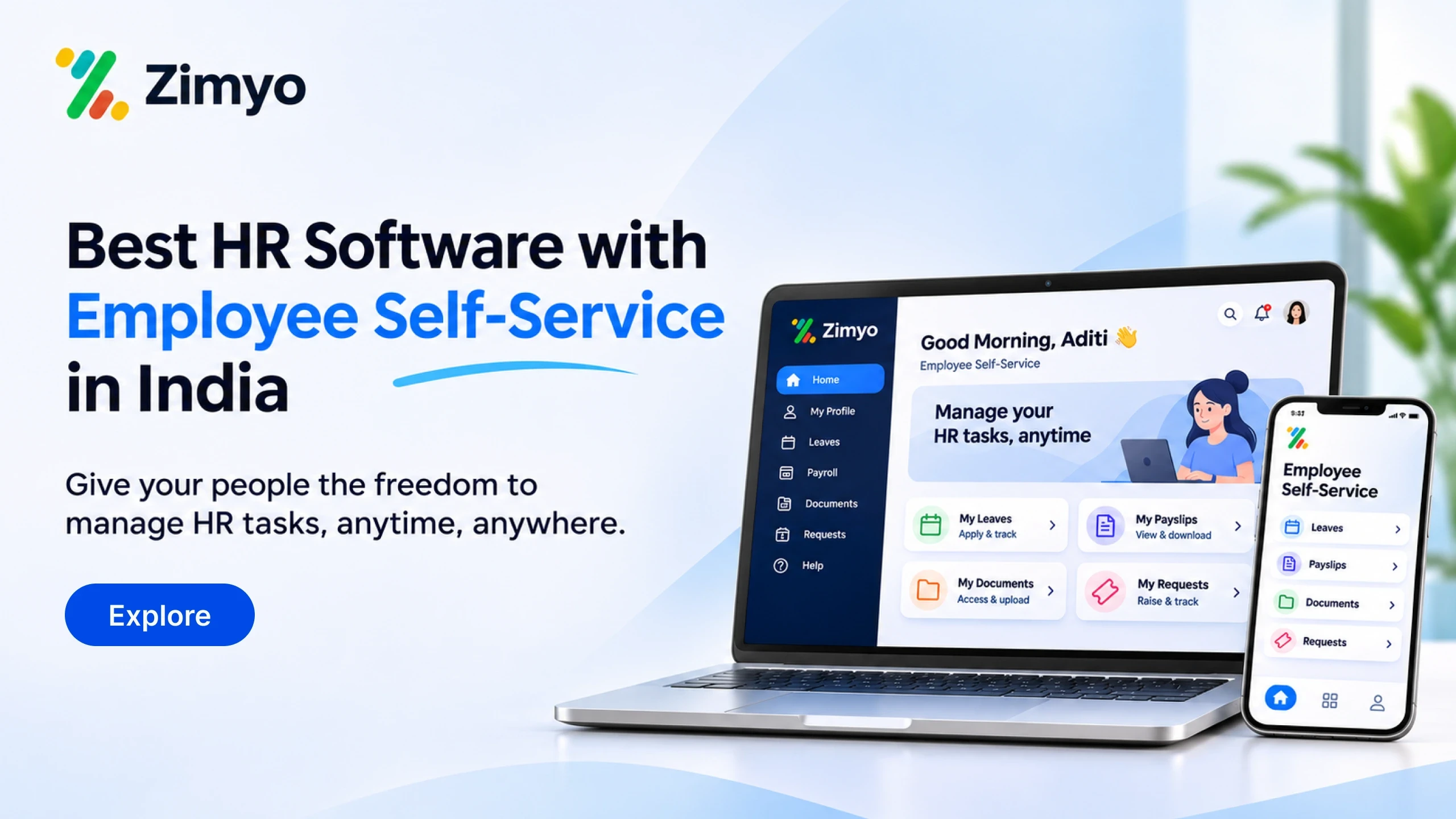
Through the portal and mobile app, employees can view and download payslips, apply for and track leave, mark attendance, update their details, submit reimbursements and raise requests- no HR email needed. Because it's part of one platform, every self-service action flows straight into payroll and records with no re-entry. Beyond the basics, Zimyo adds engagement tools like announcements, surveys, and recognition in the same employee app.
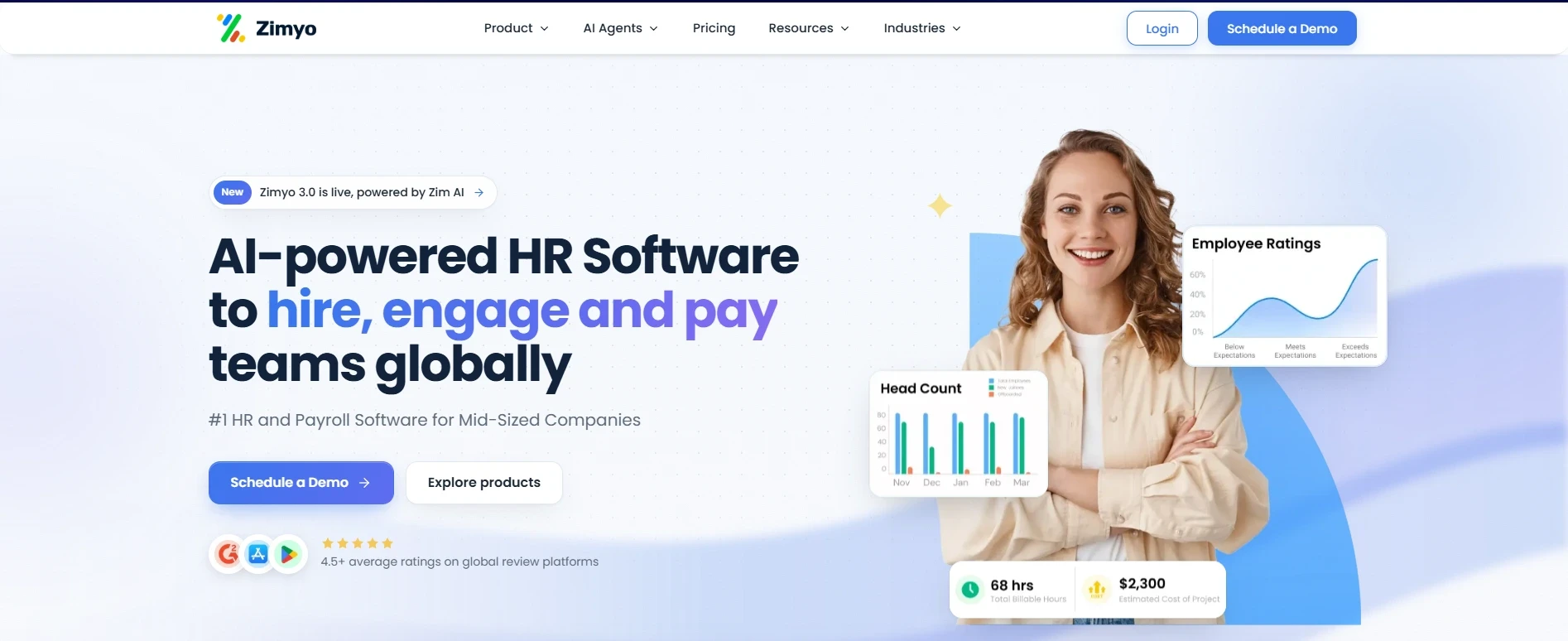
In Zim, its agentic AI takes self-service further: employees can ask a question about leave, payslips, or policies, and get an instant answer, with the system handling the task behind it.
Key features
- Mobile-first self-service for payslips, leave, and attendance.
- Profile and document updates with approval workflows
- Reimbursements and HR help-desk requests
- Engagement tools (announcements, surveys, recognition)
- AI-assisted self-service via Zim
Pros & Cons
| Pros | Cons |
| Rich, mobile-first self-service | Full value needs the wider platform |
| Connected to payroll and HR | Pricing is quotation-based |
| AI-assisted employee queries | Smaller brand than some global names |
| Engagement built in | Newer AI features still maturing |
Best suited for: Businesses of any size wanting strong, mobile-first employee self-service on a full HR platform.
Pricing: INR ₹80 per user per month, depending on modules.
2. greytHR
A well-established Indian HR and payroll platform known for payroll, leave, attendance, and HR help-desk self-service workflows tailored for Indian businesses.
Key features
- Payslip and payroll self-service
- Leave and attendance self-service.
- HR help-desk workflows
- Reliable compliance and support
Pros & Cons
| Pros | Cons |
| Strong, India-focused ESS | Interface more functional than modern |
| Reliable payroll and compliance | Advanced HR needs add-ons |
| Large, established base | Engagement tools lighter |
| Good value | Not the most mobile-led |
Best suited for: Indian businesses wanting payroll and HR help-desk self-service.
Pricing: From ~₹2,495/mo.
3. Zoho People
Part of the Zoho suite, Zoho People offers an ESS portal for leave, attendance, time logs, and profile updates, with an AI assistant and a free edition for up to 3 users.
Key features
- ESS for leave, attendance, and time logs
- Profile self-updates
- AI assistant
- Zoho ecosystem fit
Pros & Cons
| Pros | Cons |
| Free edition for up to 3 users | Payroll is a separate product |
| Affordable per-user pricing | Best value within Zoho |
| Good self-service and AI assistant | Not the deepest payroll ESS |
| Easy to set up | Deeper needs need more apps |
Best suited for: Small teams wanting affordable ESS with a free starting tier.
Pricing: Free for up to 3 users; paid per user thereafter.
4. Keka
Popular among growing Indian companies, Keka combines core HR, payroll, and employee self-service on one platform with a clean, modern interface.
Key features
- Self-service for payslips, leave, and attendance.
- Modern, intuitive interface
- Performance and engagement
- Mobile app
Pros & Cons
| Pros | Cons |
| Modern, easy-to-use ESS | Custom pricing, higher entry |
| Core HR and payroll in one | Advanced features in higher tiers |
| Good mobile experience | Larger than small teams need |
| Strong adoption | — |
Best suited for: Growing companies wanting modern self-service.
Pricing: Custom (from ~₹9,999/mo range).
5. Pocket HRMS
A mobile-first Indian HRMS covering attendance, leave, and employee self-service, handy for deskless and on-the-go staff.
Key features
- Mobile-first self-service
- Attendance and leave
- Payslip access
- Quick, simple setup
Pros & Cons
| Pros | Cons |
| Strong mobile self-service | Lighter on advanced HR |
| Simple and quick | Less suited to large enterprises |
| Good for deskless staff | Fewer integrations |
| Affordable | Engagement tools basic |
Best suited for: Businesses wanting mobile-first self-service for deskless staff.
Pricing: Custom; from ~₹4,995
6. Darwinbox
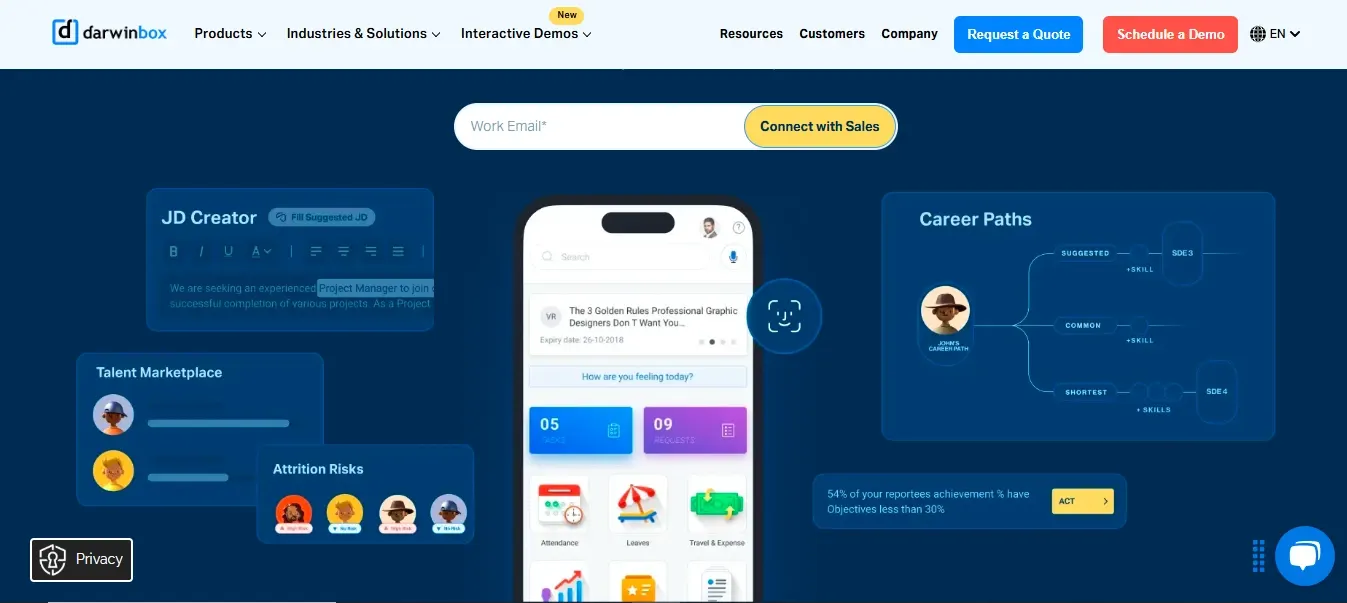
An enterprise-grade HCM used by large Indian and Asian enterprises, with a strong mobile app and deep self-service for big, distributed workforces.
Key features
- Enterprise ESS and mobile app
- Payroll, leave, and attendance.
- Performance and engagement
- Advanced analytics
Pros & Cons
| Pros | Cons |
| Powerful mobile self-service | Overkill for small firms |
| Built for large enterprises | Higher cost |
| Deep feature set | Longer implementation |
| Trusted by big brands | Pricing on request |
Best suited for: Large enterprises wanting self-service at scale.
Pricing: On request.
7. Savvy HRMS
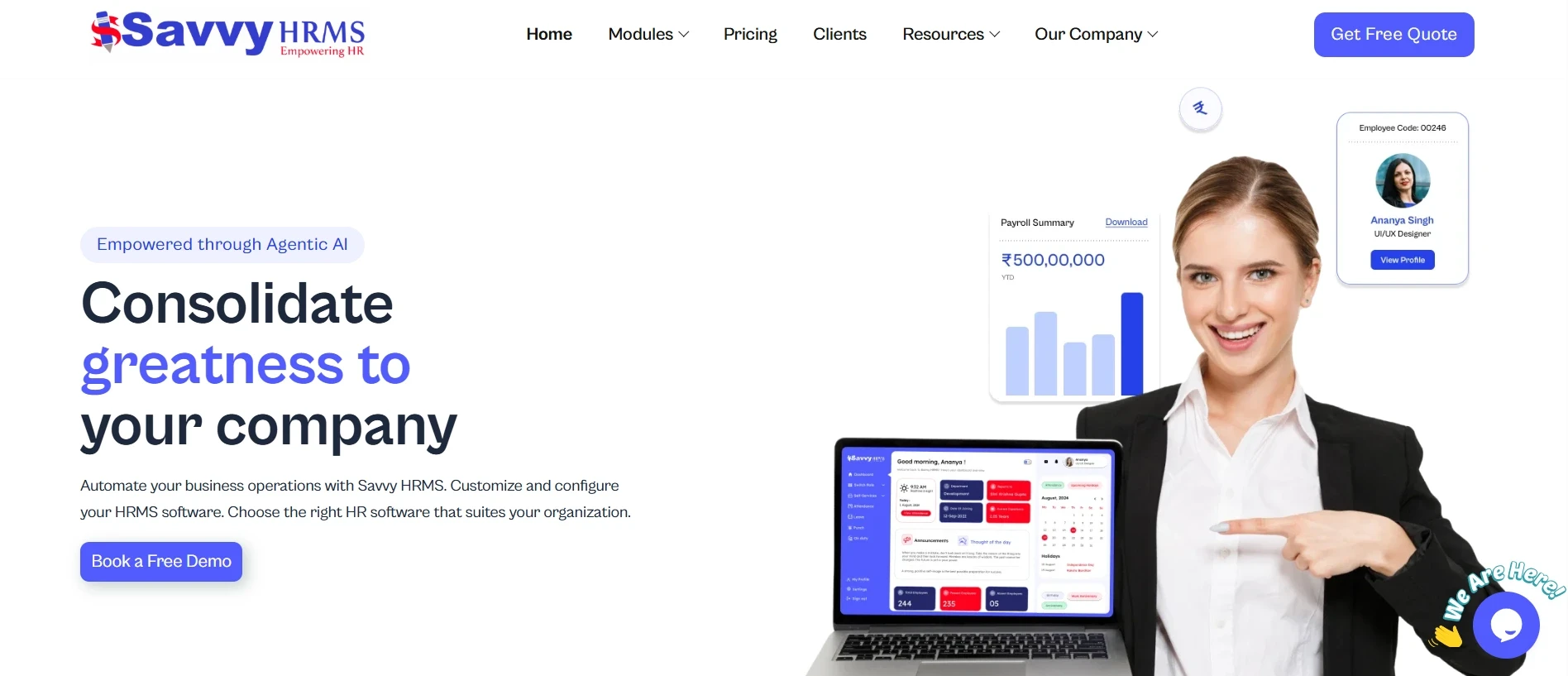
A budget-friendly Indian HRMS covering core HR, attendance, leave, and employee self-service, an option for cost-sensitive small businesses.
Key features
- Core HR and self-service
- Attendance and leave
- Payslip access
- Affordable setup
Pros & Cons
| Pros | Cons |
| Budget-friendly | Smaller brand; verify depth |
| Covers ESS basics | Fewer advanced features |
| India-focused | Limited integrations |
| Easy to start | Verify mobile-app maturity |
Best suited for: Cost-sensitive small businesses wanting ESS basics.
Pricing: On request.
8. HROne
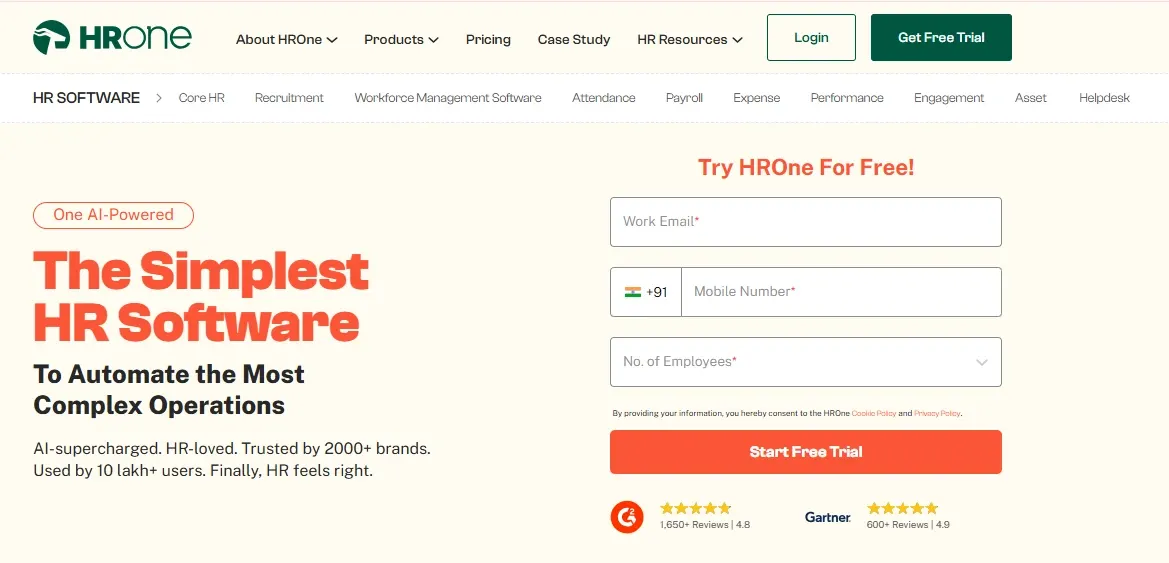
A full HCM suite with strong automation and a mobile-first design, offering self-service across large, distributed teams.
Key features
- Mobile-first self-service
- Payroll, attendance, and leave.
- Lifecycle automation
- Analytics and reporting
Pros & Cons
| Pros | Cons |
| Built for large, distributed teams | More than small firms need |
| Strong mobile self-service | Setup effort for full rollout |
| Good automation | Premium features in higher tiers |
| Scales across locations | Pricing rises with headcount |
Best suited for: Large, distributed teams wanting self-service at scale.
Pricing: From ~₹4,950/mo.
Implementing Employee Self-Service: What to Expect
Implementing self-service should be a phased approach, and success depends entirely on adoption, with employees using it rather than communicating with HR via emails.
- Discovery and configuration: Define which of the self-service capabilities will be enabled (payslips, leave, attendance) and set up policies, approvals, and roles.
- Data migration: Import all employee information, leave balances, and salaries to ensure everything works out of the box right after launch.
- Portal configuration: Set up the portal so employees have a good experience accessing the capabilities you enable.
- Integrations: Set up integrations between self-service capabilities and the payroll system and attendance system so requests are processed automatically.
- Pilot: Test your implementation with a selected team or location and collect feedback to resolve issues that arise during the pilot.
- Communication and training: Inform employees about the new capabilities and show them how to use self-service with a short guide or video; this step is critical for adoption.
- Launch and reinforcement: Go live company-wide and reinforce usage by setting up routing for certain requests (leave, payslips) exclusively through the portal.
Basic self-service can be live in one to two weeks; a full rollout with payroll integration and multiple locations typically takes three to six weeks. A platform like Zimyo, where self-service is built into the core, shortens setup since the modules already connect.
Employee Self-Service Pricing Guide
ESS is usually bundled into HR software pricing rather than sold separately, so you're really pricing the HR platform. The common models:
| Pricing model | How it works | Best for |
| Per employee (PEPM) | Charged per employee per month | Most businesses |
| Tiered plans | Fixed monthly tiers by feature set | SMBs wanting predictability |
| Free tier | Limited free plan (e.g. up to 3 users) | Very small teams |
| Quotation-based | Custom quote by size and modules | Mid-to-large and enterprise |
Driver of the cost:
- Number of Employees: The more employees you have, the higher the per-employee cost.
- Modules: Although self-service is usually included, the payroll, performance & engagement add-ons will impact the cost.
- Mobile App & AI: The mobile app and AI-powered self-service may be part of a premium tier.
- Support & Onboarding: Extra costs can include premium support & onboarding.
Indicative price range: free tiers (Zoho People, up to 3 employees), ₹50 – ₹100 per employee per month (mid-market applications), fixed tiers from ₹2,495/month (greytHR), and quotation (enterprise & all-in-one solutions, like Zimyo). Since the ESS solution is included as part of the suite, consider the entire suite and not the portal in pricing.
Conclusion
Employee Self-service has shifted from being an additional advantage to a basic requirement in today's business landscape. All the software listed above will provide effective self-service, but the right choice depends on your requirements. In general, self-service works best when built into one integrated HR platform, which is why Zimyo tops this list. Zimyo combines powerful mobile-based self-service with payroll, HR, and artificial intelligence, delivering answers immediately and giving HR time back.
Frequently Asked Questions
What is Employee Self Service (ESS)?
It is an application or portal where employees take care of their HR related actions by looking at the payslip, requesting leaves, marking attendance, editing information, and requesting reimbursements themselves, without any HR intervention via email.
Which HR software has the best employee self-service in India?
For most companies, Zimyo offers excellent self-service capabilities, plus payroll and HR, in a mobile-first way. AI-powered query resolution makes it better. greytHR, Zoho People, Keka, and Pocket HRMS also excel depending on your requirements.
Is self-service accessible to employees using a mobile device?
Yes. Examples of self-service software that is mobile-first include Zimyo and Pocket HRMS, which allow employees to access payslip information, request leave, and mark attendance using their mobile devices, which is perfect for a workforce without a desk.
What can employees perform using self-service?
Usually, employees can view/download payslips and tax documents, request leave and track leave requests, mark attendance, manage personal and bank account information, request reimbursement, raise HR tickets, and participate in onboarding and review processes.