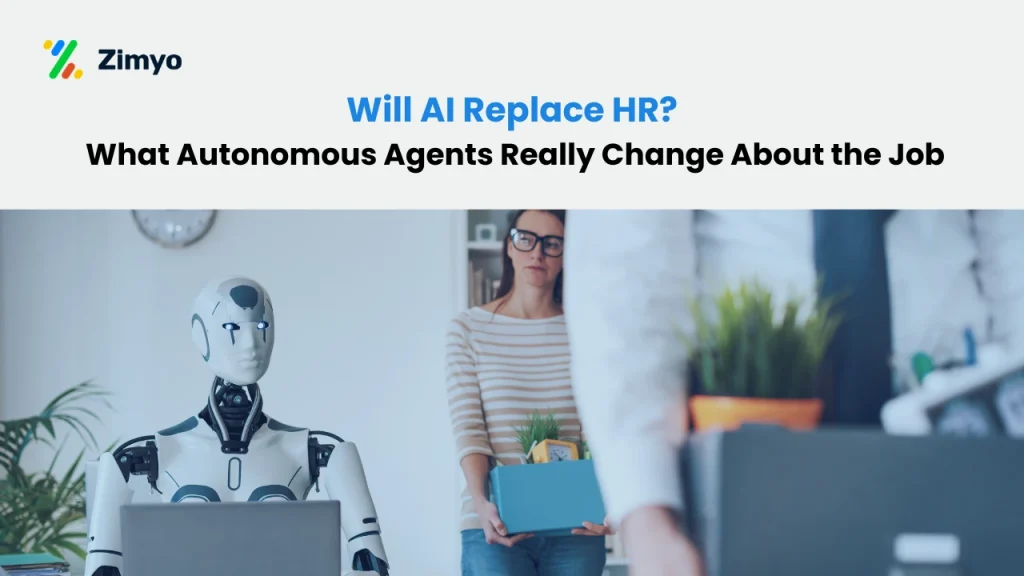

IBM’s CEO told the Wall Street Journal that the company had used AI to replace several hundred HR employees. The timing could not have been sharper. It confirmed a fear HR professionals had been sitting with quietly. In an age of digitalization, what happens to their role once AI can do the work? After all, if AI can perform policy compliance, resume screening, and time-off request management tasks, what else can humans do?
It’s only when things got even better that the story did not quite go viral. But in the same interview, Arvind Krishna added a twist. IBM’s total headcount had actually gone up, not down. The resources saved through HR automation weren’t cutting jobs, they were funding them. IBM poured that money into hiring software engineers, salespeople, and others in roles where humans still prevail.
That single story encapsulates most of the explanation behind the question people keep typing into their search engines.
The condensed version: No – AI will not take the place of human resources as an occupation, but rather take over certain functions within the occupation, leaving those activities that only people can perform more valuable than ever. According to Gartner, approximately half of all HR-related actions currently performed may well be automated or carried out by AI agents by 2030. The occupation is not disappearing; it is transforming.
In the remainder of this article, we explain why the concern is valid, which activities will be taken over, which won’t, and how the HR position transforms on the other end.
Why does the fear feel real?
The fear isn’t unreasonable. The data behind it is sizable, and HR is nearer the epicenter than most functions.
According to the World Economic Forum’s Future of Jobs Report 2025, the changes in the technological and economic environment will cause 92 million job displacements worldwide but create 170 million new jobs, resulting in a net increase in employment of 78 million people by 2030, but this figure hides considerable disruption (World Economic Forum, 2025). At the same time, 86% of companies see the influence of AI and information technology on their company in the next ten years.
As for HR specifically, it is exposed to more risk than others. According to SHRM’s 2025 analysis of the risk of automation and displacement, HR is more exposed to the risk of becoming highly automated than the rest of the U.S. workforce because HR work involves repetitive actions.
The number | What it means |
~50% of HR activities automatable or agent-run by 2030 (Gartner) | A large slice of tasks is on the table — not the same as half of HR jobs vanishing |
82% of HR leaders plan to use some form of agentic AI by 2026 (Gartner) | Adoption is no longer a question of “if” |
92M roles displaced / 170M created by 2030 (WEF) | Net job growth, but heavy churn and reskilling underneath |
43% of organizations now use AI in HR tasks, up from 26% in 2024 (SHRM) | The shift is happening fast, mostly in recruiting |
So yes, the ground is moving. But “the ground is moving” and “HR is being replaced” are two very different claims — and the data supports the first, not the second.
What AI is really replacing: tasks, not jobs
Here’s the distinction that gets lost in the panic. A job is a bundle of tasks. AI is very good at pulling specific tasks out of that bundle – and in HR, the bundle is unusually heavy on the kind of work machines handle well.
Estimates of how much HR time disappears into administrative work range from a third to well over half. Deloitte’s research has put it as high as 57% of an HR team’s time spent on routine admin – payroll runs, leave management, compliance reporting, and fielding the same five questions over and over (Deloitte, via Pentabell). That’s the part under pressure.
What modern AI agents take on inside that band:
- Resume screening and shortlisting at volume – the leading use case, with most AI-using HR teams pointing it at recruiting (SHRM)
- Interview scheduling and candidate follow-ups
- Answering routine employee questions – leave balances, policy clarifications, payroll queries.
- Payroll checks and anomaly flagging before errors reach anyone’s bank account.
- Generating first drafts of job descriptions, offer letters, and policy documents
IBM’s internal example shows the ceiling. Its AskHR agent now handles roughly 94% of routine HR inquiries – vacation requests, pay statements, documentation, and logged over 11.5 million interactions in a single year, contributing to billions in company-wide productivity gains (Entrepreneur; SHRM). That is a large amount of work taken off human desks.
But notice which work. None of it is the part of HR that people remember their HR team for.
What AI Can’t Replace: The Human Core of The Job
Strip out the admin, and what’s left is the reason the function exists in the first place, and it turns out to be the part machines are worst at.
When IBM leaned hard on automation, the limits showed up fast: the AI struggled with anything requiring empathy, nuance, or personal judgment, and the company kept hiring humans for exactly those situations. IBM wasn’t alone. Klarna, after replacing much of its customer service with AI, walked some of it back when quality slipped (ACS Information Age). The pattern keeps repeating: automate the routine, and the irreducibly human work becomes more visible, not less.
The people doing the job already sense this. Three out of four HR professionals told SHRM they expect AI to increase the value of human judgment over the next five years, not diminish it (SHRM). And the appetite for full autonomy is limited – around 80% of workers say a human should review AI’s output before it’s acted on (SHRM).
The work that stays firmly human:
- Judgment calls in grey areas – the termination that isn’t clear-cut, the accommodation request with no template.
- Difficult conversations – conflict, layoffs, performance problems, grief
- Reading the room – sensing morale, trust, and the things people don’t put in a survey
- Ethics and fairness – deciding when an algorithm’s recommendation is wrong, and owning that call
- Culture and belonging – the deliberate, human work of making people want to stay
AI handles well | Stays human |
High-volume resume screening | Final hiring decisions and judgment calls |
Scheduling and reminders | Difficult conversations and conflict |
Routine policy Q&A | Nuanced, case-by-case interpretation |
Payroll checks and reporting | Ethics, fairness, and accountability |
Drafting standard documents | Coaching, culture, and trust-building |
From Automation to Autonomy: What Does “Agentic” Really Mean?
A lot of “AI is replacing HR” fear comes from blurring two different things. Old automation followed rules: if this, then that. It could route a ticket or fire off a reminder, but it couldn’t think. The moment a request fell outside the script, it stalled and waited for a human.
Agentic AI is a different category.An agent doesn’t run a fixed rule. It works toward a goal. It breaks that goal into steps, decides what to do, takes action, checks the result, and adjusts. Gartner calls this the leap from assistants that wait for instructions to agents that do multi-step work on their own. And it predicts the shift is coming fast: by 2028, a meaningful share of everyday work decisions will be made autonomously, up from essentially zero in 2024 (Gartner).
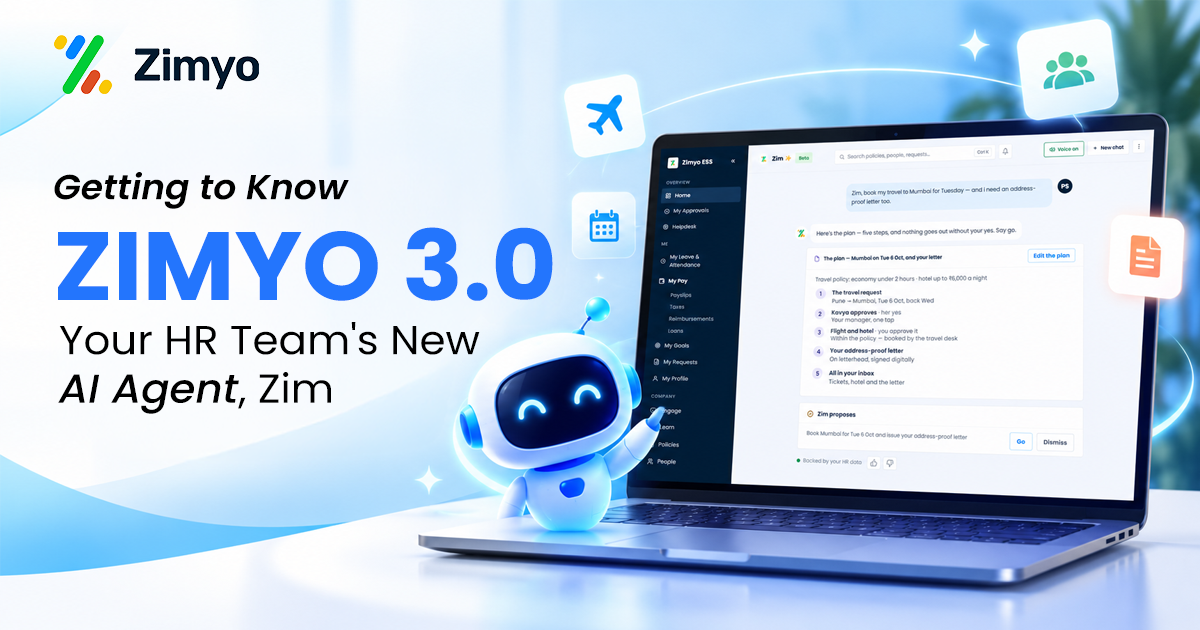
In an HR setting, the difference is concrete. A rules-based tool sends a reminder that onboarding paperwork is due. An agentic system notices a new hire has started, provisions their accounts, schedules their first-week check-ins, surfaces the documents still missing, and nudges the right people with a single instruction. This is the line Zimyo built ZIM on: an AI layer that learns from how your team works, adapts to your policies, reasons through a task, and completes it without someone re-explaining the process every time. The point of that kind of system isn’t to remove the HR team from the loop. It’s to hand them back the hours that routine work was quietly eating.
What the HR job becomes
In case AI takes on the admin function, the position doesn’t become obsolete but is elevated to a new level.
According to Gartner’s estimation, a business that implements the AI-powered HR model will be able to achieve a productivity increase of about 29%, which isn’t due to reducing the number of employees but by moving the workforce’s efforts toward areas that are critical for business development (Gartner, via BeamSec). Skills that dominate all analyses concerning the future of work cannot be provided by AI technologies (World Economic Forum, 2025).
In practice, the HR professional’s job is tilting toward three things:
- Supervising systems, not just doing tasks. Knowing what the AI is doing, checking its calls, and stepping in on the decisions that carry weight.
- Translating AI into human impact. Deciding where automation helps and where it quietly erodes trust, and designing the line between them.
- Owning the strategic work that the admin used to crowd out. Workforce planning, retention, culture, development, the things that were always supposed to be the point.
There’s a real risk worth naming. The people most exposed aren’t HR professionals as a group; they’re those whose roles are almost entirely routine processing and who don’t move up the value chain. The clearest way to stay ahead of AI in HR is to lean into the parts of the work it can’t touch.
How to stay ahead (a practical note for the worried)
If this question brought you here out of real concern, the useful response isn’t reassurance, it’s a plan.
- Get fluent, not expert. You don’t need to build models. You need to use AI tools well and know their failure modes. SHRM found most HR teams feel under-trained here, which means fluency is still a real differentiator.
- Move toward judgment work. Volunteer for the messy, human problems – conflict, change management, culture. That’s where your value compounds.
- Learn to govern AI, not just run it. As agents take on more, someone has to set the guardrails, audit the outputs, and answer for fairness. HR is the natural owner of that.
- Treat AI as the junior teammate who never sleeps. Let it do the first pass and the grunt work. Keep the final call.
Conclusion
So, will AI replace HR? The honest answer is that it already has begun — and it’s not as dangerous as it sounds. The work being taken away is the work that held HR back in the first place. The paperwork. Those remaining activities require human expertise, wisdom, and fairness.
The HR specialists who will become successful in the future are not going to compete with machines in terms of processing. On the contrary, those who will allow them to handle the routine and devote the released time to human activities are destined to win.
Frequently asked questions (FAQs)
Will AI replace HR managers?
Not really. The AI is taking care of routine HR jobs, but management, which involves judgment, handling conflicts, mentoring, and making decisions regarding people, requires human abilities, which today’s AI doesn’t have. HR managers who will now focus more on strategic and people-oriented jobs gain importance because AI takes care of the rest.
Which HR jobs are most at risk from AI?
Roles which depend mostly on rote, rule-driven activity, such as large-scale data entry, simple queries, and manual scheduling, are the most vulnerable. Roles requiring judgment, strategy, human relations skills, and ethics are very resilient indeed.
Can AI do recruiting on its own?
AI can help filter, shortlist, schedule, and draft outreach on a large scale, and recruitment is the most widespread application of AI within HR management practices. However, a person is still needed to check the decision – the majority of hiring managers and employees believe that a person should make the decision.
Is agentic AI the same as HR automation?
No. Traditional automation follows fixed rules and stops when something falls outside the script. Agentic AI works toward a goal – it plans, decides, acts, and adapts across multiple steps with far less hand-holding. That’s why it can take on whole workflows rather than single triggers.
What HR skills will be most valuable in the AI era?
Critical and analytical thinking, leadership, talent management, ethics, adaptability, and human skills related to having tough conversations and building culture. These always make up the most important global skills forecast and are precisely those that artificial intelligence cannot provide.