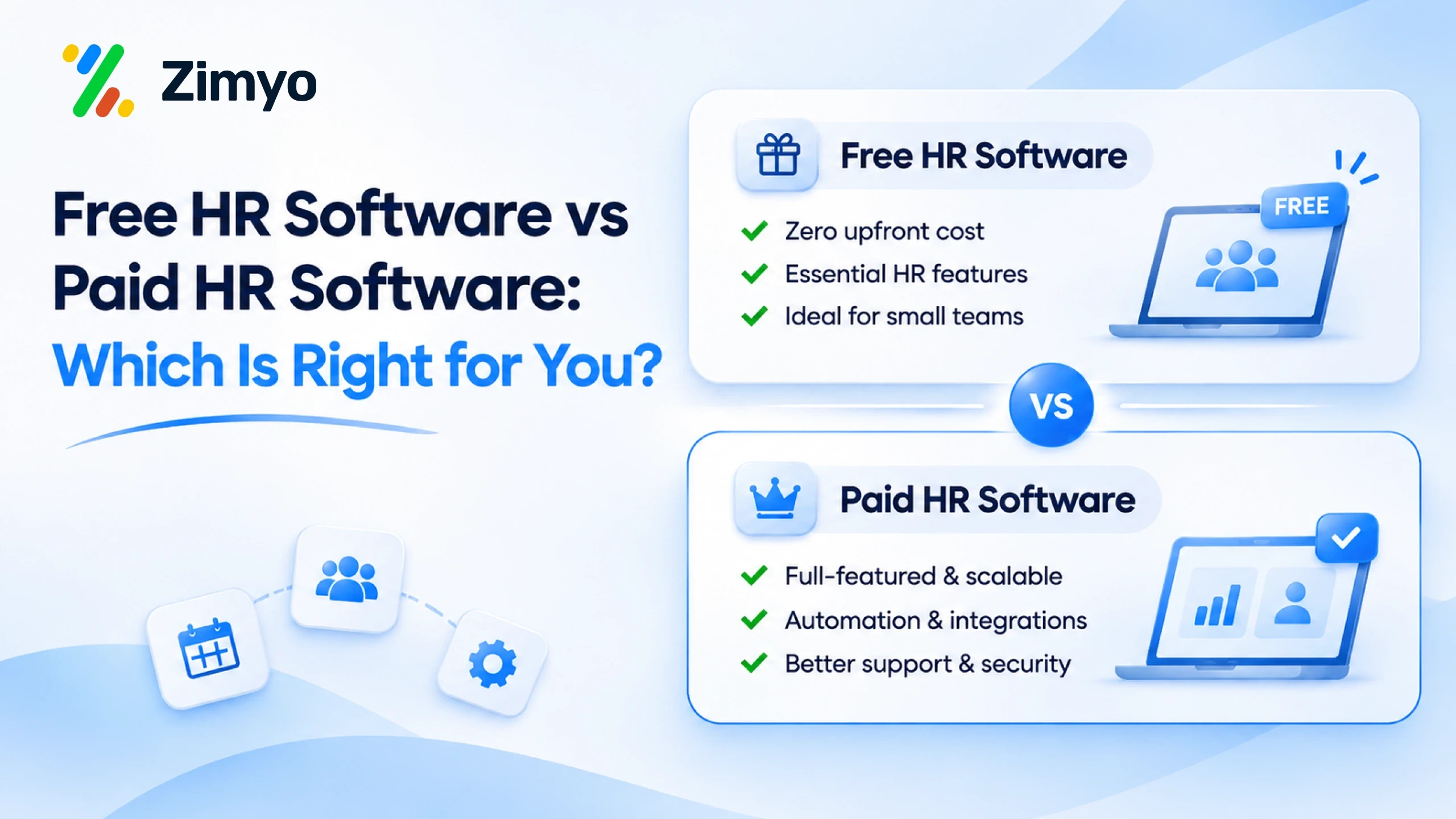
At some point, every company that deals with employees wonders whether its HR software should be free or paid. Free HR software is an attractive prospect, particularly for smaller companies trying to keep a close eye on every rupee they spend. However, "free" HR software comes with compromises, and paid software offers benefits that justify the cost. free HR software vs paid HR software is the ultimate choice.
In this short guide, we'll take a closer look at what free HR software can give you and what it lacks, what paid HR software provides, and when upgrading to paid software makes sense.
Key Takeaways
- Free HR software is suitable for startups and small teams that need basic employee records, attendance and leave management.
- Paid HR software offers advanced features such as automated payroll, statutory compliance, recruitment, performance management and employee self-service.
- Free plans often come with user restrictions, limited integrations, fewer features and basic customer support.
- Upgrading to paid HR software makes sense when manual HR tasks increase, payroll becomes complex or the business starts scaling.
- The right HR software should balance pricing, features, automation, security and long-term business needs.
What Free HR Software Offers (and Where It Stops)
Free HR software, whether a free tier or a free plan, usually covers the basics well enough for a very small team. Typically, you get:
- A central employee database and records
- Basic attendance and leave tracking
- Simple self-service (payslips, requests)
- Limited reporting
That's genuinely useful when you're a handful of people. But the limits show up fast as you grow:
- User caps: Many free plans stop at a few users (often 3–10).
- No real payroll: Payroll and statutory compliance (PF, ESI, PT, TDS) are usually paid, or absent.
- Thin features: Little or no performance, recruitment, onboarding, or engagement.
- Limited support: Community forums rather than responsive help.
- Data and security limits: Basic security, fewer controls, and sometimes caps on data or integrations.
In short, free is fine for storing records, but it rarely runs HR end to end.
Is "Free" HR Software Really Free?
And here comes the surprise most organizations learn later: the price tag of "free" HR software often isn't in the price tag at all, and it shows up in other forms.
Hidden fees through the trial period
Many "free" solutions are actually trials with a hidden price tag. Once the trial ends, a monthly or yearly fee starts to apply, and may work out even higher than a paid solution.
Upgrades to paywalled necessities
The basic requirements such as payroll or adding more users are typically available only via upgrades, making the "free" plan insufficient for HR tasks.
Installation, setup, and training fees
Some "free" tools still charge for installation, configuration, or training before they are fully operational.
Costs of integration
When you combine several "free" solutions into a single workflow, you'll be facing lots of manual data entry, which will silently steal your HR's time and thus your money.
Limited cloud capacity and storage
Often, "free" plans have limited cloud or storage capacities, which is a problem as you grow.
The summary, when comparing "free" HR software, considers not only the zero price, but also the overall costs. More
What Paid HR Software Adds
Paid HR software is where HR is truly managed and not just documented. For a charge per user, you generally get:
- Payroll and compliance: Automated salary processing with PF, ESI, PT, and TDS, plus pre-built compliance reports.
- A full life cycle: Recruitment, onboarding, performance, engagement, and offboarding in one platform.
- Scalability: Room to grow beyond more users, locations, and legal entities without changing tools.
- Automation and AI: Workflow automation and, in modern platforms, AI that automates payroll, candidate screening, and answering employee queries.
- Responsive support: Onboarding support and customer support for any issues, which is especially relevant for payroll.
- Better security: Encryption, role-based access, audit trails, and certifications (ISO, SOC, VAPT).
The investment delivers reliability and compliance while saving time, which is why most growing companies switch to paid HR management software when HR is no longer an occasional task.
Free HR Software vs Paid HR Software: Quick Comparison
Here’s a more SEO-friendly and blog-ready version of the comparison, with clearer wording, practical factors, and a balanced tone.
| Factor | Free HR Software | Paid HR Software |
| Pricing | Free to use, with basic features or limited free plans | Subscription-based pricing, usually per employee or based on modules |
| Employee Limit | May restrict the number of employees or users | Supports growing teams and larger workforces, depending on the plan |
| Payroll Management | Basic payroll tools or limited salary processing options | Automated payroll processing, salary calculations, payslips and deductions |
| Statutory Compliance | Limited compliance support; some tasks may require manual tracking | Automated compliance management for PF, ESI, PT, TDS and applicable regulations |
| HR Features | Basic employee records, leave tracking and attendance | Complete HR management, recruitment, onboarding, performance and employee lifecycle management |
| Automation | Limited automation with more manual HR processes | Automated workflows, approvals, reminders and AI-powered HR tasks |
| Employee Self-Service | Basic access to employee information or limited ESS features | Dedicated employee portals and mobile apps for payslips, leave, attendance and requests |
| Reporting & Analytics | Standard reports with limited customisation | Advanced dashboards, custom reports and workforce analytics |
| Integrations | Limited third-party integrations | Integrations with accounting, ERP, biometric devices and other business applications |
| Customer Support | FAQs, community support or limited assistance | Dedicated support, onboarding assistance and technical support, depending on the provider |
| Data Security | Security features may vary by provider and plan | May offer advanced access controls, encryption, audit logs and additional security options |
| Scalability | May become restrictive as business requirements grow | Flexible modules and plans to support changing business needs |
| Best Suited For | Startups, small teams and businesses with simple HR requirements | Growing businesses and enterprises looking to streamline HR operations |
Note -Pricing and features are indicative and vary by vendor.
When Free Is Enough, and When to Upgrade
When Free Is Enough
Free works when you're a very small team (a handful of people), you only need to store records and track basic leave and attendance, you don't run complex payroll, and budget is the overriding constraint.
When to Upgrade to Paid
It's time to upgrade when any of these become true:
- You've outgrown the free user cap.
- You need automated payroll and statutory compliance.
- Manual HR work is eating too much time.
- You want performance, recruitment, or engagement, not just records.
- You need reliable support and stronger data security.
- You're hiring and scaling, and want a system that grows with you.
A useful rule of thumb: Free HR software helps you store HR; paid HR software helps you run it.
Conclusion
Free HR software is a great place to start if you have a small team, but it’s designed to be used, not scaled. Paid HR software pays for itself through full payroll and compliance, the entire lifecycle of the employee, automation, and support- the stuff that saves you time and mitigates risk.
The good news is that paid no longer has to mean expensive. Modern platforms like Zimyo offer affordable per-user pricing with full HR, payroll, attendance, and AI in one place, so you get the reliability of paid software without enterprise-level cost. If you've outgrown free, that's the sweet spot to look for.
Not sure which you need? Book a Zimyo demo and get a clear recommendation for your team size and budget.
Frequently Asked Questions
Is free HR software sufficient for a small company?
Yes, if you have a very small team that needs record-keeping and leave/attendance tracking. However, when you need payroll, compliance, and other features, you'll need to switch to paid solutions.
What is the major distinction between free and paid HR software?
While free HR software includes core HR functions, user limits, and limited customer support, paid solutions offer full payroll and compliance, employee lifecycle management, automation, security, and customer support, making the software work for HR.
Does free HR software have payroll?
Rarely, or in a very limited way. A complete payroll module with compliance for PF, ESI, PT, and TDS is almost always a paid solution because it requires accuracy and regular updates.
When does a company need to consider paying for HR software?
When you reach the limit of free users, need payroll and compliance, need tools for performance and recruitment, need support, or need software that grows with your expanding company.
Is HR software costly in India?
No, not always. Many platforms offer affordable per-user rates (usually a few tens of rupees per employee per month).