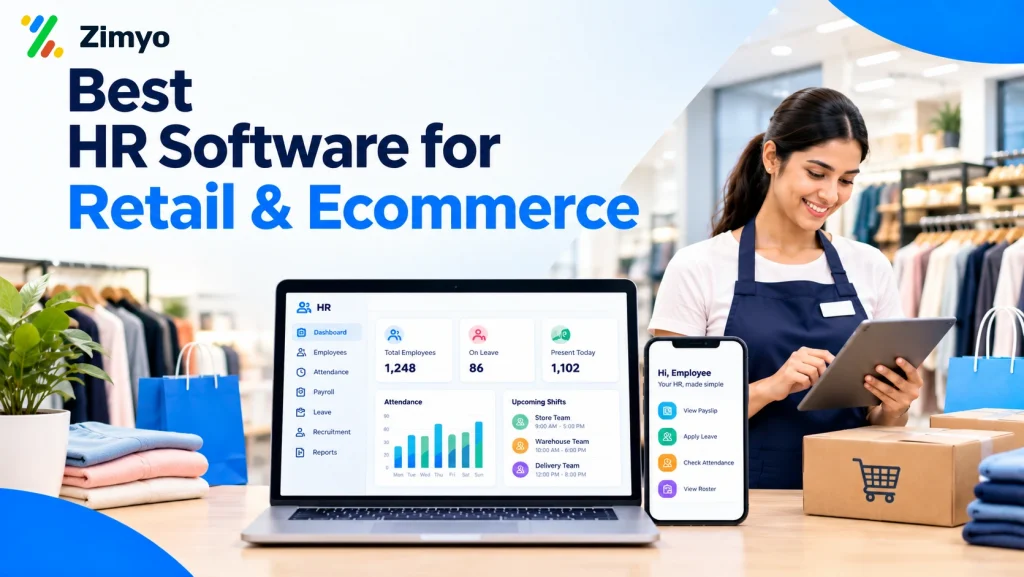

Few industries challenge HR as much as retail and ecommerce. The workforce operates in many stores, shifts, and locations. Holidays require quick hiring of seasonal and temporary employees. High attrition rates, along with payroll calculations that must include shift differentials, overtime payments, and variable working hours, complicate the picture.
Below, we will discuss the most effective HR software for retail and e-commerce businesses in India, starting with our top recommendation. We will explain each software solution’s target audience (multi-store retail business, direct-to-consumer business, or quick commerce).
Research Methodology
This list comes from a rigorous selection process, not an arbitrary choice. This is how it was done:
- Sources: We relied on vendor literature, customer feedback available on review sites like G2, and data on the Indian retail and ecommerce industry
- Shortlisting: From the broader HR software market, we selected tools with a significant presence in India and applicability to the retail and ecommerce workforce.
- Ranking: We ranked the shortlist based on the selection criteria outlined below, putting the most weight on retail applicability and feature depth.
- Validation: Where possible, we checked the claims across multiple sources.
Pricing and features change frequently, so use the information above only as a starting point.
Why We Chose These Tools
To create this list, we analyzed each platform with the unique requirements of retail and ecommerce businesses operating in India in mind. These choices reflect retail-oriented needs such as employee attendance across multiple locations, shifts, and rosters; mass and seasonal hiring; and flexible pay. We also considered India-specific statutory compliance for PF, ESI, PT, and TDS, INR pricing, and local availability. Other factors included comprehensive HR solutions, market presence, customer reviews, scalability across outlets and warehouses, and cost-effectiveness.
Retail and Ecommerce in India: The Numbers
The scale and churn of this sector explain why strong HR software is essential:
- Retail contributes over 10% of India’s GDP and employs around 8% of the workforce, roughly 35 million people, with 25 million new jobs expected by 2030.
- Attrition is the sector’s defining HR challenge. Industry experts estimate retail attrition in India at around 70 to 80%, against a global average of 30 to 40%, and most of it happens in the first few months.
- The frontline dominates: in most retail companies, 80 to 90% of staff work at the front end, the hardest group to schedule and retain.
- Ecommerce and quick commerce are booming. India’s q-commerce market was projected to reach around $5 billion in 2025, and ecommerce, logistics, and retail are leading India’s hiring surge, with a projected 4.4% net employment change for H2 FY2025-26.
High volume, high churn, and heavy frontline staffing make manual HR unsustainable, and good software a competitive advantage.
Why Retail and Ecommerce HR Is Different
It may seem that an all-inclusive HR solution would work for retail businesses. Still, in reality, this kind of software usually struggles to handle the points of retail and ecommerce businesses:
- Workforce spread across multiple locations: Employees need to be tracked across many locations, such as stores, warehouses, and even several cities.
- Roster management: Work shifts and split shifts, along with overtime, need to be calculated and included in the payroll accurately.
- High turnover and mass hires: Constant turnover requires frequent recruitment and large-group hiring.
- Seasonal workers: Festivals such as Diwali require fast hiring and offboarding of temporary employees.
- Non-desk workforce: Most workers do not work from a computer; therefore, you should take a mobile-first approach.
- Variable pay: Incentives, shift pay, and overtime require a more advanced payroll system than a fixed salary.
What to Look For
When selecting HR software for your retail or ecommerce company, ensure you select the following:
- Multi-branch attendance: Geotagged attendance or biometric attendance across all branches.
- Rotational shifts and rostering: Easy scheduling of rotational shifts, with easy transfer of overtime to payroll.
- Payroll with compliance: Accurate calculation of variable pay, along with PF, ESI, PT, and TDS across states.
- Bulk recruitment and onboarding: Ability to recruit and onboard large groups or seasonal recruits.
- Mobile-centric self-service: An easy-to-use employee self service that enables your field employees to manage attendance, apply for leave, and view payslips.
- Scalability: Ability to scale with additional branches, warehouses, and staff.
- Analytics: Insights on employee attrition, attendance, and staffing costs per branch.
Quick Comparison
Software | Best for | Starting price |
Zimyo | All-in-one HR, payroll and AI for retail/ecommerce | 80/user/month |
Keka | Growing teams wanting great UX | From ₹9,999/mo |
greytHR | Compliance-focused retail chains | ₹2,495/mo (50 employees) |
Zoho People | Small businesses on a budget | Free tier; paid per employee |
HROne | Mid-to-large retail chains | From ₹4,950/mo |
factoHR | Multi-location retail SMEs | From ₹4,999/mo |
Pocket HRMS | Smaller teams with deskless staff | ₹4,995 (up to 100 employees) |
Qandle | Configurable platform for growing retailers | From ₹49/employee/mo |
Darwinbox | Large retail/ecommerce enterprises | On request |
ZingHR | Large retail enterprises at scale | On request |
Top 10 HR Software for Retail & Ecommerce
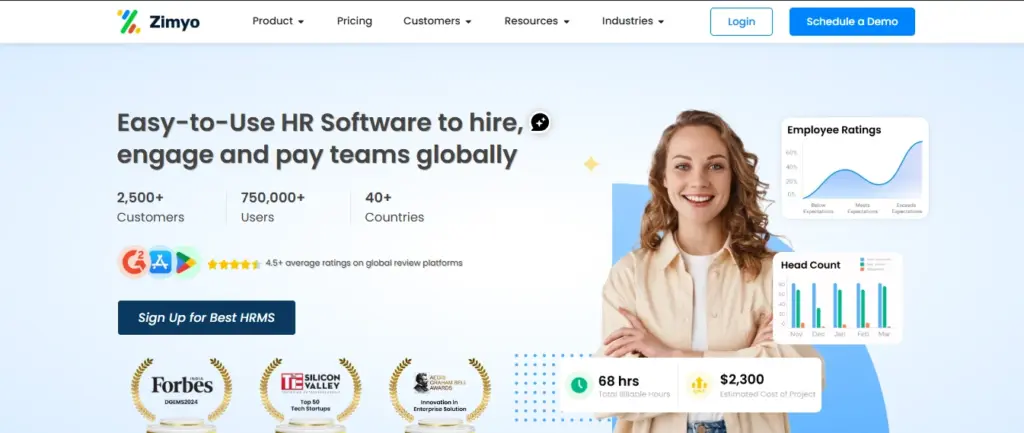
Zimyo is our top pick for retail and ecommerce businesses that need one platform to handle a large, distributed, fast-changing workforce. Trusted by 2,500+ organizations across 40+ countries, it brings Core HR, attendance, payroll, recruitment, and engagement together in 60+ integrated modules.
For retail, the fit is strong. Zimyo handles multi-location attendance with biometric and geo-tagging, manages rotating shifts, and flows overtime and allowances straight into payroll. For high-churn hiring, its recruitment and onboarding tools handle bulk and seasonal intake, and a mobile-first self-service app suits deskless frontline staff.
In 2026, Zimyo adds Zim, its agentic AI, which can screen large applicant pools in minutes for bulk hiring, audit payroll before it runs, and answer workforce questions instantly, while keeping people in control.
Key features
- Multi-store attendance with biometric, geo-tagging, and mobile options
- Shift and roster management feeding directly into payroll
- Bulk and seasonal hiring and onboarding
- Mobile-first self-service for frontline staff
- Agentic AI (Zim) for screening, payroll audits and instant answers
Pros & Cons
Pros | Cons |
All-in-one HR, payroll and hiring on one platform | Full value comes from the wider platform |
Built for a distributed, high-churn workforce | Pricing is quotation-based, not public |
Strong compliance; VAPT, ISO, AICPA SOC certified | Smaller brand than some global names |
AI shortlisting and payroll audits | Newer AI features still maturing |
Best for: Retail chains, D2C brands, ecommerce, and quick-commerce companies that want one platform for a distributed workforce.
Pricing: 80/user/month, in INR, by team size and modules.
2. Keka
A modern HRMS with a clean interface that covers attendance, payroll, and performance. Its usability suits retail head-office teams and growing D2C brands.
Key features
- Attendance and leave management
- Payroll with statutory compliance
- Performance and goal tracking
- Clean, intuitive employee self-service
Pros & Cons
Pros | Cons |
Easy to use and quick to adopt | Higher entry price than some rivals |
Strong self-service | Less tailored to deskless frontline staff |
Full HR and payroll suite | Advanced features need higher tiers |
Good reporting | Not retail-specific |
Best for: Growing retail and ecommerce teams that value user experience.
Pricing: From around ₹9,999 per month.
3. greytHR
A well-established Indian payroll and HR platform, strong on compliance and reliable at scale. A dependable choice for retail chains focused on getting payroll and statutory basics right.
Key features
- Automated payroll and statutory compliance
- Leave and attendance tracking.
- Employee self-service portal
- Reliable 24/7 support
Pros & Cons
Pros | Cons |
Strong payroll and compliance | Interface feels more HR than retail-led |
Large, established India base | Fewer retail-specific features |
Dependable support | Advanced HR needs add-ons |
Good value for SMBs | Scheduling less robust for shifts |
Best for: Retail businesses that prioritize payroll and compliance.
Pricing: From around ₹2,495 per month for 50 employees.
4. Zoho People
Part of the Zoho suite, with attendance, leave, and a free tier for very small teams. A fit for small retailers and e-commerce sellers already using Zoho.
Key features
- Attendance, leave, and shift tracking
- Employee self-service and mobile app
- Workflow automation
- Fits the wider Zoho ecosystem
Pros & Cons
Pros | Cons |
Free tier for very small teams | Best value only within Zoho |
Affordable as you scale | Payroll is a separate Zoho product |
Easy to set up | Not retail-specific |
Good mobile access | Deeper needs require more Zoho apps |
Best for: Small retail and online businesses on a budget.
Pricing: Free tier; paid plans scale per employee.
5. HROne
A full HCM suite with strong automation and a mobile-first design, built for mid-to-large, distributed workforces like retail chains.
Key Features
- Full HCM with payroll and compliance
- Attendance and shift management
- Mobile-first design
- Automation across the employee lifecycle
Pros & Cons
Pros | Cons |
Built for larger, distributed teams | More than small retailers need |
Strong automation | Setup effort for full rollout |
Mobile-first | Premium features in higher tiers |
Scales across locations | Pricing rises with headcount |
Best for: Mid-to-large retail chains.
Pricing: From around ₹4,950 per month.
6. factoHR
A hire-to-retire platform built for Indian businesses, with multi-location support and well-reviewed attendance and payroll. Suits retailers spread across many sites.
Key features
- Hire-to-retire HR suite
- Multi-location attendance and payroll
- Mobile app for frontline staff
- Well-reviewed across modules
Pros & Cons
Pros | Cons |
India-built with multi-location support | Broad suite, not retail-specific |
Strong attendance and payroll | Many features to configure |
Good mobile tools | Custom pricing, not public |
Scales with growth | Onboarding takes some effort |
Best for: Multi-location retail SMEs.
Pricing: From around ₹4,999 per month.
7. Pocket HRMS
A mobile-first HRMS focused on simplicity, handy for frontline and field staff who need payslips and attendance on the go.
Key features
- Mobile-first attendance and payslips
- Payroll processing
- Employee self-service
- Simple, quick setup
Pros & Cons
Pros | Cons |
Handy for deskless, field staff | Lighter on advanced HR |
Simple and quick to roll out | Less suited to large enterprises |
Mobile-first | Fewer integrations |
Affordable for small teams | Scheduling is basic |
Best for: Smaller retailers with a deskless workforce.
Pricing: From around ₹4,995 for up to 100 employees.
8. Qandle
A modular, configurable HRMS that lets businesses pick the features they need, with attendance, payroll, and engagement tools suited to growing retailers.
Key Features
- Modular, configurable HR modules
- Attendance and leave management
- Payroll and compliance
- Employee engagement and self-service
Pros & Cons
Pros | Cons |
Flexible, pick-what-you-need design | Configuration takes some setup |
Good value per employee | Smaller brand presence |
Modern interface | Fewer retail-specific tools |
Scales with growth | Advanced features in higher tiers |
Best for: Growing retailers wanting a configurable platform.
Pricing: From around ₹49 per employee per month.
9. Darwinbox
An enterprise-grade HCM used by large Indian and Asian enterprises, with deep features and a strong mobile experience for big, distributed workforces.
Key features
- End-to-end enterprise HCM
- Strong mobile-first experience
- Advanced recruitment and onboarding
- Analytics and workflow automation
Pros & Cons
Pros | Cons |
Built for large enterprises | Overkill for small retailers |
Powerful mobile app | Higher cost |
Deep feature set | Longer implementation |
Trusted by big brands | Pricing on request only |
Best for: Large retail and ecommerce enterprises.
Pricing: On request (custom).
10. ZingHR
An enterprise HR and payroll platform used across manufacturing and retail, built to streamline payroll and attendance at scale.
Key features
- Enterprise payroll and attendance
- Recruitment and onboarding
- Mobile access for frontline staff
- Analytics and compliance tools
Pros & Cons
Pros | Cons |
Enterprise-grade scale | Heavier than small teams need |
Proven in retail and manufacturing | Setup effort for full rollout |
Strong payroll automation | Pricing on request |
Mobile support | Interface less modern than some rivals |
Best for: Large retail enterprises needing scale.
Pricing: On request.
How to Choose the Right One
The best fit depends on your size, how many locations you have, and how seasonal your staff is. Small, budget-friendly online retailers should look at Zoho People, while large retailers with multiple store locations should consider either HROne or factoHR.
However, this software’s true value emerges when it covers attendance, scheduling, payroll, and recruitment across all your locations. Separate software creates gaps that lead to payroll mistakes and understaffing. Zimyo is the clear leader on this list because of its full-cycle employee management features, bulk and seasonal hiring capabilities, and AI agent.
Want to see it in action? Book a Zimyo demo and see how it can simplify HR across all your stores and warehouses.
Frequently Asked Questions (FAQs)
What is the best HR software?
In retail and e-commerce businesses in India, five of the most powerful solutions are Zimyo, Keka, greytHR, HROne, and factoHR. Zimyo is a great solution that combines payroll, attendance, and hiring, with 60+ modules and agentic AI that works well for dispersed retail staff.
What software does the retail store use?
Retail stores usually need HR and workforce management software for attendance, scheduling, payroll, and recruitment, along with POS and inventory systems. With an HRMS like Zimyo, you can manage HR processes such as multi-store attendance, scheduling, payroll, and recruitment.
What is the best HR software for small businesses?
For small retail and e-commerce companies, the best HR software should be affordable, user-friendly, and easy to implement. Software like Zoho People and Pocket HRMS is great for small teams, while Zimyo is ideal for growing small companies because it is scalable and won’t require a platform change later.
Is there a free HR software?
Yes, some companies offer a free version, and a few offer free trials. But as your business grows, most of them will switch to a paid model.