
Have you ever wrapped up a full day in HR and wondered where it actually went? Not into the conversations you meant to have, or the plans you wanted to build, but into approvals, attendance fixes, and the same leave question answered for the tenth time.
If that feels familiar, you are not alone. Most people choose HR because they care about people, not paperwork. Yet for years, the tools behind HR have been built to keep records, leaving the actual doing to humans.
That is starting to change with agentic AI, a new kind of AI that can plan and complete tasks instead of only answering questions. Zimyo 3.0 brings it into everyday HR through Zim, an AI agent built right into the platform. In this guide, we look at what agentic AI actually is, how Zim works, and what it could mean for your team, whether you are already exploring AI or just starting to wonder where to begin.
What Is Agentic AI? A Simple Explanation
Agentic AI is a type of artificial intelligence that works towards a goal instead of just responding to a question. You tell it what you need, and it figures out the steps, does the work across different systems, and finishes the job, asking a person for approval when needed.
From responding to performing
Chat tools are how most of us first encountered AI. You get an answer when you ask a question. Helpful, but you still have to do the job. Agentic AI is more advanced. When you give it an objective, it organizes the stages, collaborates across systems, and finishes the job.
Why it’s so important for HR
HR job is rarely a one-step process. One new hire’s onboarding involves payroll, assets, system access, and paperwork. Your onboarding policy can be explained by a chatbot. In fact, the process can be advanced by an AI agent. Agentic AI in HR is more than just a passing fad because of this change from dialog to completion.
Zimyo 3.0 and Zim: How It Works
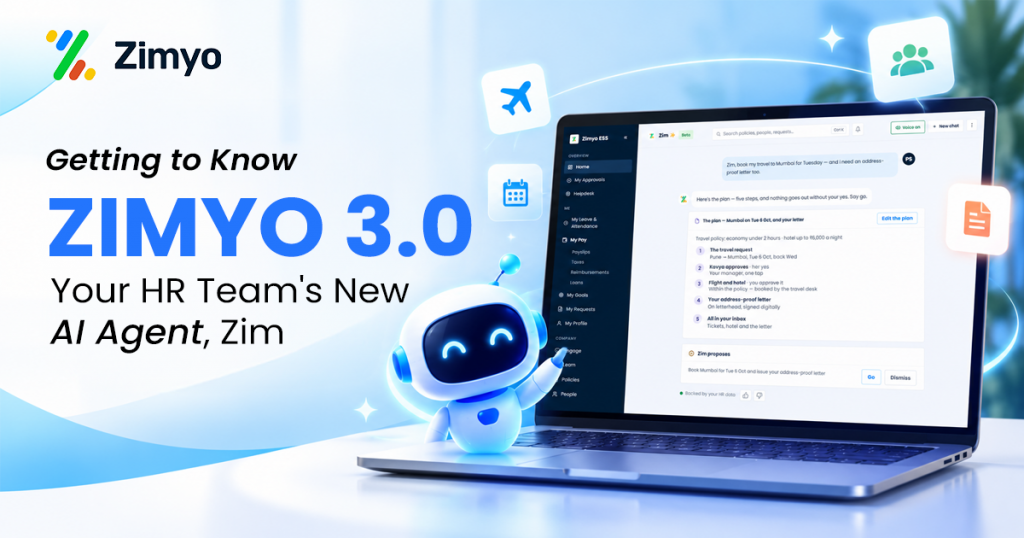
Zimyo 3.0 is the newest version of Zimyo’s HR and payroll platform, and Zim is the AI agent at its heart. Rather than hunting for the right menu, you describe the task and let Zim handle the rest. The experience follows three steps:
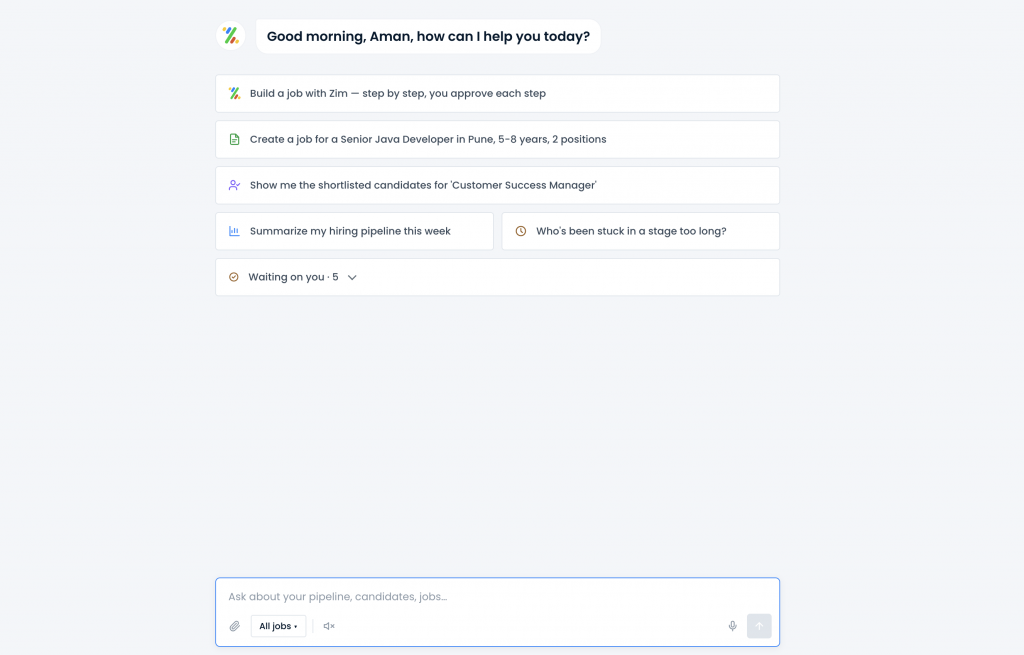
- Ask in your own words: Type what you need, the way you would tell a colleague.
- Review the plan: Zim lays out each step it will take, and you can edit anything.
- Approve, and it is done: Zim completes the work across modules and logs every action.
- The thinking behind it is simple: Zim does the preparing, and you do the deciding.
A Week in HR, With Zim on the Team
Picture an ordinary HR week, but with a colleague who never runs out of patience for the repetitive parts. Zim connects Core HR, Employee Self-Service, Payroll, Performance, and Recruit, so work no longer stops at the edge of one module.
- Before payday, not after: The pay run gets a thorough overnight check from the Payroll AI Agent, so anything unusual reaches you while there is still time to fix it.
- Attendance without the chase: When someone forgets to clock in, Zim notices and uses timesheet and attendance data to suggest the correction for your sign-off.
- Fewer repeat questions: Through the Helpdesk AI Agent, employees can request pay slips, letters, or their remaining leave on their own, in the language they are most comfortable with.
- Calmer goodbyes: When someone resigns, Zim lines up the asset return, prepares the settlement, and gets the exit documents ready.
- Reviews with substance: Managers begin with a performance review draft grounded in actual feedback rather than memory.
- Faster first rounds: Large applicant pools in the applicant tracking system are narrowed down by skills in a fraction of the usual time.
From Questions to Quick Insights
Zim also helps you understand what is happening across your workforce. You can ask it to explain an unexpected rise in payroll costs or highlight where attrition risk may be building and get a clear answer without building a single report.
Nervous About Handing Work to AI? That Is Fair
Hesitation is natural, especially when payroll and employee data are involved. Zim is designed with caution in mind.
- You stay in control: Zim never acts on its own. You can adjust its plan, turn it down, or approve it, and a record of each step is kept so you can always look back.
- Your data stays protected: Zim follows the same safeguards that already protect your Zimyo account. People see only what their role allows; sign-in runs through SSO, data is encrypted, and permissions can be set in fine detail. On top of that, Zimyo holds VAPT, ISO, and AICPA SOC compliance.
- Getting started is gentle: There is no new system to install, since Zim sits on top of the Zimyo platform you already use, so most teams are up and running within a few days. A good way to begin is with one task you repeat every week, then let your confidence grow from there.
- No technical background needed: You do not need special prompts, coding skills, or a dedicated AI team. If you can send a message, you can work with Zim. For teams taking their very first step into AI, that simplicity makes all the difference.
From Busy Work to Better Work: What Zimyo 3.0 Means for HR Teams
AI in HR is no longer a future conversation. Right now, some HR teams are still spending Friday evenings reconciling attendance, while others wake up to payroll that has already been checked. The difference is not budget or team size. It is simply who decided to start.
Every month spent doing work an agent could prepare is a month taken away from coaching, culture, and the people you actually joined HR to support. Zimyo 3.0 is not about replacing that human side of HR. It is about finally protecting it.
So here is a small challenge. Think of the one HR task you dread most this month. Then book a Zimyo 3.0 demo and watch Zim take it on. Zimyo 3.0 Beta is live, and your team’s next chapter could start this week.
FAQs
1. What does agentic AI mean in HR?
Agentic AI is AI that works toward a goal and takes action, rather than only answering questions. In HR, it means an agent like Zim in Zimyo 3.0 can carry tasks such as payroll checks or attendance corrections through to completion, with a person approving each step.
2. Can employees use Zim, or is it only for HR teams?
Both. HR teams rely on Zim for operational work, while employees can turn to it for everyday requests like payslips, letters, and leave balances.
3. Is Zimyo 3.0 suitable for teams with no AI experience?
Yes. Zim works through plain, everyday language, so there are no commands to learn. Teams can begin with one routine task and expand at their own pace.
4. Will agentic AI replace HR professionals?
No. Zim takes over preparation and repetitive steps, but people make every final call. The aim is to give HR more time for coaching, culture, and other people-focused work.
5. How can HR teams prepare for agentic AI?
Start by listing the tasks your team repeats every week. Those are usually the best place for an AI agent like Zim to begin, and a Zimyo 3.0 demo can help you picture how it would fit your own processes.