
It’s your first day at a new job. You’re trying to figure things out, where to go, who to ask, what to do first. Everything feels a bit unclear at the start, and that’s pretty normal. This is where an Employee Orientation Program actually helps, even if people don’t always notice it at first.
In many companies, the employee onboarding process and new employee orientation decide how comfortable someone feels in the first few days. If there’s no proper plan, new hires usually spend more time guessing things than actually learning. But when there’s a simple employee onboarding program in place, it becomes easier to understand how things work.
A basic onboarding program for employees doesn’t have to be complicated. Even small things like introductions, clear steps, or a simple employee orientation program checklist can make a difference. It helps improve the overall onboarding experience for new employees and avoids a lot of confusion in the beginning.
In this blog, we’ll go through how to set up an Employee Orientation Program, along with a few ideas and employee orientation best practices that companies usually follow to make things smoother.
Introduction to Employee Orientation Program

What is an Employee Orientation Program?
Starting a new job is rarely smooth on day one. There’s always some confusion — who to talk to, what to do first, how things actually work. That’s where an Employee Orientation Program comes in, though most people don’t really think about it that way.
It’s basically the part where the company helps a new joiner understand the basics. Things like meeting the team, knowing the rules, and getting a rough idea of how the work is done. This is what people usually experience as new employee orientation, even if it’s just a simple session or a few conversations.
It also sits within the bigger employee onboarding process, but orientation is more about those first few days. Some companies follow a proper onboarding program for employees, while others just keep it informal and explain things as they go.
There’s nothing very complex about it. It just makes the start a little less confusing and helps improve the onboarding experience for new employees so they don’t feel completely lost in the beginning.
What is the Official Definition of Employee Orientation Program?
The official definition of an Employee Orientation Program can be explained as a structured process that organizations use to introduce new employees to their role and the workplace environment. It typically includes information about job responsibilities, company policies, team structure, and overall work culture.
According to Society for Human Resource Management (SHRM), an Employee Orientation Program is designed to help new hires transition smoothly into the organization while improving their understanding of how things work. This process supports better adjustment, clearer expectations, and improved job performance over time.
In many companies, this is considered an important part of the broader employee onboarding process. While orientation focuses more on the initial introduction, it sets the foundation for a better onboarding experience for new employees and helps them feel more prepared from the start.
An Employee Orientation Program is a structured process used by organizations to introduce new employees to their roles, responsibilities, colleagues, workplace policies, and the organizational culture, with the goal of facilitating a smooth transition into the company and enhancing job performance.
Society for Human Resource Management (SHRM)
What Orientation Matters for Both Employers and Employees?
Orientation matters for both employers and employees because it sets the tone for the entire working relationship.
For employees, a well-structured Employee Orientation Program reduces anxiety, answers common questions, and helps them feel welcomed and confident in their new role. It gives them clarity about their responsibilities, introduces them to workplace culture, and connects them with the right people and resources from day one.
For employers, orientation ensures that new hires understand company policies, values, and expectations right away. It boosts productivity, reduces mistakes, and increases employee engagement and retention. A strong orientation program also helps build trust, prevents confusion, and saves time in the long run by minimizing repeated explanations or miscommunications.
In short, orientation is a win-win, employees feel supported, and employers get better performance and loyalty.
Did you now we can onboard new employees with an automates virtual system too? Learn how to Onboard New Employees With HRMS
Quick Stats on Employee Orientation Program Success
A good Employee Orientation Program doesn’t always look complicated, but it usually makes a difference in how people settle in. In many companies, the way the employee onboarding process is handled in the first few days ends up affecting how long someone stays.
- A lot of studies suggest that close to 6 out of 10 employees are more likely to stay longer when their joining experience goes well.
- Companies that follow a proper employee onboarding program often see much better retention, sometimes even 70–80% higher compared to those without a clear process.
- On the other side, it’s quite common for people to leave early — roughly 1 in 5 employees don’t continue beyond the first couple of months if things feel unclear.
- When the new employee orientation is done properly, teams usually notice that new hires become productive faster, sometimes by more than 50% in the early stage.
- Even with all this, only a small percentage of companies actually get onboarding right, which shows there’s still a gap in how organisations approach it.
All of this basically points to one thing — the overall onboarding experience for new employees matters more than most teams expect. It doesn’t have to be perfect, but having a simple and clear approach from the beginning usually helps people feel more comfortable and stay longer.
Key Objectives of an Employee Orientation Program
When someone joins a company, the first few days are mostly about understanding things rather than doing actual work. That’s where an Employee Orientation Program comes in. It’s just meant to make the start a bit easier as part of the overall employee onboarding process.
Most companies try to cover a few basic things during new employee orientation:
- Give a simple idea of what the company is about and how things are usually done
- Explain the role so the person knows what’s expected from them in the employee onboarding program
- Go over important policies, benefits, and rules that they should be aware of
- Help them get introduced to teammates so they don’t feel completely new in the setup
- Make sure they have access to tools, logins, or anything needed for daily work
It’s not always very detailed, and honestly, it doesn’t need to be. Even a simple onboarding program for employees that covers these basics can make the overall onboarding experience for new employees feel less confusing.
Difference between Orientation and Onboarding
| Aspect | Employee Orientation | Employee Onboarding |
|---|---|---|
| Definition | A short introduction that helps new hires understand company basics, policies, and initial setup | A broader process that helps employees adjust to their role, team, and work environment over time |
| Duration | Usually a few hours or a couple of days | Often continues for a few weeks to 3–6 months (or longer depending on the role) |
| Focus | Covers basic company information, policies, tools, and initial access | Focuses on role clarity, training, team integration, and performance expectations |
| Purpose | To help employees get started and feel less confused in the beginning | To help employees become comfortable, productive, and aligned with company goals |
| Activities | Introductions, basic training, policy overview, and system setup | Ongoing training, feedback sessions, goal setting, and manager check-ins |
| Approach | Short-term and mostly one-time | Continuous and part of the overall employee onboarding process |
| Employee Experience | Improves the first impression during new employee orientation | Shapes the full onboarding experience for new employees over time |
| Outcome | Employee understands the basics and knows where to begin | Employee feels settled, confident, and able to contribute effectively |
| Example | A first-day session covering company overview and policies | A 60–90 day plan with training, check-ins, and gradual responsibility |
Importance of an Employee Orientation Program
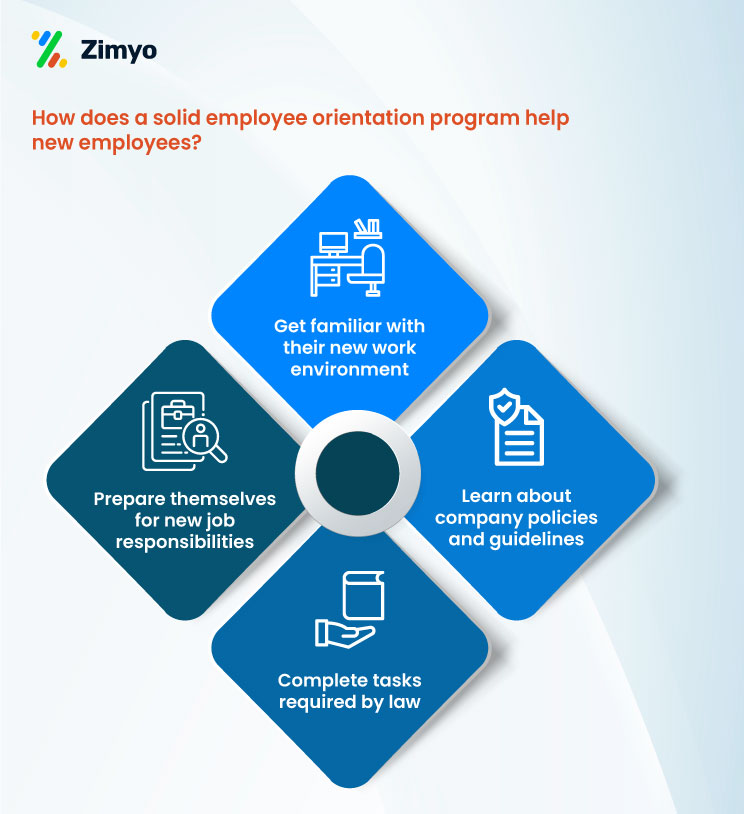
A strong Employee Orientation Program isn’t just “nice to have”—it’s a game changer for:
- First impressions: It sets the tone for the employee’s entire journey.
- Retention: Employees who go through proper orientation program samples are more likely to stay long-term.
- Productivity: With the right information early on, employees become effective faster.
- Culture fit: They quickly understand the values, mission, and work style of the organization.
Types of Employee Orientation Programs
Not every Employee Orientation Program looks the same. Different companies follow different approaches depending on their size, work style, and how they manage their employee onboarding process.
Here are some common types you’ll usually see:
- Formal Orientation – This is more structured. It often includes planned sessions, presentations, and sometimes a checklist as part of the employee onboarding program.
- Informal Orientation – A more relaxed approach where things are explained through casual conversations, team interactions, or even during day-to-day work.
- On-the-Job Orientation – In this case, employees learn while actually doing their tasks. It’s quite common in roles where practical understanding matters more.
- Online Orientation – This happens mostly in remote or hybrid setups. Companies use virtual sessions or shared documents, like a basic guide or a new employee orientation program sample PDF, to help new hires get started.
In reality, many companies mix these approaches to improve the overall onboarding experience for new employees, rather than sticking to just one method.
Key Elements of an Effective Employee Orientation Program
When creating an Employee Orientation Program, it’s important to design it in a way that makes new hires feel welcome, informed, and confident in their roles. Whether you’re working on an orientation program for new employees or looking at a new employee orientation program sample PDF for inspiration, these are the must-have elements that ensure a smooth new hire orientation process.
1. Welcome and Introductions
The very first step of an Employee Orientation Program is a warm welcome. This can include a personal greeting from the manager, a short speech from company leaders, and icebreaker activities to make new hires feel comfortable. In any orientation program sample, you’ll notice that the introduction phase sets the tone for the entire day. This is also the time to introduce the orientation program for new employee sample schedule so they know what to expect.
2. Company History, Mission, and Values
A well-structured new hire orientation process always includes a session on the company’s background. This covers how the company started, its mission, vision, and values. Reviewing the company’s story helps new hires connect emotionally and understand the “why” behind their work. Many orientation program for new employees examples, including a new employee orientation program sample PDF, dedicate at least 30 minutes to this section.
3. Policies and Compliance Training
Every Employee Orientation Program must include policies and compliance training. This ensures employees know the rules, workplace ethics, and legal requirements they must follow. This could cover workplace safety, anti-harassment guidelines, data security policies, and other essential compliance topics. A good orientation program for new employee sample will have clear documentation or handbooks to accompany this section.
4. Job-Specific Training and Resources
While general information is important, a strong orientation program for new employees also focuses on role-specific training. This includes providing manuals, workflow guides, and any new employee orientation program sample PDF that is tailored to the job. This step is where the new hire orientation process becomes more personalized, ensuring employees have the tools and knowledge to start contributing quickly.
5. Technology and Tools Setup
No Employee Orientation Program is complete without setting up the tools and technology employees will use daily. This might include email accounts, software logins, project management tools, or specialized industry applications. A good orientation program sample will have IT support on standby during this stage to help with troubleshooting.
6. Workplace Tour or Virtual Tour
In a physical setting, a tour of the workplace is an essential part of the new hire orientation process. In remote or hybrid setups, a virtual tour can be offered instead. This helps new hires become familiar with their work environment, facilities, and resources. In most orientation program for new employee sample guides, this activity is scheduled after the welcome session to help employees settle in quickly.
7. Meet-the-Team Activities
A great Employee Orientation Program ends the day with team integration activities. These might include group lunches, collaborative games, or short meet-and-greet sessions with each department. Whether in a new employee orientation program sample PDF or a hands-on orientation program for new employees, this part fosters connection and builds a sense of belonging from day one.
Step-by-Step Process to Conduct an Employee Orientation Program
- Step 1: Pre-boarding – Send a welcome email, company handbook, and orientation program for new employee sample.
- Step 2: Day 1 Welcome – Greet the employee warmly, introduce them to the team, and share the new hire orientation process.
- Step 3: Policy & Culture Overview – Cover workplace policies, code of conduct, and cultural values.
- Step 4: Role-Specific Training – Explain job expectations and performance measures.
- Step 5: Technology Setup – Ensure all tools, logins, and devices are ready.
- Step 6: Follow-up – Check in after the first week to answer questions and ensure smooth adaptation.
Learnt the Complete Employee Onboarding Process 2025: A Modern Step-by-Step Guide to Wow New Hires
Essential Components of a Successful Employee Orientation Program
- Engaging Presentations instead of boring policy reading.
- Interactive Sessions to build relationships.
- Clear Documentation, like an orientation program sample for reference.
- Hands-On Guidance for technical tools.
- Feedback Collection to improve future programs.
Best Practices for an Effective Employee Orientation Program
- Personalize the experience for each role.
- Use visuals and storytelling, not just text.
- Include senior leaders to inspire new hires.
- Provide an orientation program for new employees guide in advance.
- Keep it short, engaging, and relevant.
Common Mistakes to Avoid in Employee Orientation
- Overloading with too much information on Day 1.
- Skipping culture-building activities.
- Not following up after orientation.
- Using outdated orientation program samples.
Measuring the Success of an Employee Orientation Program
- Employee feedback surveys
- New hire retention rates
- Time-to-productivity metrics
- Manager feedback on readiness
Get the complete Guide to Automated employee onboarding
Zimyo Employee Onboarding Software: Redefining the New Hire Experience
An effective onboarding process is the first step toward making a new hire feel valued, confident, and ready to perform. Zimyo Employee Onboarding Software takes this critical stage and transforms it into a smooth, automated, and engaging experience for both HR teams and employees.
Instead of drowning in paperwork and endless manual tasks, HR professionals can rely on Zimyo’s platform to create customized onboarding workflows that are quick to set up and easy to manage. From sending pre-boarding welcome emails to sharing the company handbook and orientation program for new employee sample, every step is thoughtfully designed to save time and improve efficiency.
Key Features That Make Zimyo Stand Out
- Automated Onboarding Workflows – Define your process once, and let the software execute it seamlessly for every new hire.
- Digital Documentation & E-Signatures – Upload, share, and collect important documents without printing a single page.
- Pre-Onboarding & Welcome Kits – Engage employees before Day 1 with personalized welcome messages, videos, and resources.
- Background Verification (BGV) – Ensure smooth compliance with integrated verification services.
- Customizable Checklists – Include role-specific tasks and resources, so no detail is missed.
- Analytics & Reporting – Track onboarding progress, identify bottlenecks, and measure the impact of your efforts.
How is Zimyo Beneficial for Businesses?
According to a study by SHRM, effective onboarding can improve new hire retention by 82% and productivity by 70%. Zimyo’s solution aligns perfectly with this by enabling:
- Faster Ramp-Up Time – Employees get the tools, training, and clarity they need from day one.
- Higher Engagement & Morale – A warm, well-organized start helps employees feel like part of the team instantly.
- Reduced HR Workload – Automation frees up HR teams to focus on culture-building rather than chasing forms and follow-ups.
With Zimyo Employee Onboarding Software, companies can set the tone for long-term loyalty, productivity, and employee satisfaction; while ensuring every step of the new hire orientation process is consistent, compliant, and memorable.
Understand the 7 Steps to Creating a Virtual Onboarding Program
Conclusion
A well-planned Employee Orientation Program is not just something extra, it often becomes an important part of how new employees settle in. When the employee onboarding process starts on the right note, people tend to feel more comfortable, understand their role better, and adjust faster.
Even a simple new employee orientation can improve the overall onboarding experience for new employees, especially when it’s clear and not rushed. Over time, this also helps teams stay more stable and reduces early drop-offs. Many companies now look at their employee onboarding program as something worth improving rather than just completing.
For HR teams, it doesn’t always have to be complex. Starting early, keeping things simple, and following a few employee orientation best practices can make a difference. Some HR platforms, like Zimyo, also include features that support onboarding and orientation, which can make it easier to manage everything in one place.
If you want to explore this further, you can also read HR software blogs for more details. In the end, a clear and practical onboarding program for employees usually leads to better engagement and a smoother start for new hires.
Frequently Asked Questions (FAQs)
What is an employee orientation program?
An employee orientation program is a structured process to welcome and guide new hires into the organization, providing them with tools, resources, and information to succeed.
How to prepare an orientation program?
Plan the schedule, gather resources, create a new employee orientation program sample pdf, involve key team members, and ensure all logistics are ready.
What is the main purpose of orientation?
The main purpose is to help new employees adjust quickly, understand company policies, and feel comfortable in their new workplace.
What is the difference between training and orientation?
Orientation introduces the company and job, while training develops the specific skills needed to perform the role effectively.