

You have probably seen the word tentative used in a job offer email, a meeting invite, or a project timeline. But what does it actually mean, and how does it work specifically in an HR and workplace context?
This glossary explains the meaning of tentative clearly and completely: its definition, synonyms, how it differs from similar words like provisional and conditional, and how it is used across hiring, scheduling, agreements, and performance management.
What Does Tentative Mean?
Tentative means not yet confirmed, finalised, or certain. When something is described as tentative, it is subject to change depending on further review, approvals, or conditions being met. It signals intent without commitment.
The word is used across professional and everyday contexts to describe plans, offers, schedules, decisions, or agreements that are still in progress and have not yet been made official.
Quick definition: Tentative = not yet final. It expresses that something is planned or intended, but could still change.
Tentative Synonyms
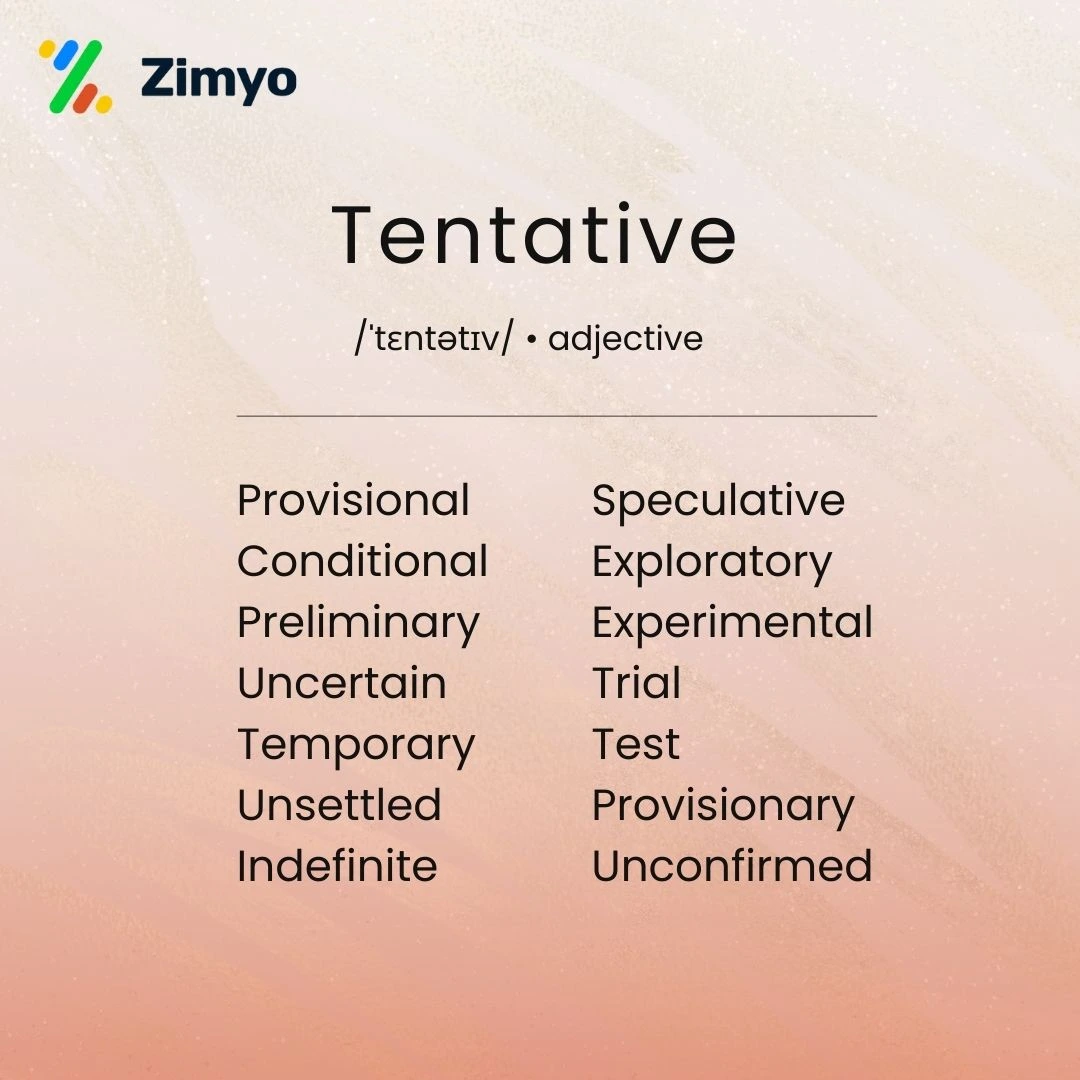
- Provisional – acting as a temporary stand-in until something is confirmed
- Conditional – dependent on a specific condition being satisfied
- Preliminary – at an early stage, before finalisation
- Unconfirmed – not yet officially verified or approved
- Subject to change – may be altered based on new information
- Pending – awaiting further action or decision
- Uncertain – not definitively established
- Exploratory – in the process of being investigated or tested
Tentative vs Provisional vs Conditional: What is the Difference?
These three terms are frequently confused in HR and business writing. Here is a clear comparison:
Aspect | Tentative | Provisional | Conditional |
Meaning | Not yet confirmed; subject to change | Acting in place of something final | Dependent on a specific condition being met |
Status | Uncertain, pending confirmation | Temporary but currently active | Inactive until condition is fulfilled |
Common in HR | Job offers, schedules, agreements | Approval processes, interim roles | Contracts, background checks, probation |
Changes when | Conditions are verified or approval received | Permanent arrangement is established | The stated condition is met or fails |
Example | Tentative job offer pending BGV | Provisional appointment pending board ok | Conditional offer subject to medical test |
Types of Tentative/Temporary Decisions
Temporary decisions come in many forms. Here are a few you might encounter:
Tentative Job Offer:
When a candidate receives a conditional job offer, they know it’s not final until certain conditions meet. Therefore, it becomes official, background checks, reference verification, medical tests, or documentation reviews must be completed.
Provisional Agreements
In union negotiations, an agreement is often preliminary until both sides sign the deal. Also, think of it like a handshake, but still in review. Overall, it serves as a working draft that leads discussions while keeping all aligned.
Project Deadlines
Project managers might speculate about a timeline when they have not fully defined the scope. It gives teams the flexibility to adjust as they get more clarity. Furthermore, the project’s scope becomes clearer, the deadlines can be adjusted accordingly.
Company Policies
Sometimes, a company might introduce a provisionary policy subject to employee feedback and further evaluation. Ultimately, this allows leadership to evaluate real-world impact, gather insight, and make better long-term decisions.
Tentative Plans:
Lorem ipsum dolor sit amet, consectetur adipiscing elit. Ut elit tellus, luctus nec ullamcorper mattis, pulvinar dapibus leo.
How to Handle Experimental Decisions in Business?
While experimental actions or decisions are often necessary, managing them well is key. How do you manage these effectively?
- Communicate Clearly: Always inform others that the decision is temporary and may change. Further, For example, when offering a tentative promotion, let the employee know the final decision depends on certain factors.
- Set Expectations: It’s essential to be transparent about when the final decision will be made. Afterwards, this approach ensures that individuals are not left with uncertain timelines.
- Review Regularly: If the decision is still under trial, keep reviewing it. Additionally, situations evolve, and what was yesterday might need to be confirmed today.
Conclusion
In summary, the word tentative meaning describes actions, decisions, agreements that are not yet final. Whether in HR, business, or personal life, understanding the role of exploratory actions helps you navigate uncertainties. Overall, clear communication and understanding that things are subject to change allow better decision-making and planning.
Therefore, next time you hear the word, you’ll know it refers to something in progress. So, something that could change, improve, or evolve based on further review or new information. Additionally, always keep in mind that actions are required in adapting to challenges. Hence, giving way to flexible approaches in any organization.
Frequently Asked Questions (FAQs)
What is the meaning of tentative?
Tentative meaning refers something that is not yet finalized or confirmed. Also, It reflects uncertainty or a provisional state, often used to describe plans, schedules, or agreements that are subject to change.
How do you use 'tentative' in a sentence?
You can use tentative to express uncertainty or a lack of finality. Further let’s look at an example below-
Example: “The meeting is scheduled for Monday, but the time is tentative.”
What is tentative synonym?
Common tentative synonyms include – provisional, conditional, preliminary, uncertain, experimental, trial, and unconfirmed – all implying something temporary or subject to change.
Is tentative the same as temporary?
Not exactly. While both imply non-permanence, tentative emphasizes uncertainty or being subject to confirmation, whereas temporary focuses more on a limited time frame.
What does 'tentative schedule' mean?
A tentative schedule & tentative time meaning refers to a preliminary timeline that may change. Moreover, it is subject to confirmation and often used when details are still being finalized or explored.
When can i use tentative?
Choose it when to describe something you are unsure or hesitant about. Further can use it in context that includes non decisive result.
What is the tentative period?
A tentative period means a provisional time that has not been finalized or confirmed. Moreover, it means the schedule is still subject to adjustment and might still be changed when pending conditions or approvals are met, prior to its finalization.