
When people think about growing a business in India, government funding rarely comes to mind first. Private investors, bank loans, or bootstrapping tend to dominate conversation. But quietly, consistently, and largely under the radar a structured ecosystem of government-backed MSME schemes has been funding businesses, generating employment, and building enterprises across every state in the country.
India’s MSME sector employs over 34 crore people and contributes nearly a third of the country’s GDP, yet a significant number of these businesses are yet to fully explore the government funding infrastructure built specifically for them. The capital exists. The schemes are live. The subsidies are real. What’s missing, for most, is the knowledge to access them.
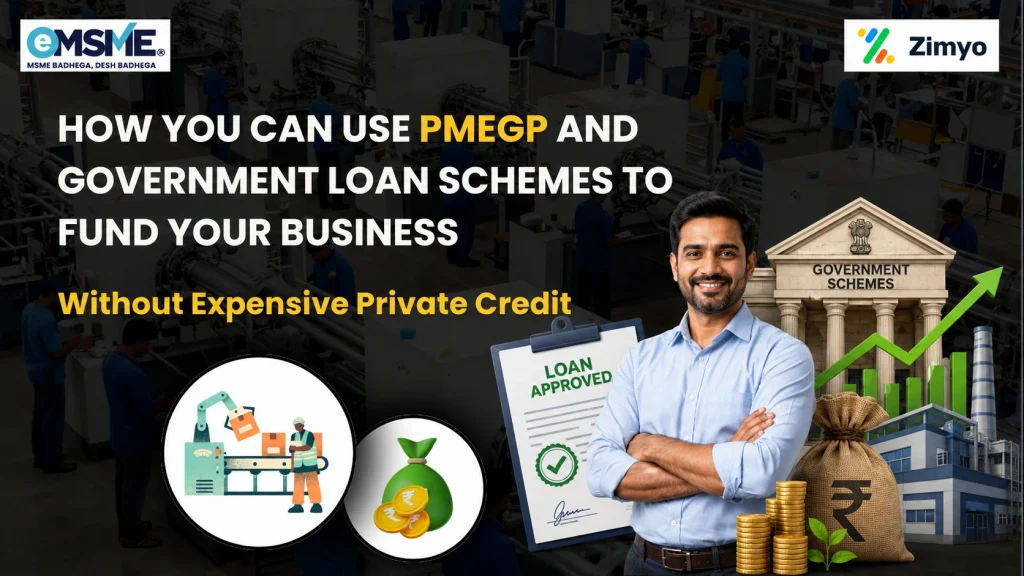
At the centre of this ecosystem is PMEGP, the Prime Minister Employment Generation Programme, one of the most accessible and subsidy-rich government loan schemes available to Indian MSMEs today. This is a breakdown of how it works, who qualifies, and how to actually use it.
What Is PMEGP?
The Prime Minister Employment Generation Programme (PMEGP) is a credit-linked subsidy scheme under the Ministry of Micro, Small and Medium Enterprises, Government of India. Announced on 15th August 2008, it was formed by merging two earlier schemes:
- The Prime Minister’s Rozgar Yojana (PMRY)
- The Rural Employment Generation Programme (REGP)
KVIC, The Khadi and Village Industries Commission is the nodal agency at the national level. At the state and district level, the scheme is implemented through State KVIC Directorates, Khadi and Village Industries Boards (KVIBs), and District Industries Centres (DICs).
The core purpose is straightforward: to generate continuous and sustainable employment opportunities in both rural and urban areas by supporting the setting up of new micro enterprises across manufacturing, services, and trading sectors.
PMEGP Loan Subsidy Details and Benefits: What You Actually Get
Most business loans ask you to repay every rupee you borrow with interest. PMEGP works differently, and that difference is significant.
A portion of your total project cost is covered by the government as a non-repayable grant called Margin Money. It is not a loan. It does not accumulate interest. Once your unit completes three years of satisfactory operation, it gets adjusted against your principal, effectively reducing what you owe the bank. That is free capital, built into the scheme by design.
The percentage you receive depends on who you are and where you are setting up:
Who You Are | Beneficiary Contribution | Urban Area | Rural Area |
General Category | 10% of project cost | 15% of project cost | 25% of project cost |
Women / SC / ST / OBC / Minorities / Ex-Servicemen / Hill & Border areas | 5% of project cost | 25% of project cost | 35% of project cost |
The bank finances the balance; that is, the remaining amount after deducting both your own contribution and the government subsidy.
When it comes to project size, PMEGP gives genuine room to build something substantial:
Sector | Maximum Project Cost |
Manufacturing | ₹50 lakhs |
Service | ₹20 lakhs |
For a business at the right stage, in the right sector, PMEGP is not just a loan; it is a head start.
PMEGP Loan Eligibility: Who Can Apply?
PMEGP is open to any individual above 18 years of age, with no income ceiling. Whether you are a first-time entrepreneur or someone looking to set up a new venture, the basic eligibility bar is deliberately kept accessible.
The scheme covers a wide range of applicant type- individuals, Self Help Groups, co-operative societies, and charitable trusts; across manufacturing, service, and select trading sectors in both rural and urban areas.
PMEGP serves a wide spectrum of MSMEs across sectors and geographies. If your business falls under any of the following, it is worth exploring whether you qualify:
- Manufacturing units of any kind
- Agro and food processing businesses
- Textile, handloom and khadi operations
- Engineering and metal-based industries
- Forest and mineral-based enterprises
- IT and service-based micro businesses
- Rural transport operations
- Select retail and trading outlets
Whether you are in a city or a village, just starting out or formalizing an existing idea, PMEGP is designed to serve businesses at the ground level of India’s economy.
That said, eligibility goes beyond just age and income. There are specific conditions around project type, sector, location, and applicant history that determine whether your business qualifies and getting that assessment right from the start saves significant time down the line.
How To Apply For a PMEGP Scheme Loan?
Before going through the application process, let’s go through the documents required:
- Aadhaar card, PAN card, and proof of age and residence.
- Educational qualification certificate (minimum Class VIII).
- Caste or special category certificate (if applicable).
- Detailed project report covering financials, operations, and employment potential.
- Bank account details for loan disbursal.
Here’s how to apply for a PMEGP loan:
1- Submit the Online Application
The first step is to visit the official PMEGP portal and complete the application form. Applicants must register using Aadhaar-linked credentials and provide personal details, educational qualifications, and the proposed business type.
Along with this, the project profile including cost estimates, employment generation potential, and expected operations needs to be uploaded. Once submitted, the application is forwarded automatically to the District Industries Centre (DIC) or the relevant implementing agency for review.
2- Screening and Training
After submission, applicants are called for an interview or interaction session with the implementing agency. Here, project viability, entrepreneurial intent, and local demand are assessed. Successful applicants must then undergo a mandatory Entrepreneurship Development Programme (EDP), usually lasting two weeks, to gain essential knowledge in business operations, finance, and compliance.
3- Project Evaluation and Sanction
Once training is complete, the project is evaluated jointly by the financing bank and implementing agency. On approval, the loan is sanctioned, and the margin money subsidy is credited after verification. The bank then releases the final disbursement, enabling the entrepreneur to start operations.
CMEGP Loan Details: The State-Level Option Worth Knowing
Several states have introduced their own employment generation schemes that complement PMEGP at the local level. The Chief Minister’s Employment Generation Programme(CMEGP) is the most widely known, operational in Maharashtra state.
CMEGP follows a similar structure to PMEGP, subsidised funding for new micro enterprises but is administered through state government machinery with its own eligibility thresholds and project cost limits. For entrepreneurs who may not meet specific national-level criteria, or whose projects fall within state-defined thresholds, CMEGP can be an equally viable route.
Always check both the national PMEGP scheme details and your state’s equivalent programme. In certain cases, different schemes can be accessed for different project components and understanding both gives you a clearer picture of what funding is actually within reach.
Your Business Deserves Better Than Expensive Credit
Every year, businesses that could have accessed PMEGP end up taking expensive private credit instead, not because the scheme did not work for them but because they never got far enough to find out.
For any business owner who has ever felt that capital was the one thing standing between where they are and where they want to be, PMEGP is worth understanding properly. Not as a backup plan, but as a first move. The subsidy structure is generous, the process is fully digital, and the scheme covers a wider range of businesses and entrepreneurs than most people realise. Getting it right simply takes preparation and the right guidance, both of which are available.
That guidance is available at emsme.com , built specifically for MSME owners who are serious about growing their business the smarter way.
Frequently Asked Questions
What is PMEGP and how does it work?
PMEGP is a central government scheme that funds new micro enterprises through a combination of a government subsidy, a bank loan, and a small contribution from you. The subsidy portion is non-repayable and gets adjusted against your loan after a 3-year lock-in period.
Who is eligible for a PMEGP loan?
Any individual above 18 years with no income ceiling. Only new projects qualify, existing businesses or units that have already availed any government subsidy are not eligible. Only one person per family can apply.
How much subsidy will I get under PMEGP?
Between 15% and 35% of your project cost depending on your category and location. General category gets 15% in urban and 25% in rural areas. Special categories (women, SC/ST, OBC, minorities, ex-servicemen) get 25% urban and 35% rural.
What is the maximum loan amount under PMEGP?
₹50 lakhs for manufacturing and ₹20 lakhs for service or trade businesses. Beyond these limits, banks can still fund the excess but without any government subsidy on that portion.
What businesses are not allowed under PMEGP?
Meat processing, tobacco and intoxicant-related businesses, etc. Also, any activity prohibited by local authorities on environmental or socio-economic grounds. A full negative list is available on the official KVIC portal.