



Ever wondered what CTC salary means? Whether you’re a job seeker, a fresh graduate, or someone looking to understand their paycheck better, it is a term you should know. CTC full form stands for Cost to Company, and it’s a crucial concept in the corporate world. This guide will walk you through what it is, its components, and how it impacts your earnings. So, Let’s understand!
What is CTC Meaning?
CTC meaning refers to Cost to Company, which is the total amount an employer spends on an employee in a year. Annual CTC includes not just the basic salary, but all monetary and non-monetary components that form the complete salary package.
This typically covers basic pay, allowances, bonuses, employer contributions to PF or gratuity, insurance benefits, and other perks. Understanding the CTC full form and meaning helps employees clearly evaluate their overall compensation, differentiate between take-home salary and total benefits, and make informed career and salary decisions.
What is CTC in Salary?
When we talk about cost to company in salary, we are referring to the overall financial commitment a company makes towards an employee annually. This includes:
- Basic Pay
- Allowances
- Bonuses
- Perks and Benefits
Moreover, It’s an all-inclusive figure that reflects the total cost of hiring and retaining an employee. So this comes both in terms of direct salary and additional perks.
What are the Constituents of CTC?
It includes various components, both direct and indirect, that contribute to the overall cost. So, the components typically are:
1. Basic Salary
Firstly, the Basic Salary is the fundamental part of the salary which is usually 35-50% of the Cost to Company.
2. Allowances
There are ample of allowances included in your total CTC. Here’s a list of those allowances:
- House Rent Allowance (HRA): A House Rent Allowance (HRA) is a stipend provided to employees to meet housing rent expenses.
- Dearness Allowance (DA): A Dearness Allowance (DA) is an allowance given to cope with inflation and the cost of living.
- Conveyance Allowance: The Conveyance Allowance is a compensation for travel expenses between home and workplace.
- Medical Allowance: The Medical Allowance is the reimbursement for medical expenses.
- Special Allowances: Any other allowances specified by the employer come under Special Allowances.
3. Bonuses and Incentives
Apart form allowances, various Bonuses, Overtime and Incentives are also included your Cost to company. Thus, here are some of the important ones:
- Performance Bonus: The Performance Bonus is based on individual or company performance.
- Annual Bonus: The Annual Bonus is often a percentage of the annual salary.
- Sales Incentives: The Sales Incentives are for employees in sales roles, based on sales performance.
4. Benefits
These days many organizations are being considerate about their employees and this empathetic behavior has led to contributions for Employee Benefits. However, these are also included in the net CTC. Here are the notable Benefits:
- Health Insurance: A complete Health Insurance coverage is sometimes provided by the employer for medical expenses.
- Life Insurance: Ample of organizations provide Life Insurance coverage in case of their employee’s demise.
- Retirement Benefits: All of the Government organizations and most of the Private firms provide Retirement Benefits contributions to retirement funds like the Employee Provident Fund (EPF) or National Pension Scheme (NPS).
5. Perquisites
Perquisites are non-monetary benefits or allowances provided to employees on top of their basic salary, and they form a part of the Total Cost to Company (CTC). Further, examples include the following:
- Organization-allotted Car: Many big firms provide a vehicle for personal and professional use.
- Accommodation: Several organizations provided housing facility or housing rent reimbursement to their relocated employees.
- Meal Vouchers/Coupons: Huge enterprises give away daily meal and refreshments vouchers/coupons.
6. Gratuity
Additionally a lump sum payment made to an employee at the end of their tenure, provided they have completed a minimum number of years with the company (typically five years in many countries, including India).
7. Provident Fund (PF) Contributions
Both employer and employee contributions to the Provident Fund (PF) government-mandated retirement savings scheme.
8. Leave Travel Allowance (LTA)
Leave Travel Allowance (LTA) is the reimbursement for travel expenses incurred during holidays.
9. Stock Options
This includes offering employees the opportunity to buy the shares of the organization at a later date. Further, the shares are bought at a predetermined price.
10. Education Allowance
This include the reimbursement for the educational expenses of the employees’ children.
Overall, these components can vary based on the company’s policies, the employee’s role, and the country of employment.
Check Out Our Blog to Learn About Employee Benefits in Detail.
What is the Importance of CTC?
Understanding what is cost to company, should be the top priority when considering a job offer. So, CTC in salary helps employees:
- It sets realistic expectations for monthly in-hand salary.
- Allows you to negotiate job offers wisely.
- Plan your financial goals without confusion.
Moreover for employers, this gives a comprehensive measure because it includes benefits beyond direct salary.
Categorization of the Components of Cost to company
1. Direct Benefits
Direct benefits in CTC include your basic salary, house rent allowance (HRA), and other cash components that you receive monthly. However, these are the amounts that are directly credited to your bank account and form a significant part of your cost to company.
2. Indirect Benefits
Indirect benefits are non-cash components included . Moreover, these can be health insurance, company car, meal coupons, and any other perks provided by the employer. Although you don’t receive these benefits in cash, they add substantial value to your overall compensation.
3. Saving Contributions
Savings contributions are another critical part. Also, this includes contributions to your provident fund (PF), gratuity, and other retirement benefits. Overall, these contributions might not be immediately available to you, but they ensure long-term financial security.
How to Calculate CTC?
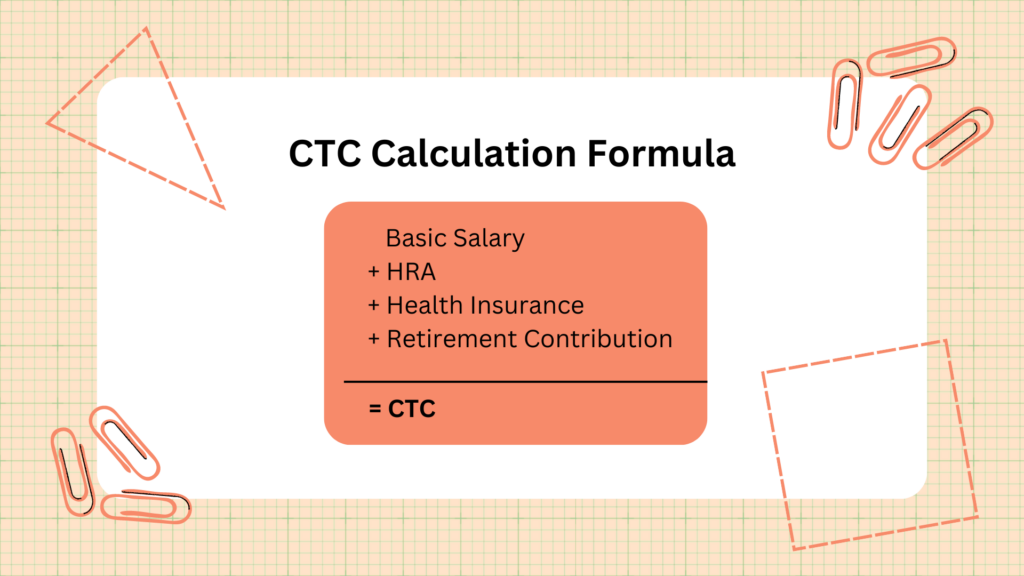
Calculating Cost to company CTC salary means can seem daunting, but it’s quite straightforward once you understand the components. Further, Add your basic salary, allowances, bonuses, and indirect benefits to get your total cost to company.
CTC Calculation Formula
An Example of CTC Calculation
Let’s say your basic salary is ₹3,200,000 per year. Further, you receive a house rent allowance (HRA) of ₹800,000, health insurance worth ₹240,000, and a retirement contribution of ₹400,000. Your CTC would be:
CTC = Basic Salary + HRA + Health Insurance + Retirement Contribution
CTC = ₹3,200,000 + ₹800,000 + ₹240,000 + ₹400,000 = ₹4,640,000
Know Your Salary & its Components with a Salary Calculator
A salary calculator can be a handy tool to understand your Cost to company better. Also, by entering your salary components, you can get a detailed breakdown of your CTC salary means, helping you understand what each component contributes to your overall compensation.
Now-a-days, a diverse range of salary calculators are available. Overall, to name a few prominent ones; take-home salary calculators and income tax calculators are mostly used.
Use Our In-Hand Salary Calculator to Know Your Monthly Salary.
What is Difference in CTC vs Gross Salary vs In Hand Salary
Here’s a quick comparison between CTC, Gross Salary and In Hand Salary through a tabular representation:
|
Parameter |
CTC (Cost to Company) |
Gross Salary |
In Hand Salary |
|
Definition |
Defined as the total annual cost a company spends on an employee |
Salary before deductions, excluding employer benefits |
Amount credited to your bank account after deductions |
|
Includes |
Basic + Allowances + Bonus + Employer Contributions + Perks |
Basic + Allowances |
Basic + Allowances – Deductions |
|
Excludes |
Nothing – includes all costs |
Employer contributions (PF, gratuity, insurance) |
Tax, PF, Professional Tax, other deductions |
|
Value |
Highest |
Lower than CTC |
Lowest |
|
Purpose |
Shows overall cost to employer |
Shows pre-deduction salary |
Shows actual monthly income |
Conclusion
Understanding CTC salary means is crucial for every professional. It gives you a broad view of what you’re truly earning and helps you make informed financial decisions. Overall, by knowing the components, you can better negotiate your salary and benefits, ensuring you get the most out of your employment package. So, the next time you see the term, you’ll know exactly what it entails and how it affects your overall compensation.
Frequently Asked Questions (FAQs)
What is the CTC for 18,000 salary?
CTC for ₹18,000 salary normally comprises basic pay, HRA, PF, gratuity, allowances, and employer contributions. Overall, your in-hand salary will be lower than ₹18,000 after statutory deductions.
What is the CTC salary?
Cost to Company or CTC meaning refers to the total expense a company incurs on an employee annually. Moreover, it contains salary, benefits, bonuses, employer contributions, and statutory components.
What does 25k CTC mean?
25k CTC means the total cost incurred by the employer is ₹25,000 per month. Therefore, Net take-home after PF, TDS (if applicable), and other deductions would be lower.
What is CTC for 40,000 salary?
Cost to company for ₹40,000 salary is an abbreviation for the complete compensation package comprising gross pay and employer-paid benefits. So, Your in-hand salary will be lower, depending upon PF, gratuity, and other statutory deductions.
Is a high CTC always better?
Not necessarily, since some firms artificially inflate by adding benefits one may never actually get in cash. Overall, what is more important is actual in-hand salary + real usable benefits, and not only Cost to company.