

Organization Meaning
Organization meaning basically is a group of people who come together to work for a common goal in an arranged and planned way. In the simplest words, it means people working together in a proper system to get something done.
Organization Definition
Following is the Official Organzation Definition:
An organization is a structured group of individuals working together in a coordinated way to achieve shared goals. It operates within defined systems, processes, roles, and authority levels to deliver products, services, or social value. Organizational firms can be small or large, formal or informal, local or global.
Organization Synonyms
Following are some of the most commonly and interchangeably used Organization Synonyms:
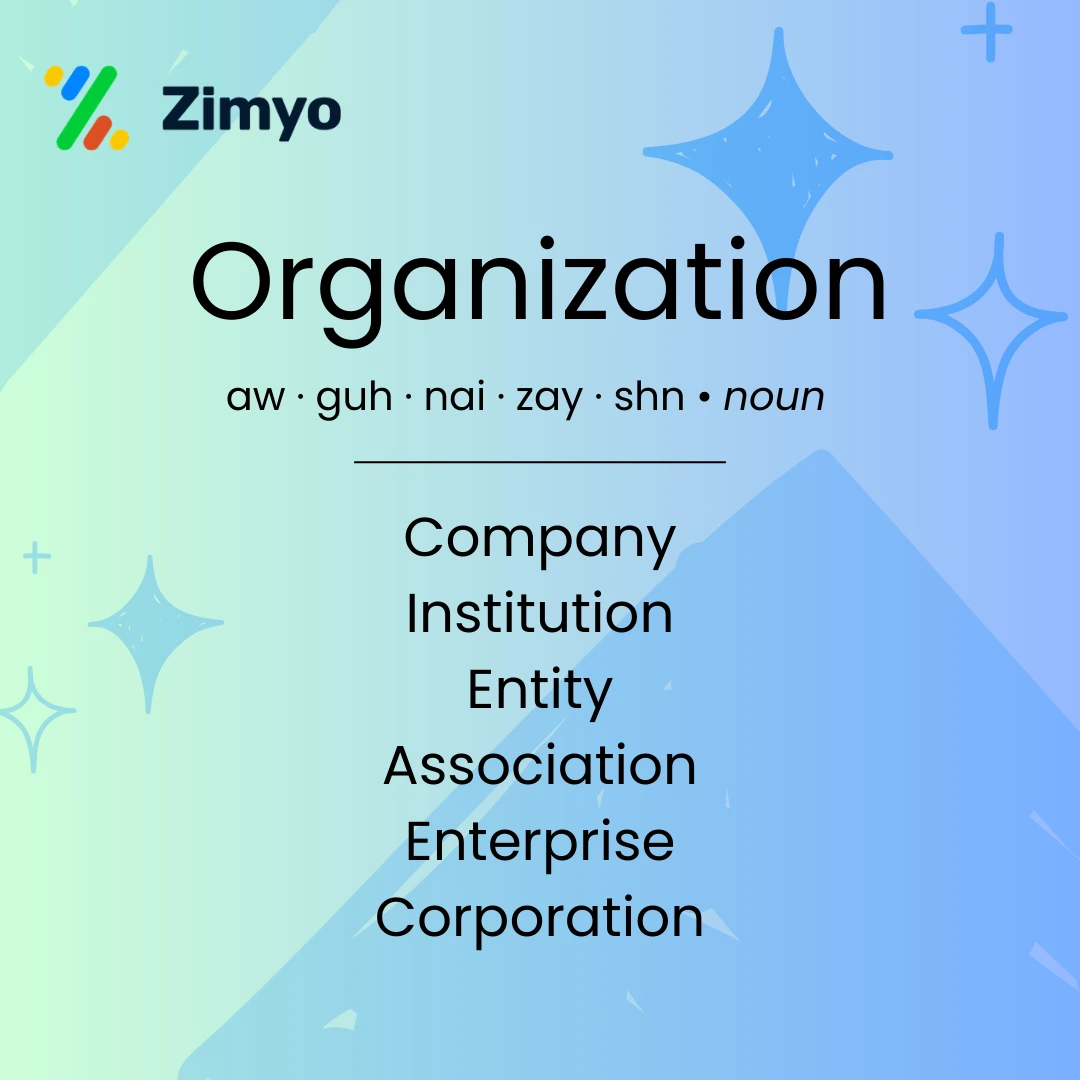
Now that you’ve learnt Organization Synonyms, we’ll be using them interchangeably in the rest of our content.
Key Characteristics of a Corporation
Common Purpose: Established to achieve specific goals or missions.
Structured Roles: Defined hierarchy, job responsibilities, and reporting relationships.
Coordination of Activities: Tasks and processes are aligned to ensure efficiency and productivity.
Resource Management: Utilizes human, financial, technological, and physical resources.
Continuity: Designed to function beyond the involvement of individual members.
Types of Organizations
| Type of Organization | Primary Purpose | How It Operates | Examples |
|---|---|---|---|
| Business | To earn profit and grow financially | Sells products or services to customers and reinvests revenue for expansion | Corporations, Partnerships, Sole Proprietorships |
| Nonprofit | To serve a social, educational, religious, or charitable cause | Uses donations, grants, or funding to support a mission instead of distributing profits | Charities, NGOs, Trusts, Foundations |
| Government | To provide public services and maintain law and order | Funded by taxes and public revenue; operates under legal and constitutional frameworks | Ministries, Public Departments, Municipal Corporations |
| International | To address global issues across countries | Formed by multiple nations or global stakeholders to solve worldwide challenges | United Nations, World Bank, International Monetary Fund |
Relevance in HR and Management
In human resource management, an institution defines the framework within which recruitment, performance management, payroll, compliance, and employee engagement processes function. Organizational structure and culture significantly influence employee behavior, productivity, and overall business performance.
Organization Structure and Hierarchy
Organizational structure defines how tasks are divided, coordinated, and supervised. Hierarchy refers to the chain of command within an association.
Common Structures:
Functional Structure: Divided by departments such as HR, Finance, Marketing, and Operations.
Divisional Structure: Organized by product, geography, or market segment.
Matrix Structure: Combines functional and divisional reporting.
Flat Structure: Fewer management levels, faster decision making.
Hierarchical Structure: Clear chain of command or approval chain from top management to entry-level employees.
A well-defined structure or hierarchy of needs ensures clarity in reporting relationships, accountability, and workflow efficiency.
Simplify Organizational Structure with Zimyo
Create and manage your company hierarchy with ease using Zimyo’s Employee Management System. Build dynamic org structures, define roles and permissions, and visualize reporting relationships with interactive organizational charts.
Purpose and Mission
Every institution exists for a reason.
Purpose: The fundamental reason for existence.
Mission: A clear statement of what the corporation aims to achieve.
Vision: The long-term aspiration or future goal.
Purpose drives strategy. While a Mission Statement guides daily operations. Vision inspires stakeholders.
Functions of an Organization
A company performs essential functions to operate effectively:
- Planning: Setting goals and determining strategies.
Organizing: Allocating resources and assigning responsibilities.
Leading: Directing and motivating employees.
Controlling: Monitoring performance and ensuring targets are met.
Resource Management: Managing finances, people, and assets.
Communication: Facilitating internal and external information flow.
Importance of Company Culture
Company culture refers to shared values, beliefs, attitudes, and behaviors within a workplace.
Influences employee engagement and morale.
Impacts productivity and retention.
Shapes leadership style and decision making.
Strengthens brand identity and employer reputation.
A strong company culture aligns employees with business objectives.
Evolution of Organizations
Organizations have evolved significantly over time:
- Traditional Era: Rigid hierarchies and centralized control.
Industrial Era: Departmental structures and mass production.
Modern Era: Digital transformation, remote work, agile frameworks.
Contemporary Era: Employee-centric models, AI-driven systems, flexible and hybrid structures.
Technology and globalization continue to reshape organizational models.
What is an organization?
An organization is a structured, purposeful entity where people, processes, and resources are brought together to achieve specific common goals. These entities operate within a defined framework of roles, hierarchies, and rules, ranging from businesses and non-profits to government agencies, facilitating coordination and efficient task accomplishment.
Is every company an organization?
Yes. Every company is a type of organization, but not every organization is a company.
What is company culure?
Company culture is the shared set of values, beliefs, attitudes, and behaviors that define an organization’s “personality” and guide how employees interact, work together, and make decisions. It is essentially the “hidden rules” of the workplace, often shaped by leadership and, if aligned with employee values, drives engagement, productivity, and retention.
What are organization synonyms in English?
In English, the term organization encompasses a wide range of synonyms depending on the specific context of its use. When referring to a collective of people or a social body, you might use terms like association, institution, society, federation, league, alliance, coalition, or body. In a business or professional setting, appropriate alternatives include company, corporation, firm, enterprise, establishment, syndicate, consortium, or even outfit for more informal situations. Furthermore, if the word is being used to describe the act of arranging or a structural framework, synonyms such as arrangement, structure, system, configuration, methodology, coordination, management, or administration are commonly employed.
Can one person form an organization?
Yes. A sole proprietorship is considered an organization.
What is the difference between an organization and an institution?
An organization is a structured group formed for specific objectives. An institution is an established system or entity with long-term societal recognition.
Why is organizational structure important?
It clarifies roles, improves efficiency, and prevents confusion.
Does size determine whether something is an organization?
No. Even small teams or startups qualify as organizations.
Can organizations exist without hierarchy?
Yes. Some operate with flat or decentralized structures.
What makes an organization successful?
Clear goals, strong leadership, effective communication, adaptable structure, and positive culture.