


What is Human Resource Management?
Human resource management meaning in simple words is the structured and well planned process through which organizations hire, train, manage, support and retain employees. It focuses on improving the performance of people and aligning their goals with the objectives of the business.
When companies ask what is human resource management, the simplest answer is that it is the management of all activities related to people in a workplace.
Studies show that nearly 72% of business leaders believe that strong HRM practices directly improve productivity and revenue.
In modern companies, HRM has become a strategic foundation rather than just an administrative function.
Official Human Resource Management Definition
The official human resource management definition provided by many global institutions states that human resource management is a continuous and formal process of planning, organizing and controlling all employee related activities in order to use human talent in the most effective and productive way.
Many international HR bodies report that HRM contributes nearly 40% to an organization’s long term performance by improving employee output, engagement and compliance.
Objectives of Human Resource Management
The objectives of human resource management revolve around creating a positive and productive workplace. These objectives include hiring the right talent, developing skills, improving employee satisfaction, creating fair policies, enhancing performance, reducing turnover and ensuring compliance.
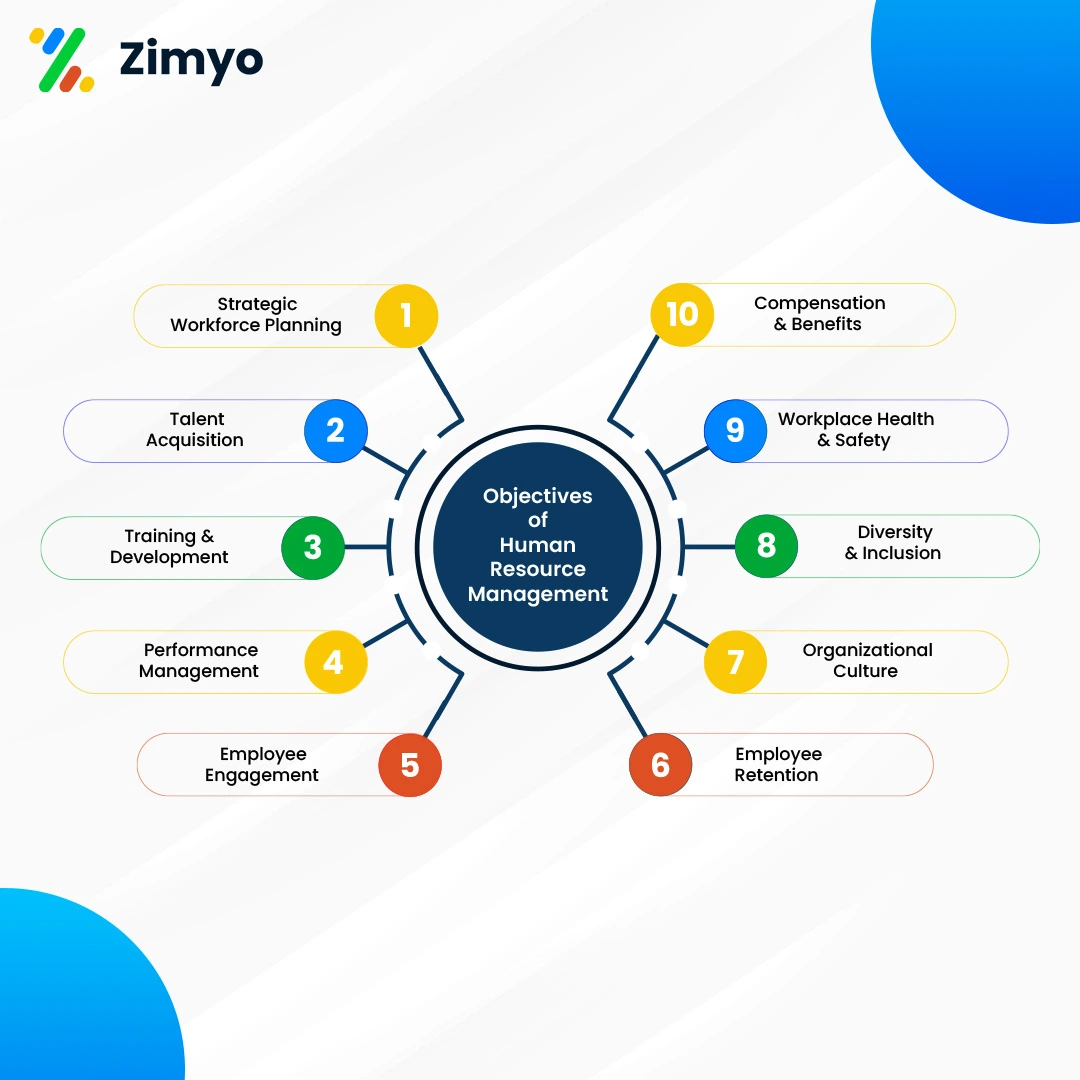
So, the major objectives of Human Resource Management include the following:
1. Workforce Planning: Ensuring the right number of employees with the right skills
Workforce planning is one of the most important objectives of human resource management because it ensures the company always has the right number of employees and the right type of talent. This means HRM studies how many people the company needs today and how many people it will need in the future.

HRM also checks what skills are required for each job and whether employees already have those skills or need more training. Workforce planning helps prevent problems like understaffing, overstaffing or mismatched skills, which can slow down business results. By planning ahead, HRM makes sure the company runs smoothly without delays or talent shortages.
2. Learning and Development: Improving employee training programs
Learning and development focuses on building strong training programs that help employees grow in their jobs. HRM identifies skill gaps, understands what employees need to learn and creates training sessions, workshops or online courses to help them improve. This helps employees do their work faster, reduces errors and increases confidence.
Good training programs also keep employees motivated because they feel supported and valued. Many studies show that companies with strong learning and development programs see higher productivity and lower turnover, which makes this a major objective of human resource management.
Explore engaging Web Stories to get tips, how-to’s, and insights into HR Tech.
3. Employee Relations Management: Maintaining healthy employee relations
Employee relations management ensures that the relationship between employees and the company stays positive, respectful and smooth. HRM works to reduce conflicts, handle grievances, maintain open communication and promote teamwork. A healthy work environment makes employees feel safe, comfortable and supported in their workplace.
HRM also builds fair rules, creates policies and communicates them clearly so that employees understand what is expected. When there is trust and transparency between employees and the organization, the workplace becomes more stable and productive. Strong employee relations also reduce turnover and absenteeism.
4. Compensation Management: Creating transparent reward systems
Compensation management deals with designing fair and clear systems for salaries, bonuses, incentives and promotions. HRM studies market trends, job roles, employee skills and performance levels to create reward structures that motivate employees. Transparency is important because employees want to know how their pay is decided and what they need to do to grow.
When reward systems are fair and open, employees feel valued and motivated to perform better. Compensation management also helps the company stay competitive in the job market because attractive salary and benefits can help attract talented employees and reduce hiring costs.
5. Compliance Management: Ensuring compliance with labor laws
Compliance management ensures that the company follows all government rules related to employees. HRM tracks labor laws, updates company policies and trains managers and employees to follow these rules. This includes laws related to working hours, minimum wages, safety standards, leaves, equal opportunities and workplace rights.
If a company does not follow these laws, it can face legal penalties, fines or damage to its reputation. Compliance management helps prevent such risks and creates a safe and lawful environment for employees. It also builds trust because employees know that the company treats them fairly and legally.
Research shows that companies with clear HRM objectives experience 25% higher retention and 30% lower hiring costs.
6. Strategic HR Planning: Supporting long term organizational growth
Strategic HR planning focuses on aligning HRM practices with the long term goals of the company. HRM studies business plans, market trends and future challenges and then designs people strategies that help the company grow. This includes leadership development, succession planning, skill building, digital transformation and long term workforce planning.
HRM ensures the company has capable and skilled employees who can support future expansion, new projects or changing market conditions. Strategic HR planning turns HRM from a support function into a core part of business strategy because people are the key drivers of growth, innovation and performance.
Summarized Objectives of Human Resource Management:
- Ensuring the right number of employees with the right skills
- Improving employee training programs
- Maintaining healthy employee relations
- Creating transparent reward systems
- Ensuring compliance with labor laws
- Supporting long term organizational growth
What is Strategic Human Resource Management?
Many organizations do not only ask what is human resource management but also what is strategic human resource management. Strategic HRM means linking HR practices with long term business goals. It focuses on forecasting talent needs, building leadership strength, designing future oriented policies and using data based workforce planning.
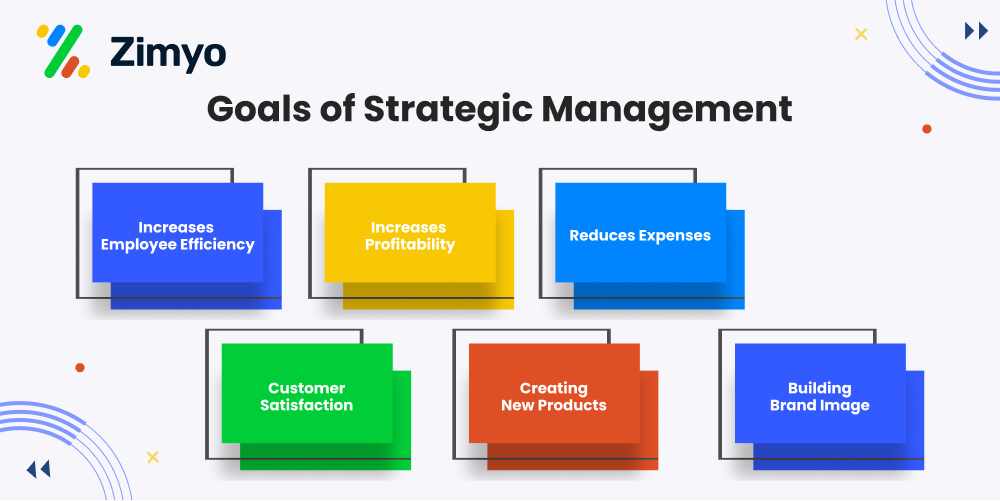
Curious how Strategic Human Resource Management actually works? Read the full blog now for quick insights and real world tips.
Functions of Human Resource Management
The functions of human resource management cover a wide and detailed set of activities that help companies run smoothly. These functions ensure that employees are hired, trained, paid and supported in a structured manner.
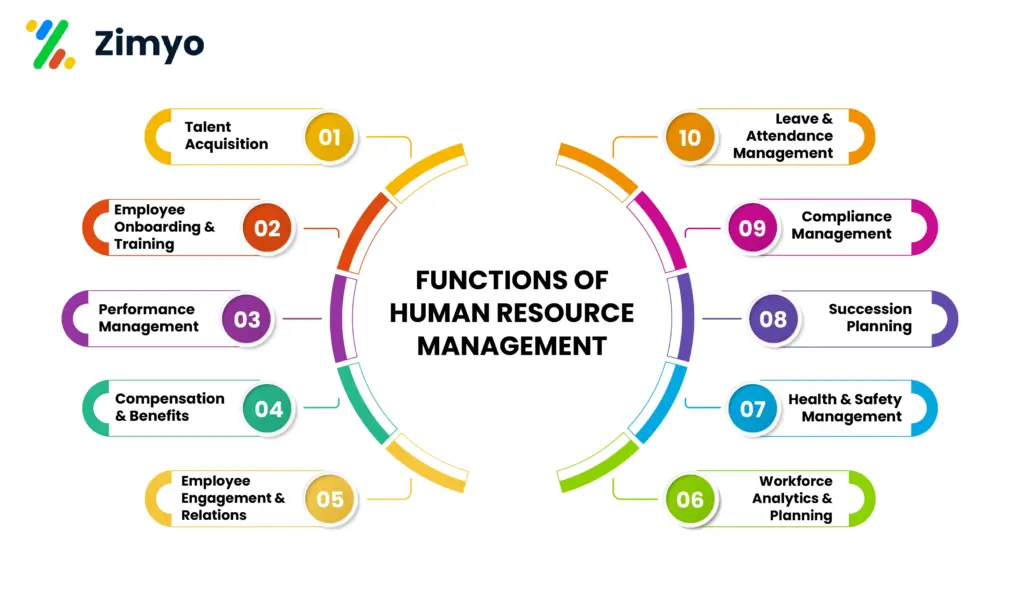
So, the major functions of Human Resource Management include the following:
1. Human Resource Planning: Planning future employee needs
Human resource planning, also called workforce forecasting, is the function where HRM studies how many employees the company needs now and in the future. HRM checks the company’s business goals, upcoming projects, market changes and skill requirements to decide how many people should be hired and what skills they must have.

This helps the company avoid problems like not having enough staff during busy periods or having too many employees when the workload is low. Human resource planning also identifies skill gaps, so HRM can plan training programs or new recruitments accordingly. This function ensures that the company always has the right talent to support growth and stability.
2. Talent Acquisition: Recruiting and selecting the right candidates
Recruitment and selection, also called talent acquisition, is the process of finding and choosing the right candidates for open job roles. HRM creates job descriptions, posts job ads, screens resumes, conducts interviews and selects the best candidates based on their skills and suitability.
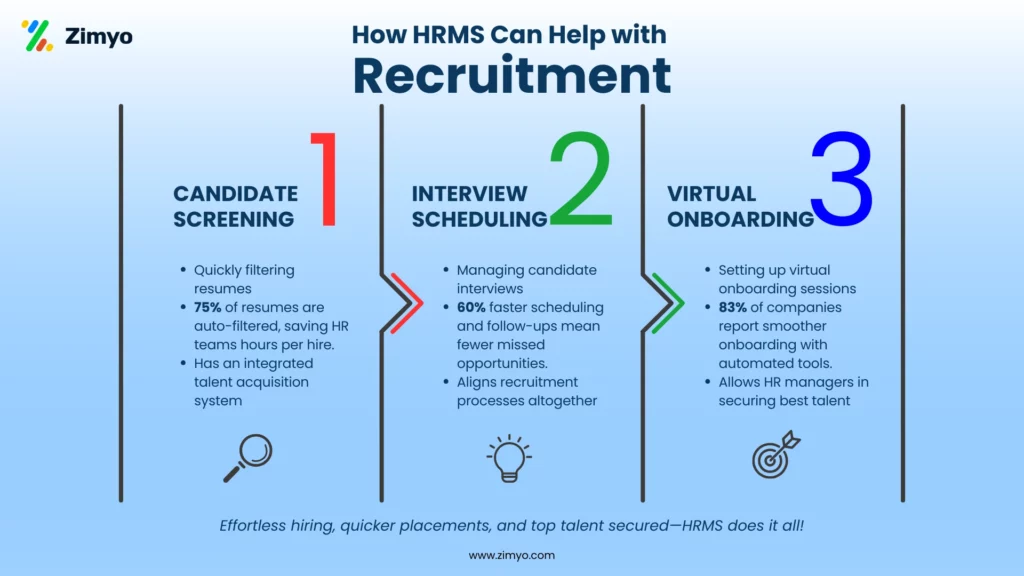
This function is important because hiring the right people directly affects the performance and culture of the company. HRM also ensures that the recruitment process is fair, transparent and aligned with company values. A strong recruitment and selection process helps reduce turnover, improves productivity and builds a skilled workforce.
3. Employee Onboarding: Onboarding and supporting new employees
Employee onboarding, also known as new hire integration, helps new employees adjust to the company smoothly. HRM introduces them to their team, explains company policies, shares job responsibilities and provides the tools they need to start working.
Onboarding also includes training sessions, orientation programs and regular check ins to make new employees feel supported and confident. A well planned onboarding process reduces confusion, builds trust and helps new employees become productive faster. Many studies show that strong onboarding improves retention and reduces early employee turnover.
Research from global business forums shows that companies using strategic HRM practices grow 20 to 25% faster because their workforce is aligned with strategic plans.
4. Skill Building and Learning: Training and developing employees' skills
Training and development is the function where HRM helps employees improve their skills and learn new ones. HRM identifies what skills employees lack and creates learning programs such as workshops, online courses and on the job training. This function helps employees grow in their careers, improve their performance and feel more confident in their roles.
Companies that invest in training and development often see better work quality, higher employee satisfaction and stronger teamwork. This function also prepares employees for future responsibilities and leadership roles.
5. Performance Management: Evaluating and improving employee performance
Performance management is the process where HRM measures how well employees are doing their jobs and helps them improve. HRM sets performance goals, conducts reviews, collects feedback and tracks employee progress. This function ensures that employees understand what is expected from them and how they can perform better.
HRM also identifies employees who need additional support or training. Performance management encourages fairness, transparency and growth. It directly supports business success because employees work better when they receive regular feedback and guidance. Now-a-days, various organizations are going for a Performance Management Software to track and improve employee performance digitally.
6. Compensation and Benefits: Rewarding, recognizing and providing benefits to employee
Compensation and benefits, also known as reward and recognition management, is the function where HRM decides salaries, bonuses, incentives and other employee benefits. HRM studies market data, job roles and skills to ensure employees are paid fairly and competitively. Benefits may include health insurance, paid leaves, allowances and rewards for performance.
A strong compensation and benefits system keeps employees motivated and reduces turnover. HRM also ensures transparency in how rewards are given so employees feel valued and appreciated. This function helps attract skilled talent and build long term employee loyalty.
7. Employee Engagement: Motivating employees for communication and collaboration
Employee engagement, also called workplace motivation management, focuses on keeping employees motivated, connected and satisfied with their work. HRM organizes engagement programs, conducts surveys, creates feedback channels and builds a positive workplace culture. Engaged employees show better performance, stronger teamwork and higher loyalty.

HRM also looks for ways to make employees feel heard, respected and appreciated. High engagement leads to lower absenteeism, fewer conflicts and better overall productivity. This function shows how HRM plays a major role in creating a healthy work environment.
8. Conflict Resolution and Support: Handling employee relations and grievances
Employee relations and grievance handling refers to managing the relationship between employees and the company. HRM ensures that communication is open, problems are solved quickly and employees feel safe sharing their concerns. When conflicts or grievances arise, HRM listens carefully, investigates the issue and provides fair solutions.
Research shows that strong HRM functions can improve employee performance by 40% and reduce general employee issues by 20%.
Conflict Resolution HR function protects employees from unfair treatment and ensures the company follows proper policies. Healthy employee relations reduce workplace stress and create trust. Effective grievance handling ensures employees feel respected and supported at all times.
9. Payroll Management: Administering payroll accurately and processing employee salaries
Payroll administration, also known as salary processing management, includes calculating salaries, deductions, bonuses and ensuring employees are paid accurately and on time. HRM uses HRMS tools, attendance data and company policies to process payroll correctly.
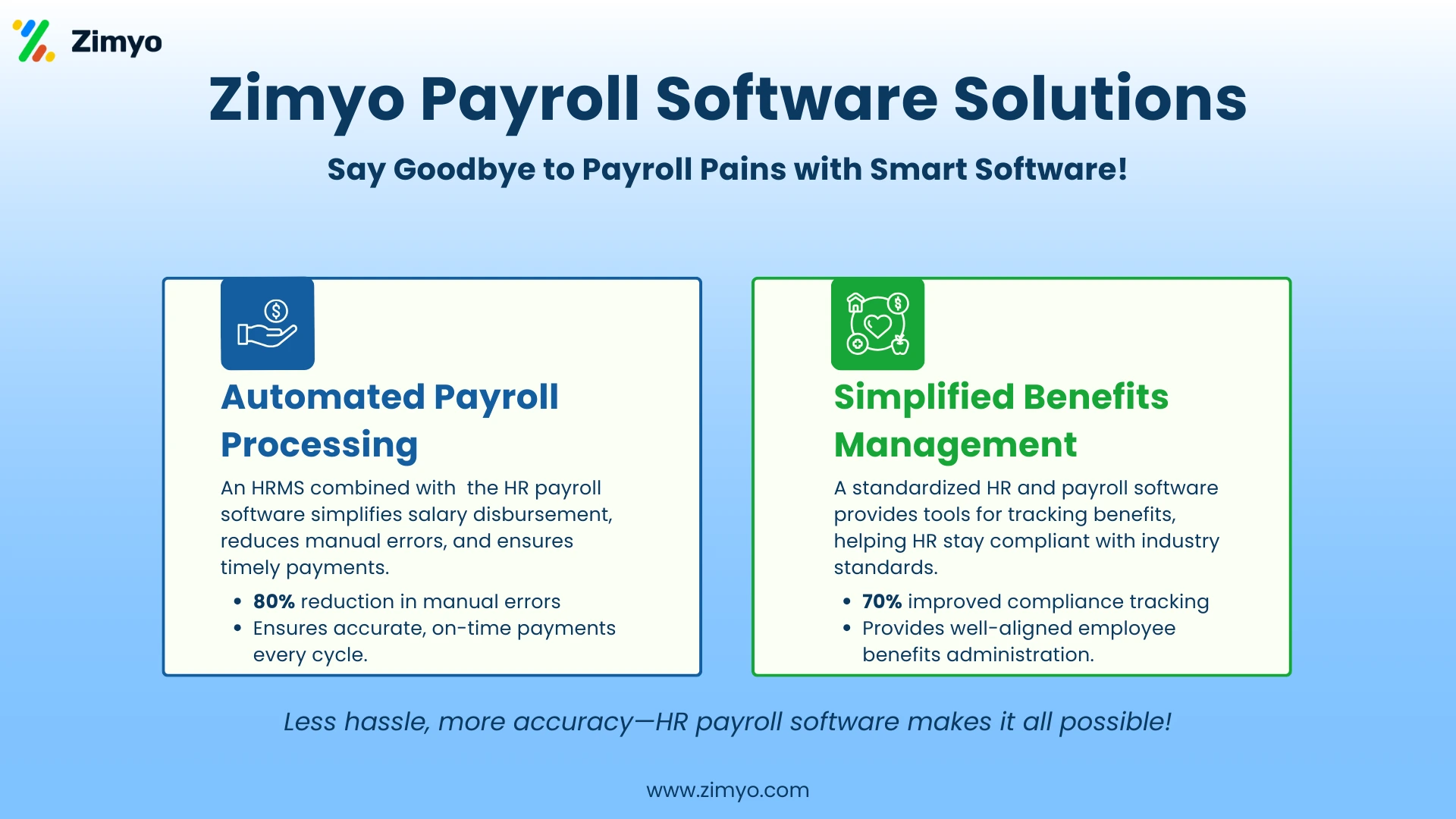
This function is extremely important because payroll mistakes can cause employee dissatisfaction and legal issues. HRM also manages tax filings, payslips, reimbursement claims and records. A strong payroll administration system ensures financial accuracy, trust and compliance. For that matter, numerous organizations are opting for a Payroll Software, which can automate all compensation and salary-related tasks of HR professionals. Thus reducing their manual work burden.
10. Compliance and Safety Management: Overseeing legal and workplace safety
Compliance and safety management ensures the company follows all labor laws and maintains a safe working environment. HRM updates policies according to legal rules, trains employees on workplace safety and conducts audits to check if everything is followed properly.
This includes rules related to working hours, minimum wages, equal opportunities, workplace safety and employee rights. Compliance failures can cause penalties, fines or brand damage, so HRM plays a key role in reducing risks. Safety management also ensures that employees feel secure and protected at work.
11. Employee Offboarding: Managing employee exit processes and providing transition suppport
Exit management, also called offboarding and transition support, handles the process when an employee leaves the company. HRM conducts exit interviews, collects feedback, processes final settlements and ensures the resignation or termination process is smooth. This function also includes returning company assets, removing system access and completing all formalities.
A proper exit management system maintains professionalism and protects the company legally. It also helps HRM understand why employees leave so the company can improve retention strategies. A respectful offboarding process leaves employees with a positive experience even after they leave.
Even more curious about the Functions of Human Resource Management actually works? Read the full blog now for quick insights and real world tips.
Scope of Human Resource Management
The scope of human resource management is very broad and covers every activity related to employees from joining to separation. The scope covers strategic planning, administrative tasks, cultural development, employee motivation, corporate social responsibility, organizational structure, and business continuity planning.
The global HR market has grown to nearly 25 billion USD in 2024 which shows how important the scope of HRM has become for modern industries. The scope also includes analytics and digital transformation because more than 65% of companies use HR analytics tools and HRMS platforms today.
Importance of Human Resource Management
The importance of human resource management has increased as organizations depend strongly on skilled employees. HRM improves workforce productivity, reduces risk, strengthens culture and ensures smooth business operations.
Reasons showing the importance of HRM:
- Companies with strong HRM practices see 2.5 times higher revenue per employee
- Employee engagement increases by nearly 35% when HRM policies are effective
- Workplace conflicts reduce by almost 50% with structured HR support
- Compliance failures decrease significantly when HRM follows proper labor guidelines
The importance of human resource management becomes visible when companies face rapid growth, talent shortages, market instability or technological change.
Even more curious about the Importance of Human Resource Management actually works? Read the full blog now for quick insights and real world tips.
Evolution of Human Resource Management
The evolution of human resource management shows how HRM has moved from a simple administrative role to a highly strategic function. Earlier HR roles were called personnel management and focused mostly on record keeping and payroll. With globalization, digital transformation and workforce diversity, HRM evolved into a data driven and people focused function.
Stages in the evolution of human resource management:
- Early industrial era focused only on hiring and wages
- Mid 1900s saw rise of welfare officers and personnel managers
- Late 1900s introduced performance systems and structured training
- Modern era adopted HRMS, HR analytics and strategic HR planning
- Today HRM is a key contributor to business strategy and leadership development
Nearly 92% of top performing companies use modern HRM practices influenced by this long evolution.
What is a Human Resource Management System?
Many companies also ask what is a human resource management system. A human resource management system is a digital platform that automates HR activities. HRMS helps companies manage payroll, attendance, performance, recruitment and employee records in one centralized system.
HRMS adoption has increased rapidly, with more than 70% of small and mid sized companies now using HR software to improve efficiency by up to 50%.
Key capabilities of HRMS:
- Payroll automation
- Leave and attendance tracking
- Employee database
- Recruitment and onboarding tools
- Training management
- Performance evaluation
- Expense and travel management
HRMS reduces manual work, saves time, improves accuracy and enhances employee experience.
Learn about The Secret to a great HRMS for Improving Employee Experience and guide your self through the intricacies of HRMS tool.
Difference Between Personnel Management and Human Resource Management
The difference between personnel management and human resource management is important because it explains how HR has changed over time.
| Factor | Personnel Management | Human Resource Management |
|---|---|---|
| Primary Focus | Administration and record keeping | Strategic people management |
| Approach | Reactive | Proactive |
| Employee View | Workers as tools or resources | Employees as assets |
| Training | Limited | Continuous and structured |
| Technology Use | Very low | High due to HRMS |
| Role in Strategy | Almost none | Very strong |
| Decision Making | Based on rules | Based on data and analytics |
The difference between personnel management and human resource management clearly shows how HRM became much broader and more strategic.
Human Resource Management Process
The human resource management process is a step by step cycle that handles every activity from staffing to separation. This process ensures that employees are managed in a structured and systematic way.
The Human Resource Management process includes:
- Manpower planning
- Job analysis and job design
- Recruitment and selection
- Employee onboarding
- Training and skill development
- Performance management
- Compensation and benefits management
- Employee engagement and motivation
- Workplace safety and compliance
- Employee relations
- Exit and final settlement
Studies indicate that companies following a structured HRM process achieve up to 35% higher operational efficiency.
Conclusion
Henceforth, Human resource management is the backbone of every successful organization. It helps companies hire the right people, train them well, manage their performance and support long term growth. So, when businesses ask what is human resource management or look for the official human resource management definition, the answer is simple. Precisely, HRM is the complete system that manages people and improves productivity.
Moreover, the functions of human resource management and the scope of human resource management show how HRM supports every part of a company. With the evolution of human resource management and the rise of modern HRMS tools, HRM has become more strategic, data driven and employee focused.
As a result, when companies understand the human resource management meaning and apply strong HRM practices, they build a workplace that is efficient, motivated and ready for future challenges. Strong HRM always leads to stronger business results.
Frequently Asked Questions (FAQs)
What is human resource management?
Human resource management is the process of hiring, training, managing and supporting employees in an organization. It focuses on improving employee performance, creating a positive work environment and aligning people with the goals of the business. In simple words, human resource management deals with all activities related to people in a company, such as recruitment, payroll, training, performance management and compliance. It helps organizations build a skilled, motivated and productive workforce.
how to become a human resource manager
To become a human resource manager, you need the right education, skills and work experience. Most people start by completing a bachelor’s degree in HR, business administration, psychology or a related field. After that, gaining experience through internships or entry level HR roles such as HR assistant, recruiter or HR executive helps build practical knowledge. As you grow, you can develop skills in recruitment, payroll, training, employee relations and HRMS tools. Many professionals also complete HR certifications like SHRM, HRCI or other specialized courses to strengthen their profile. With enough experience and strong people management skills, you can move into HR manager roles in small or large organizations.
what do you mean by human resource management
Human resource management means managing all the people related activities in a company. It includes hiring employees, training them, checking their performance, solving their problems, handling payroll, ensuring compliance and creating a healthy work environment. In simple words, human resource management is the process of helping employees work better and supporting the company in achieving its goals through its people.
Who is the father of HRM?
George Elton Mayo is widely known as the father of HRM. His famous Hawthorne Studies showed how employee emotions, motivation and social factors strongly affect performance. His work laid the foundation for modern human resource management practices used around the world today.
What is the highest salary in HR?
The highest salary in HR is usually earned by senior leadership roles such as Chief Human Resources Officer (CHRO), VP of HR or Head of HR. In large companies and multinational organizations, these roles can offer very high pay because they handle strategy, culture, compliance and large workforce operations. Salaries depend on the country, industry, company size and experience. In big global companies, CHROs can earn extremely high packages that include bonuses, stock options and other benefits. In simple words, the highest salaries in HR go to top level HR leaders who manage the entire HR strategy of the organization.