

In many companies, managers do not judge employee performance only on hard work or targets. Businesses also use different methods to compare overall performance across teams, and one of the most common methods is the Bell Curve in Performance Appraisal.
The bell curve rests on a simple idea: in every group, most people perform at an average level, while only a few fall into the highest or lowest category. Because of this, many organisations use the Bell Curve appraisal method in employee performance evaluations and reviews.
Understanding the Bell Curve meaning, how it works, and where it can help businesses build a better and more balanced performance appraisal system.
What is Bell Curve Meaning?
The Bell Curve meaning shows how data distribution in a group takes place. In most cases, a large number of values stay around the average, while only a few fall on the higher or lower side. Since the graph looks similar to the shape of a bell, it is called the bell curve.
To illustrate, an organization involved in selling can adopt the Bell Curve approach in assessing the performance of its workers in order to place them in various performance categories. The top-performing 10% can get more rewards, while the average-performing 70% can be praised for living up to their expectations. The bottom-performing 20% will be assisted. However, this kind of practice might raise fears about how fair it is to assess employee performance.
Companies often use the Bell Curve in Performance Appraisal to understand employee performance levels. Usually, most employees fall into the average performance category, a smaller group performs exceptionally well, and some employees may perform below expectations.
Because of this, many organizations use the Bell Curve in HR as part of their employee performance evaluation and performance management process. It helps managers compare performance in a more structured and organized way.
Bell Curve Formula
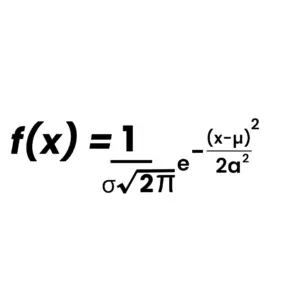
Here:
- f(x) is the value of the probability density function at a particular point x.
- μ (mu) is the mean (average) of the distribution, which is the center of the bell curve.
- σ (sigma) is the standard deviation, which controls the width of the curve. A smaller σ means the curve is narrower, and a larger σ means the curve is wider.
- eis Euler’s number, approximately 2.71828 (the base of the natural logarithm).
- π is the constant pi, approximately 3.14159.
- x is a point on the horizontal axis (where the value of the curve is being calculated).
Two important things help explain how the bell curve works:
- Mean (μ): This is the average value of the data and stays at the center of the curve. In employee performance evaluation, it usually represents the average performance level of a group of employees.
- Standard Deviation (σ): This shows how far the values count start from the average. When the variation is high, the bell curve looks wider because employee performance differs more. When the variation is low, the curve becomes narrower, which means most employees perform around the same level.
In the Bell Curve in HR, these measurements are often used to understand how employee performance complies within a company.
Key Characteristics of Bell Curve in Performance Appraisal
The Bell Curve has a few common characteristics that make it useful in statistics as well as in the Bell Curve in Performance Appraisal process.
- Symmetrical Shape: The bell curve comes on both sides, which means the data spreads evenly around the average value.
- Highest Point at the Center: The peak of the curve stays at the mean or average point. This shows that most employees or data values usually fall in the middle range.
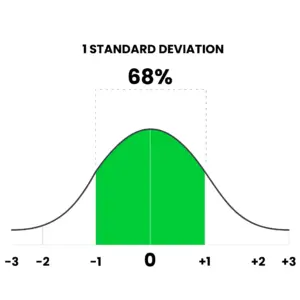
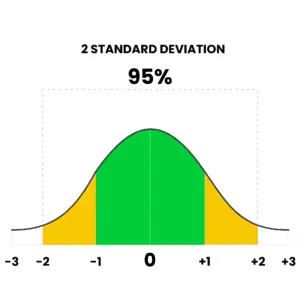
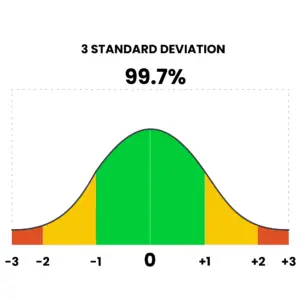
- Standard Distribution Pattern: In a normal bell curve distribution, around 68% of values stay within one standard deviation from the mean, 95% fall within two standard deviations, and nearly 99.7% remain within three standard deviations.
In the Bell shaped Curve in HRMS, these characteristics help organizations group employee performance levels in a more structured way during employee performance evaluation and performance review processes.
Applications of Bell Curve
The Bell Curve is used in different fields to understand how performance or data spreads within a group. It helps people compare average results with higher and lower results in a simple way.
- Education: Schools and colleges use the bell curve while checking exam results and student performance. It helps teachers get an overall idea of how a class has performed.
- Healthcare: In healthcare, the bell curve is for studying patient data and health reports collected from large groups of people.
- Business and HR: Many companies use the Bell Curve in Performance Appraisal during employee reviews. It helps managers understand employee performance levels across teams.
- Finance: In finance, the bell curve helps experts study market risks, stock price changes, and investment trends.
Why is the Bell Curve in Performance Appraisal Used?
In many organizations, the Bell Curve in Performance Appraisal is used to compare employee performance across teams and departments. The idea behind this method is simple not every employee performs at the same level, so companies group employees into different performance categories.
Usually, employees come in categories of top performers, average performers, and employees who may need improvement. This type of Bell Curve appraisal helps managers during employee performance evaluation and makes the performance review process more organized.
Over the years, the bell-shaped curve in HR has become a common part of performance management systems because companies use it to identify high performers, plan rewards, and understand overall workforce performance better.
The Basics of the Bell Curve in Performance Management
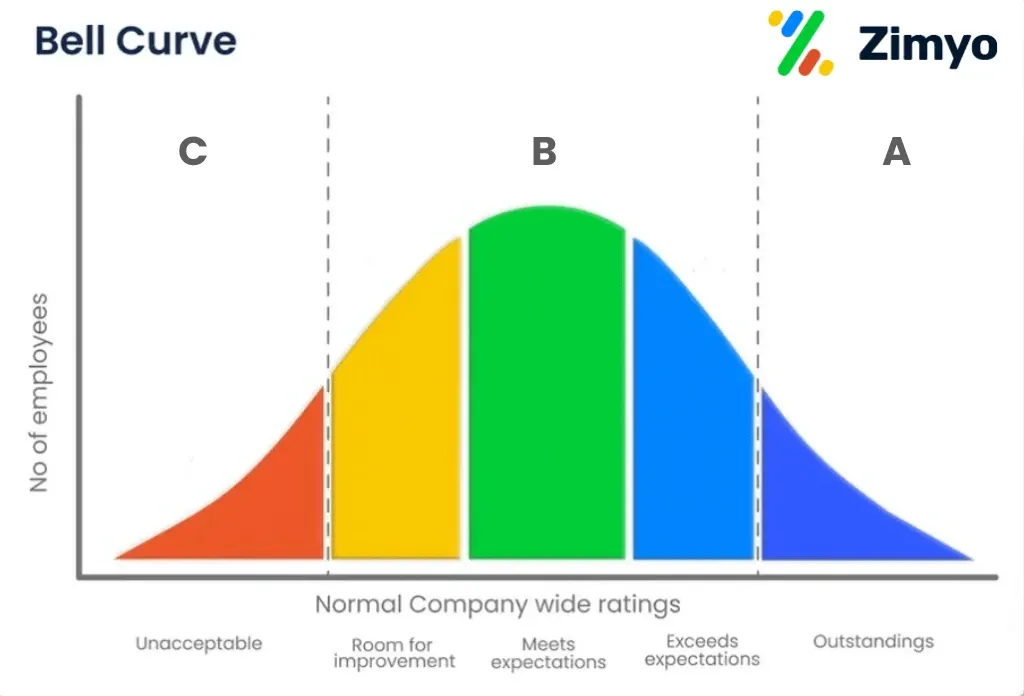
In a typical bell curve HR appraisal system, employee performance is ranked across a range of categories, typically divided into three main groups:
- Top Performers (A): These are the employees who perform at the highest level. They rank in the top 20% of the distribution and often receive promotions, bonuses, or other incentives.
- Average Performers (B): Most employees (usually around 70%) fall into this category. These employees meet expectations and perform well but may not exhibit exceptional achievements.
- Low Performers (C): Employees in the bottom 10-20% are considered low performers. They may require development plans, coaching, or even disciplinary actions.
Benefits of Bell Curve in Performance Appraisal
No performance appraisal method is perfect. The Bell Curve has its own strengths and weaknesses. Let’s explore both.
1. Standardization
The bell curve in appraisals helps standardize evaluations across different departments or teams, making it easier to compare performance fairly.
2. Easy Identification of Top Performers
The Bell Curve makes it easy for managers to identify high performers, helping with reward and retention strategies. For instance, the company can fast-track employees in the top 20% for promotions.
3. Objectivity
It reduces subjectivity in performance ratings and ensures that performance is measured against clear metrics.
4. Balances Manager Bias
If a manager is too strict or too lenient, the Bell Curve forces a balanced evaluation. This keeps performance reviews fairer across the board.
5. Resource Allocation
By categorizing employees into different performance tiers, HR can better allocate resources. For example, on the job training programs can be tailored for low performers, while development plans can be created for future leaders.
Challenges of Appraisal Bell Curve
While organizations widely use the appraisal bell curve distribution, it does face its fair share of criticisms and challenges:
Forced Ranking
One of the biggest drawbacks of using this curve in performance appraisal is that it forces managers to rank employees even if the performance distribution doesn’t fit the curve. This can result in unfair ratings and may demotivate employees.
Discrepancy in Team Performance
In teams that perform exceptionally well as a whole, applying the bell curve can be problematic, as even great employees may fall into the “average” or “low performer” category.
Lack of Flexibility
The rigid structure of the bell curve system may not reflect the true performance of employees, especially in roles where performance isn’t easily quantifiable.
Rigid System
Sometimes, the system’s rigidity means high performers don’t get the recognition they deserve, simply because there are too many high performers for the curve.
Loss of Morale
Employees placed in the lower categories may feel demotivated, even if they are good performers. This can increase turnover costs.
Performance Management Bell Curve Examples
Some large organizations like Infosys, Wipro, and ICICI Bank still use the Bell Curve in Performance Appraisal to assess thousands of employees. These companies rely on the Bell Curve appraisal method to identify top performers and manage reward systems in a structured way.
However, other companies such as Google and Microsoft have moved away from the traditional Bell Curve in HR approach. Instead, they prefer more flexible performance management systems that focus on continuous feedback and individual growth.
The main reason behind this shift is simple many modern workplaces feel that employees should not always into fixed categories. Instead, they should be evaluated based on their individual performance and contribution rather than fitting them into a strict Bell Curve distribution.
Does the Bell Curve Always Work?
Now, let’s ask the hard question: Does this method always work? Not always. While it offers a structured system, it can also be rigid. Here’s why.
Assumptions and Restrictions
- Rigid Pattern: The curve assumes that only a few employees will be high performers, while most will be average. But what happens if your team has higher performers than the curve allows? Managers may have to rank someone lower than they deserve, just to fit the curve.
- Restricted Ranking: Only 10% can be labeled as low performers, even if there are fewer than that. This can create unfair pressure on managers and employees.
Alternatives and Evolving Trends
To address some of the criticisms, companies are increasingly moving towards more flexible performance evaluation methods. Some of these alternatives include:
- Continuous Feedback Systems: Providing employees with ongoing feedback rather than annual performance appraisals.
- 360-Degree Feedback: Gathering input from peers, subordinates, and managers to get a more holistic view of employee performance.
- Employee Development Focus: Shifting the focus from ranking employees to identifying growth opportunities and providing training and support.
Conclusion
Many companies still use the Bell Curve in Performance Appraisal, especially when they want a quick way to understand how employees are performing across a team. It gives a broad picture who’s doing well, who’s steady, and who might need some support.
What matters more is whether the system actually helps employees improve instead of just categorising them. A fair review process should feel practical, transparent, and useful for both employees and managers.
Today, many HR teams also use tools like Zimyo to keep appraisals, performance tracking, and employee data organised in one place, so the process doesn’t become messy or manual.
At the end of the day, whether a company uses the Bell Curve in HR or another system, the real focus should stay the same helping people perform better and creating a healthier work environment overall.
(Frequently Asked Questions) FAQs
What is the Bell Curve in Performance Appraisal?
The Bell Curve meaning in Performance Appraisal is a method used by companies to evaluate employee performance by grouping them into categories like top performers, average performers, and low performers based on a normal distribution pattern.
What are the advantages of the Bell Curve appraisal method?
The Bell Curve appraisal helps companies maintain performance standards, identify top talent, and create a balanced distribution of employee ratings. It can also support better decision-making in compensation and promotions.
What are the disadvantages of the Bell Curve in performance management?
One major drawback is that the Bell Curve in performance management can sometimes force employees into fixed categories even if performance differences are small. This may lead to dissatisfaction or unfair evaluation in some cases.
Is a bell curve good for performance appraisal?
A bell curve performance appraisal can assist an organization to evaluate and measuring the performance of employees in order to find out high performers. But at times, forced ranking may not fairly represent employee performances.
What is the purpose of a bell curve?
The purpose of the bell curve in performance management is to classify the employees depending on their relative levels of performance. Bell curve can be used in making decisions regarding rewards, promotions and development plans.
How to create a bell curve for performance appraisal?
In order to develop a bell curve for performance appraisal one needs to first obtain the ratings of employees, then sort them according to levels of performance, followed by plotting these ratings on a normal distribution graph.