

What is KPI or key performance indicators?
In the modern business landscape, tracking performance is crucial to achieving organizational success. One of the most widely used performance measurement tools is KPI full form Key Performance Indicator). KPIs are positive or negative measurable values that demonstrate how effectively a company achieves its key objectives.
KPIs help organizations track progress, identify areas of improvement, and make informed decisions about where to allocate resources. Commonly used KPIs include measures of profits, costs, productivity, efficiency, quality, customer satisfaction levels, and key performance indicators for employees.
Organizations should carefully select KPIs that align with their strategic objectives and consider the company’s unique circumstances and industry. KPIs should be revisited regularly to ensure they remain relevant and meaningful.
KPI Full Form and Definition
KPI meaning stands for Key Performance Indicator. It is a measurable value that shows how effectively an individual, team, or organization is meeting specific objectives. KPIs help businesses analyze performance and ensure alignment with their goals.
Types of KPI
There are various types of key performance indicators, each serving a different purpose in evaluating success.
- Quantitative KPIs – These are numerical indicators that can be measured directly, such as revenue, profit margins, or sales figures.
- Qualitative KPIs – These involve subjective data, such as customer satisfaction scores or employee engagement levels.
- Leading KPIs – These predict future success, such as the number of new leads generated or employee training hours completed.
- Lagging KPIs – These measure past performance, such as quarterly revenue or total units sold.
- Process KPIs – These assess the efficiency of internal operations, such as production cycle time or the average time taken to resolve customer queries.
- Outcome KPIs – These focus on the end results of business efforts, such as customer retention rates or net promoter scores (NPS)
Benefits of KPIs
KPIs are critical to success because they embody a way of defining success, promote activity to move things forward when there is no way to define success, and establish accountability within groups.
- Clarifies Organizational Performance- Not having KPI full form goals can also determine whether the business is actually being developed or not because KPIs measure performance according to set criteria. For instance, the performance of posting $1,000,000 in revenue every year can mean very little, but compared to the previous performance or against an set goal, the business can determine whether it has improved or not.
- Enables Strategic Decision-making- KPIs point out both the positives and negatives and thus facilitate easier decision-making on the subsequent steps to be taken. For example, a comparison between the revenue increase of sales teams that use different methods will illustrate which approach works better and which approach should be replicated elsewhere.
- Aligns the organization around shared goals- Through the establishment of what success entails, KPIs ensure that the entire organization is working towards a single set of employee goals, as opposed to languishing without goals and succeeding on individual definitions thereof.
- Fosters accountability in teams- KPIs serve as a yardstick for measuring the effectiveness of teams and individuals. Where workers understand the goals set for the organization, for instance, increasing revenues, they can make their own goals essentially consisting of smaller goals associated with the organization’s objectives.
Why are KPIs Important?
Implementing well-defined key performance indicators brings several benefits to an organization:
- Improves Decision-Making – KPI meaning provide data-driven insights that help businesses make informed choices.
- Enhances Performance Tracking – Organizations can measure progress against set goals and make necessary adjustments.
- Aligns Teams with Business Goals – Employees and departments can focus on key objectives that contribute to the company’s success.
- Identifies Areas for Improvement – KPIs highlight weaknesses and help businesses optimize strategies.
- Boosts Accountability – Clear KPIs encourage employees to take responsibility for their contributions.
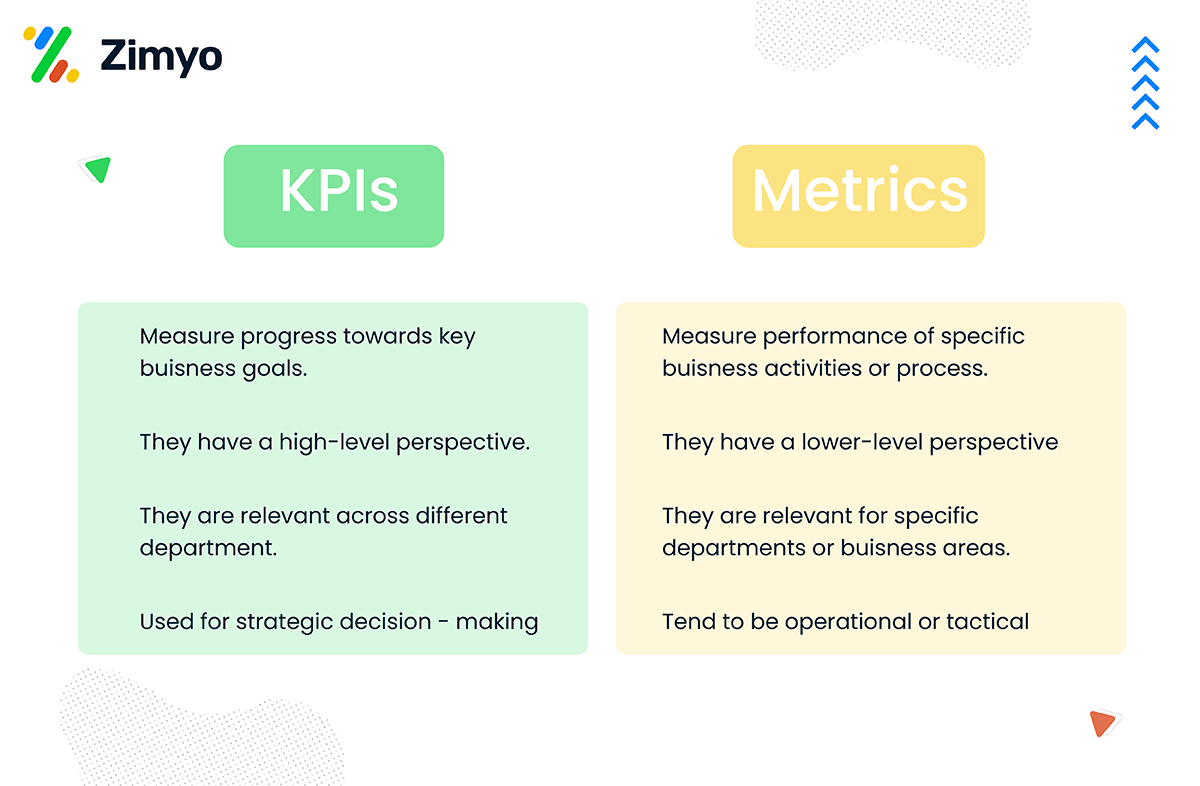
KPIs vs Metrics
Examples of KPI in Different Industries
Marketing KPIs
- Website traffic growth
- Social media engagement rate
- Conversion rate from leads to customers
Sales KPIs
- Monthly revenue growth
- Customer acquisition cost (CAC)
- Sales conversion rate
Customer Service KPIs
- Average response time
- Customer retention rate
- First call resolution (FCR)
HR KPIs
- Employee turnover rate
- Training completion rate
- Employee satisfaction index
How to Set Effective KPIs
To ensure key performance indicators drive success, they should follow the SMART Goal criteria:
- Specific – Clearly defined objectives
- Measurable – Can be tracked with data
- Achievable – Realistic and attainable
- Relevant – Aligns with business goals
- Time-bound – Has a clear deadline for achievement
Conclusion
KPI full form or meaning (Key Performance Indicator) is a vital tool for business performance management. By setting the right key performance indicators, organizations can track progress, optimize operations, and achieve their objectives efficiently. Whether for marketing, sales, HR, or customer service, effective KPIs help drive continuous improvement and long-term success.
FAQs (Frequently Asked Questions)
What is KPI and examples?
A KPI meaning stands for Key Performance Indicator, and it refers to the value measured by the progress towards the achievement of the objective. An example includes sales growth rate, customer satisfaction, and on-time delivery percentage.
What is KPI for an employee?
Employee KPI: This measures the performance of the employee based on work responsibilities and set goals. This KPI full form Key Performance Indicators could include the number of tasks completed, the level of productivity, the quality of work, or the employee’s attendance.
What does the 4 KPIs mean?
The 4 KPIs’ generally relates to a narrow group of four key performance indicators. These generally include financial performance, outputs, internal business processes, or learning or growth.
How is KPI calculated?
A KPI is done using a formula that is related to a measure that aims at something else, like this: actual result ÷ target result × 100. It depends on what is being calculated.
What are the 4 Pillars of KPI?
There are four pillars: Financial, Customer, Internal Process, and Learning & Growth. These allow performance to be measured from a variety of business perspectives.
What are the three types of KPIs?
There are three main categories that include Strategic, Tactical, and Operational KPIs. They measure long-term plans, departmental, and day-to-day activities, respectively.