
It doesn’t matter which platform you choose: they all look the same on a feature checklist. All of them do goals, reviews, feedback, and dashboards. The factors that make a deployment successful – where managers complete review cycles without having to chase them down, where performance information gets into compensation, where performance information survives the next staff increase – aren’t even listed on the checklist.
This comparison will include twelve platforms, what each one is actually good for, and where each is the wrong tool for you. It will also include the factors no other buyer guide considers – total cost after implementation, integration capability, and why so many deployments fail for reasons unrelated to features.
If you’re comparing, the table below reduces twelve down to three in sixty seconds flat. If you’re at an earlier stage, begin with the tools vs. methods section, which outlines the frameworks behind the software.
13 Best Performance Management Tools At a Glance
The best performance management software depends on company size and what you are trying to fix. Lattice and Leapsome suit mid-market teams building a full program. Zimyo, Keka, and Darwinbox lead in India and APAC. Workday and SAP SuccessFactors serve global enterprises. BambooHR and PerformYard fit teams wanting less, not more.
| Tool | Best for | Pricing model | G2 rating |
|---|---|---|---|
| Zimyo | India and APAC teams wanting HR, payroll and performance in one system | Published tiers, per employee | 4.5 |
| Lattice | Mid-market people teams building a full performance program | Per user, per month, modular | 4.7 |
| 15Five | Teams replacing annual reviews with weekly check-ins | Per user, per month, tiered | 4.6 |
| Eletive | Organizations wanting employee engagement, performance management, goals, and people analytics in one platform | Custom, quote-based pricing across Essential, Standard, and Professional tiers | 4.5 |
| Leapsome | Companies linking performance to learning and development | Per user, per month, modular | 4.8 |
| Culture Amp | Engagement-led organizations measuring culture and performance together | Quote-based, banded by headcount | 4.5 |
| BambooHR | Small teams needing light performance inside a simple HRIS | Per employee, per month | 4.4 |
| Keka | Indian mid-market wanting polished UX with payroll | Published tiers, flat then per employee | 4.5 |
| Darwinbox | Large APAC enterprises with complex org structures | Quote-based, enterprise | 4.4 |
| Engagedly | Teams combining performance, recognition and learning | Per user, per month, modular | 4.3 |
| SAP SuccessFactors | Global enterprises with multi-country compliance needs | Quote-based, enterprise | 4.1 |
| Workday | Enterprises already running Workday HCM | Quote-based, enterprise | 4.1 |
| PerformYard | Organizations wanting review cycles run well and little else | Per user, per month | 4.7 |
How We Evaluated These Tools
All twelve were assessed against five criteria, weighted toward what determines whether the review process actually runs rather than whether it demos well. These are the most critical features to test.
- Cycle administration. How much manual chasing a full review process takes, and whether reminders and approvals are automated.
- Manager adoption. Whether the day-to-day employee experience is one a line manager will use unprompted.
- Integration capabilities. Whether the tools connect performance data to compensation, payroll, learning, and core HR business systems.
- Configurability against complexity cost. Whether competencies, rating scales, and cycle types are self-serve or need vendor involvement.
- Scale ceiling. The headcount and organizational complexity at which each platform starts to strain.
Ratings are from G2 and Capterra as of August 2026. Where a vendor does not publish pricing, that is stated rather than estimated. Zimyo appears in this list, and we are explicit about where it does not fit.
What Performance Management Software Actually Does?
Goal-setting, review, feedback, and evaluation processes take place in a single performance management system, which replaces the spreadsheets that most companies initially use. A good platform connects employees’ performance to the company’s objectives and provides managers with information, not just memories, during the review process.
The category covers four functions: goal-setting and helping managers track progress, gathering feedback throughout the year, performing performance appraisals, and converting performance information into insights. Most performance management tools are effective in one or two, which is why it is more practical to match the tool with the actual problem faced by your organization than to compare their features.
Top 13 Performance Management Software: Compared in Detail
1. Zimyo
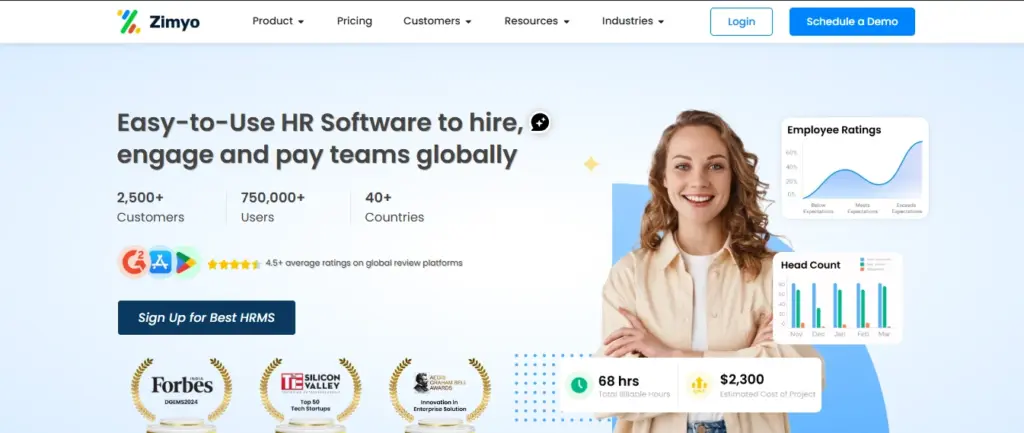
Zimyo is an all-in-one HR and payroll platform with performance management built into the same system as attendance, payroll, and core HR records. It serves 2,500+ organizations across 40+ countries, strongest in India and APAC. The practical argument is the absence of handoffs: a completed appraisal feeds a compensation revision, and that revision reaches payroll without an export step. ZIM Agents, Zimyo’s AI suite, assists with drafting and summarization.
Key Features:
- OKR and KRA frameworks with weighted scoring and role-based templates
- 360-degree feedback from managers, peers, and direct reports
- Configurable appraisal cycles by team, role or business unit
- Performance analytics dashboards and KPI tracking
- Native integration with payroll, attendance, and core HR
Best for: India and APAC teams wanting performance, payroll and core HR on one record.
Not for: Teams outside APAC seeking a best-in-class standalone tool, or needing multinational succession depth.
2. Lattice
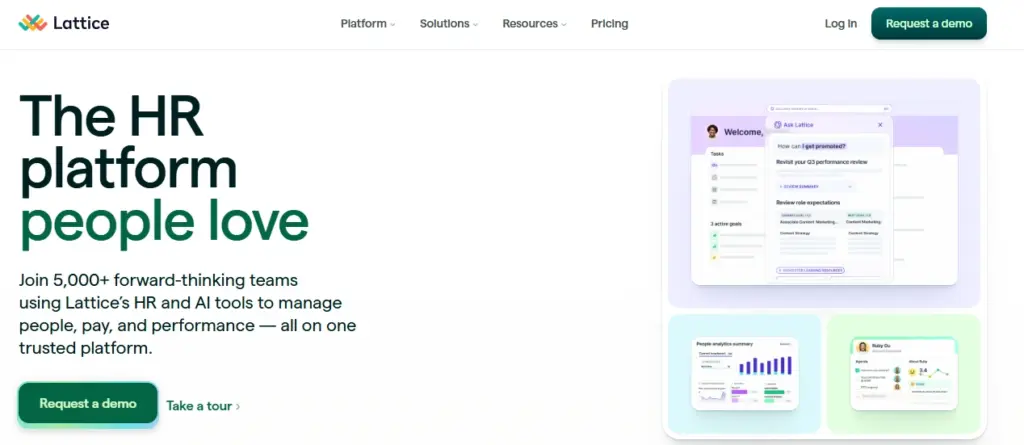
Lattice is a people platform for mid-market companies building a structured review process for the first time. Performance and employee engagement data sit together, so a manager preparing a performance review sees engagement signals alongside employee progress on goals.
Core capabilities
- Review cycles with self, manager, peer, and upward feedback
- Goal and OKR tracking aligned to organizational goals
- Engagement surveys on the same platform
- Career development frameworks and compensation workflows on higher tiers
Best for: Mid-market companies of 100 to 1,500 formalizing performance and engagement together.
Not for: Very small teams or enterprises needing deep calibration and succession.
Consider instead: BambooHR or PerformYard for smaller teams. Workday for enterprise.
3. 15Five
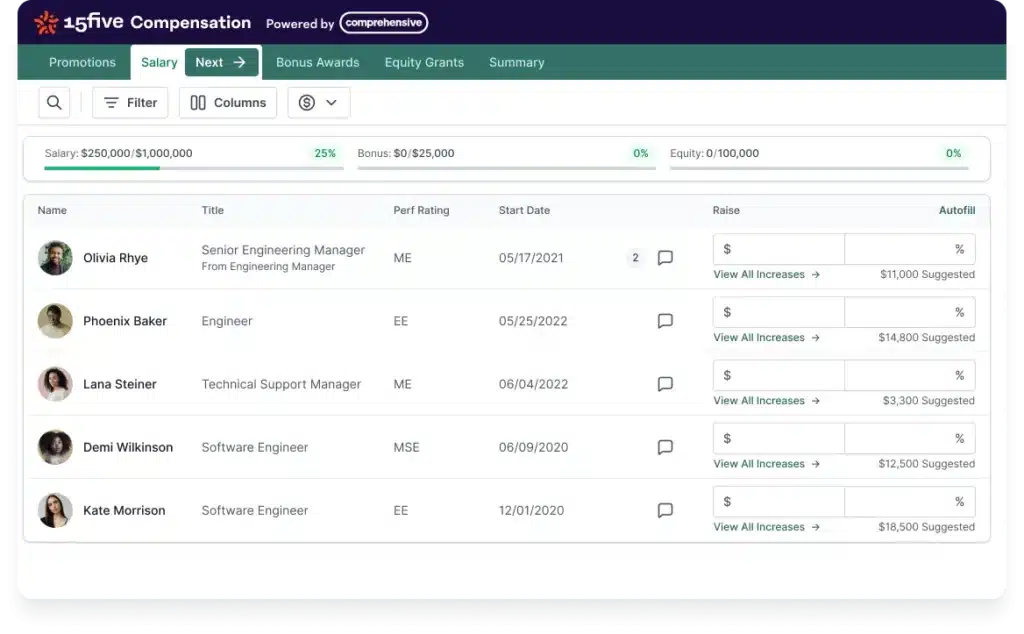
15Five is built around a weekly check-in cadence rather than an annual cycle, making it the clearest fit for organizations moving away from annual performance appraisals. Data of performance accumulates continuously, so the review summarizes a documented year rather than a recall exercise. Where that matches how leadership operates, adoption is strong; where it does not, the cadence feels like overhead.
What it does well
- Weekly check-ins with structured prompts for ongoing feedback
- 1:1 agendas and talking points for performance conversations
- Peer recognition tied to company values
- Goal setting, OKR tracking, and manager coaching content
Best for: Teams committed to a continuous feedback loop, especially remote and hybrid organizations.
Not for: Organizations needing formal calibration, compensation planning or multi-entity cycles.
Consider instead: Lattice or Leapsome for breadth. SAP SuccessFactors for calibration at scale.
4. Eletive
Eletive combines employee engagement, performance management, and self-leadership in one platform, with employee feedback feeding directly into real-time insights and action. It is less focused on treating performance reviews as a standalone HR event and more on connecting engagement data, goals, 1:1s, assessments, and development over time. That makes it a broader people-management platform than a dedicated performance-review tool, though organizations looking primarily for compensation planning or complex enterprise calibration may need additional systems.
What it does well
- Pulse surveys, eNPS, real-time engagement analytics, and employee feedback
- Performance assessments, self-evaluations, manager evaluations, AI – Powered and 360° feedback
- SMART goals, OKRs, action plans, and progress tracking
- 1:1 templates, individual dashboards, and tools designed to encourage self-leadership
Best for: Organizations looking to connect employee engagement data with performance, goals, and continuous development in one platform.
Not for: Teams looking for a narrowly focused performance-review system or highly specialized compensation and calibration workflows.
Consider instead: 15Five or Lattice for a more performance-management-centered approach. SAP SuccessFactors for broader enterprise HR processes.
5. Leapsome
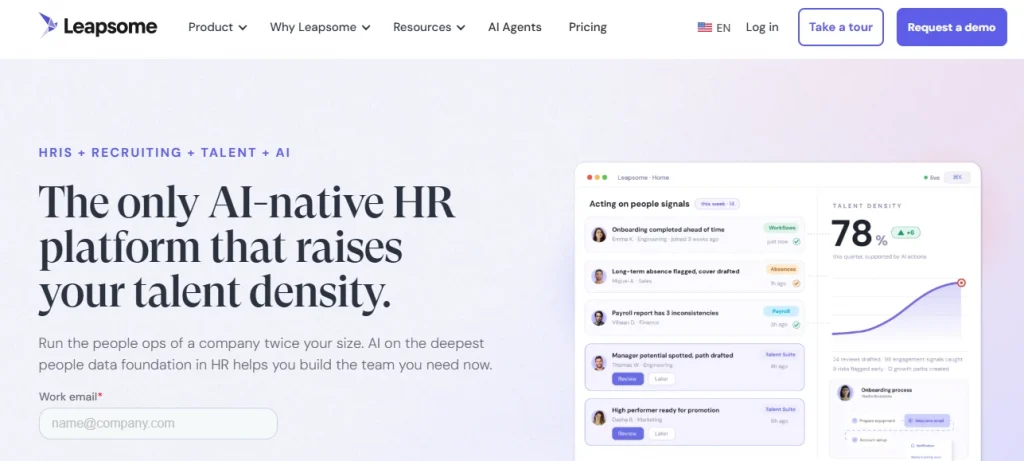
Leapsome connects appraisals to learning, so an employee development need identified during a review routes into enablement rather than a spreadsheet of good intentions. It offers one of the deepest self-serve competency configurations in the mid-market, supporting continuous improvement rather than an annual reset, useful where job families need different rating frameworks in one cycle.
Standout functionality
- Configurable cycles with custom competency frameworks
- Integrated learning paths tied to development plans
- Goal management aligned to strategic objectives
- Engagement surveys and instant, actionable feedback
Best for: Companies closing the performance-to-skills-development loop inside one platform.
Not for: Teams wanting a simple review tool, or enterprises needing deep HCM integration.
Consider instead: PerformYard for straightforward cycles. Workday for enterprise HCM.
6. Culture Amp
Culture Amp came from employee engagement and extended into performance, so its center of gravity is measurement, benchmarking, and organizational performance rather than cycle administration. Results compare against a large external dataset that is difficult to replicate, which matters for people teams reporting to a board on culture as a business metric.
Key Features:
- Engagement surveys with external benchmarking
- Performance reviews and continuous feedback
- People analytics across engagement and performance
- Manager effectiveness measurement and skills development coaching
Best for: Organizations treating engagement measurement as a strategic function.
Not for: Teams whose main problem is administering cycles efficiently.
Consider instead: PerformYard or Lattice for cycle administration.
7. BambooHR
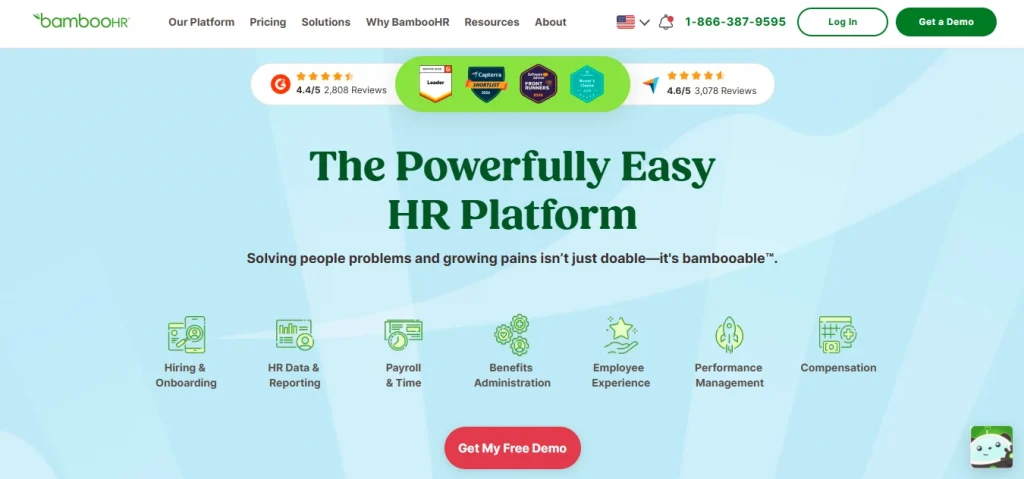
BambooHR is a core HRIS with a deliberately light performance module. Employees and managers need almost no extensive training, which for small teams is worth more than feature depth. The capability is basic by design: goal tracking, self and peer assessment, simple forms, and for a fifty-person company running its first performance review process, basic is the correct specification.
Core capabilities
- Simple performance evaluations and self-assessment
- Goal setting with the ability to track progress over time
- Peer employee feedback
- People analytics, core HRIS, onboarding, and time off
Best for: Small to mid-sized global teams wanting a clean HRIS that can run structured reviews.
Not for: Organizations needing OKRs, calibration tools, weighted scoring, or Indian statutory compliance.
Consider instead: Zimyo or Keka for Indian payroll. Lattice or Leapsome for a real program.
8. Keka
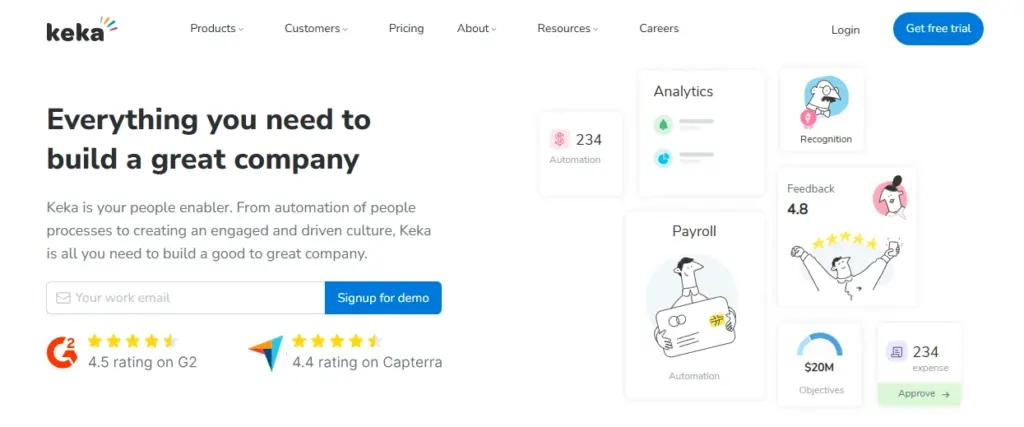
Keka is an Indian HR platform known for interface quality and manager-facing workflow design. Its tooling beats most India-market HRMS platforms, with genuine OKR support, continuous feedback, and 9-box talent mapping. The consideration is the cost structure at smaller headcounts, where flat-fee pricing works out expensive per employee.
What it does well
- OKR and goal management with continuous check-ins
- 360-degree feedback and 9-box talent mapping
- Praise, recognition, and structured reviews
- Integrated payroll with PF, ESI, TDS, and PT compliance
Best for: Indian mid-market companies of 100 to 1,000 wanting a polished UX with payroll.
Not for: Very small teams and organizations above roughly 2,000 employees.
Consider instead: greytHR or Zimyo for smaller Indian teams. Darwinbox for larger enterprises.
9. Darwinbox
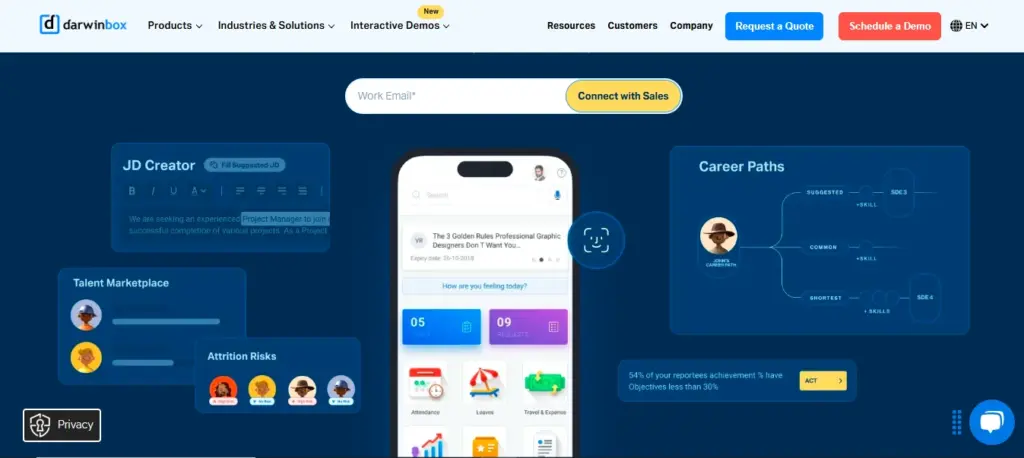
Darwinbox is an enterprise HCM built in India and adopted widely across APAC, designed for large organizations with complex structures and multi-country operations. Configurability wins it enterprise deals – frameworks, workflows, and approval chains adapt to unusual org structures without custom development, but that flexibility costs implementation time measured in months.
Standout functionality
- Highly configurable performance and goal frameworks
- 360-degree feedback, talent reviews and succession planning
- Mobile-first employee experience for deskless workforces
- Multi-country payroll, compliance and workforce analytics
Best for: Large APAC enterprises of 1,000+ with complex organizational structures.
Not for: Small and mid-sized companies. Implementation effort is not recoverable at that scale.
Consider instead: Keka or Zimyo for Indian mid-market. Workday for global headquarters.
10. Engagedly
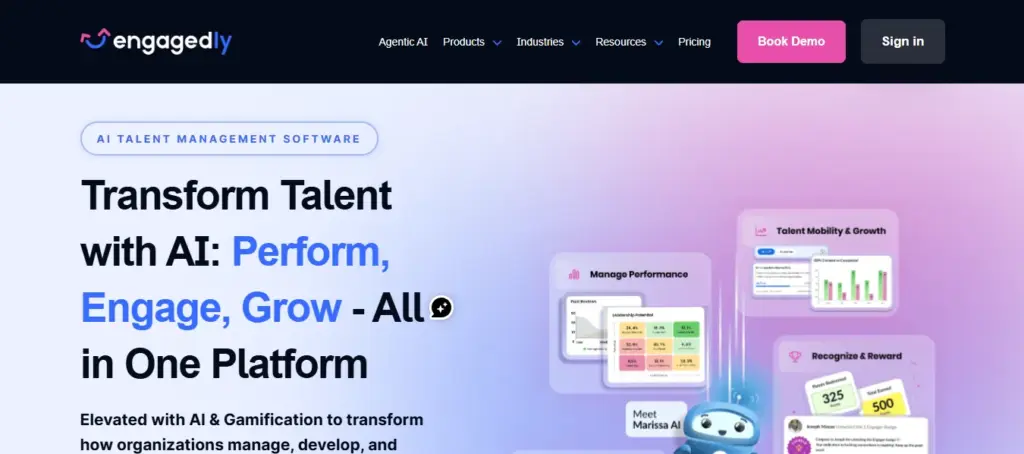
Engagedly combines appraisals with recognition, learning, and engagement, aimed at organizations building a feedback culture rather than just administering reviews. Teams benefit when they use the full suite; teams that only need reviews pay for modules they will not adopt.
Key features
- Continuous feedback tools and OKR management
- 360-degree reviews with configurable workflows
- Recognition and rewards, including gamification
- Built-in learning, mentoring and development resources
Best for: Organizations combining performance, recognition, and learning under one program.
Not for: Teams wanting focused review-cycle software, or very small companies.
Consider instead: PerformYard for focused cycles. 15Five for continuous feedback.
11. SAP SuccessFactors
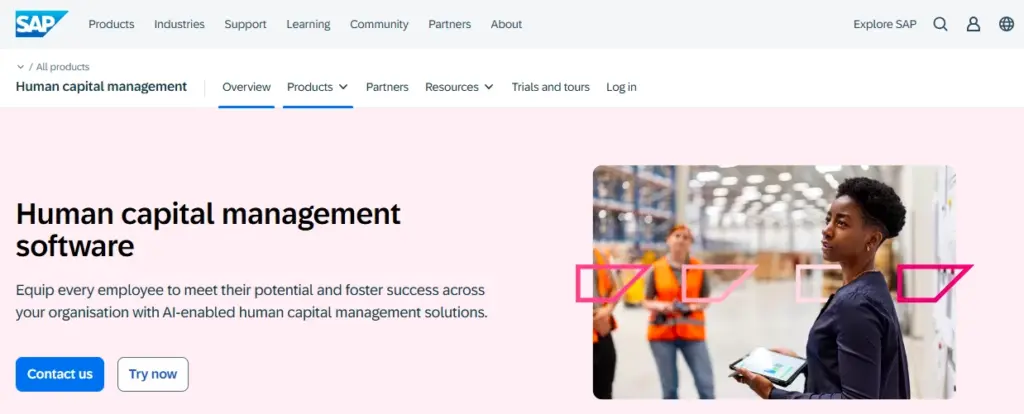
SAP SuccessFactors is an enterprise HCM suite serving large, multi-country organizations, with performance and goals as one module in a broader talent platform. It handles what breaks lighter tools – calibration sessions, succession planning, complex approval hierarchies, and compliance across jurisdictions, but needs dedicated administration.
Core capabilities
- Comprehensive performance and goal management
- Calibration tools and talent review
- Succession planning and continuous development
- Deep workforce analytics and global compliance
Best for: Global enterprises with multi-country operations and a dedicated HRIS resource.
Not for: Any organization without a dedicated administrator.
Consider instead: Lattice or Leapsome for mid-market. Darwinbox for APAC-weighted enterprises.
12. Workday
Workday’s performance and talent capability is strongest as an extension of Workday HCM, where performance, compensation, succession, and workforce planning share one employee record. For organizations already on Workday, alternatives rarely make sense. For everyone else, adopting it for performance alone is not a realistic path.
What it does well
- Performance and goal management on the HCM record
- Calibration, talent review, and succession planning
- Compensation planning integration
- Skills-based talent matching and enterprise analytics
Best for: Enterprises already running Workday HCM.
Not for: Organizations not on Workday. It is not sized as a standalone performance tool.
Consider instead: SAP SuccessFactors for comparable scope. Lattice or Leapsome for mid-market.
13. PerformYard
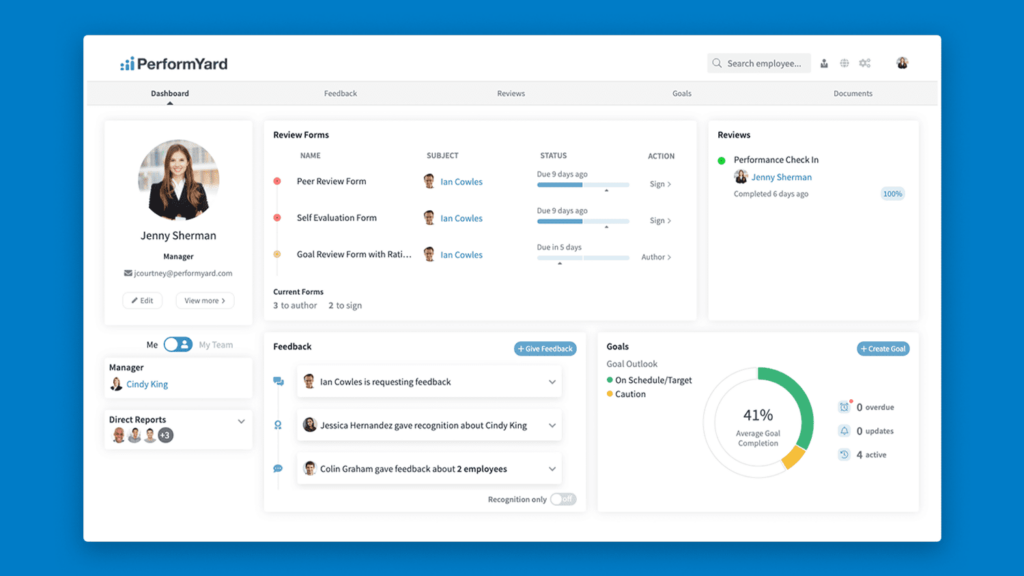
PerformYard runs review cycles and little else, which is the point. Cycle flexibility is unusually good for the price, with different review types, frequencies, and forms across business units, without a configuration project. Where the requirement is genuinely just a performance review process, it deploys faster and costs less than a suite.
Standout functionality
- Flexible cycles by department or role
- Goal management and progress tracking
- 360-degree and project-based review tools
- Reporting on completion and outcomes
Best for: Organizations that want reviews run properly without buying an HR suite.
Not for: Teams wanting engagement surveys, learning, or recognition in the same platform.
Consider instead: Lattice or Leapsome for breadth. Culture Amp for engagement analytics.
More than 2500 businesses today rely heavily on Zimyo performance management software to automate goal setting, track progress, deliver feedback, manage reviews, and reward employees fairly.
Performance Management Tools vs. Techniques: What People Mean By “Tools”
The phrase “performance management tools” means two things. It can mean software platforms, and it can mean the frameworks those platforms run – Management by Objectives, OKRs, 360-degree feedback, the Balanced Scorecard. Choosing software before choosing a framework is the more common and more expensive mistake.
A platform is an implementation of a method. Buying one without deciding the other lets a vendor’s defaults decide how your organization evaluates people against its organizational objectives.
Technique | What it does | Where software helps |
Management by Objectives (MBO) | Cascades organizational goals into individual objectives agreed between manager and employee | Goal trees, alignment views, progress roll-ups |
Objectives and Key Results (OKRs) | Pairs an ambitious objective with measurable key results on a quarterly cadence | Check-in prompts, confidence scoring, alignment maps |
KRAs and KPIs | Defines the result areas a role owns and the metrics that prove delivery | Role-based templates, weighted scoring, dashboards |
360-degree feedback | Collects input from managers, peers, direct reports and sometimes clients | Anonymized collection, rater selection, bias flags |
Balanced Scorecard (BSC) | Measures organizational performance across financial, customer satisfaction, process and learning perspectives | Multi-perspective dashboards and strategy maps |
Behaviorally Anchored Rating Scales (BARS) | Rates behavior against defined, observable anchors instead of vague scales | Configurable rating scales tied to competencies |
9-box grid | Plots performance against potential to identify high performers for succession | Auto-populated grids from review and goal data |
Continuous feedback and 1:1s | Replaces the annual snapshot with regular documented performance conversations | Meeting agendas, talking points, shared notes |
Most organizations combine several: OKRs for goal setting, continuous check-ins through the quarter, 360-degree feedback at review time, a 9-box grid for succession. What matters is that the combination is deliberate.
Matching software to your review philosophy
Match the tool to how your organization already works, not the reverse. Continuous-first platforms like 15Five and Lattice have lightweight check-in interfaces but lighter comprehensive review templates. Structured-review platforms like SAP SuccessFactors and Darwinbox have robust competency matrices but heavier ongoing feedback experiences. Genuinely hybrid systems are rare.
This is the most common cause of implementation regret, and it is invisible on a feature comparison. Managers who run quarterly conversations will not adopt weekly check-ins because the software offers them; the tool goes unused while the old habit continues in email. Continuous feedback is a culture change first and a purchase second.
Before shortlisting, write down three things: how often you review, whether ratings are competency-based or goal-based, and whether the purpose is evaluation or employee development. Then ask each vendor to demonstrate that combination. The job is mostly ruling out the platforms that assume a different philosophy.
Best For Startups and Small Teams
For teams under about 100 people, the risk is buying more platform than you can administer. BambooHR and PerformYard are the safest picks; both run structured reviews without a configuration project. Zimyo suits Indian startups needing payroll system and statutory compliance in the same system rather than bolted on later.
Small teams rarely fail because the software lacked features. They fail because nobody owned the cycle. The test is whether one part-time HR person can launch a round without vendor support.
Best All-in-One HR Platform to Replace Point Tools
If you run separate tools for HR records, payroll, and reviews, the consolidation candidates are Zimyo and Keka in India, BambooHR for smaller global teams, and Workday or SAP SuccessFactors at enterprise scale. The gain is a single employee record; the cost is a performance module that is competent rather than best-in-class.
Point solutions like Lattice and 15Five are stronger on performance specifically. Worth it when performance is among your top business priorities; not when the real problem is HR data in four places. One question settles it: when a review triggers a salary revision, is that automatic or does someone re-key it?
Best for Moving Away From Annual Appraisals
15Five and Leapsome are built for continuous feedback rather than retrofitted to it. Both center on regular check-ins with structured prompts, so feedback accumulates through the year instead of being reconstructed from memory each December. Lattice and Engagedly also support the model well.
Academic research documents this shift toward continuous feedback systems. The failure mode is replacing one ritual with a lighter one nobody completes either. Look for a default cadence built in, prompts that reach managers where they work, and visible completion tracking. The point of a continuous feedback loop is that the year-end review writes itself from evidence already captured, so past performance is documented rather than remembered.
Best for Custom Competencies and KRA Templates
Leapsome and Lattice offer the deepest self-serve competency configuration in this group. Zimyo and Keka handle KRA-based frameworks well, which suits organizations where roles are defined by key result areas with weighted scoring. SAP SuccessFactors and Workday can be configured to almost anything, with implementation effort to match.
Ask two questions in any demo. Can an HR admin create a competency framework and assign it to a role without a ticket? Can job families run different rating scales in one cycle? Many allow customization in principle but route it through professional services.
Best for Global, Standardized Review Cycles
Workday and SAP SuccessFactors are the defaults for multi-country programs, handling calibration, local compliance, and multi-currency compensation on one record. Culture Amp is the strongest non-suite option where standardized measurement matters more than deep HCM integration. Darwinbox is a credible alternative for APAC-weighted organizations.
The hard part is one framework respecting local variation – fiscal calendars, statutory review requirements, rating conventions. Confirm the platform supports cycle variation by legal entity without forking the framework.
Best for Manager Adoption
If your last rollout stalled because managers did not complete it, prioritize interface simplicity over capability. BambooHR and PerformYard have the lowest training overhead. 15Five is built to reach managers inside the tools they already use. Keka is the strongest India-market option on manager workflow design.
Completion rate decides whether any of this works, and it is almost never a function of features. Ask to see the manager view, not the HR admin console. Count clicks from login to submitted review; past five is a warning sign. The best tool is the one your managers will actually open.
Best Mobile-First Tools for Deskless Workforces
Zimyo and Darwinbox both offer mobile experiences designed for employees without a desk, covering goal visibility, feedback, and review completion from a phone. For distributed retail, manufacturing, and field teams, mobile parity matters more than any individual feature.
The test is whether the mobile app is the primary interface or a companion. Many handle approvals and little else – fine for managers, useless for the workforce you are trying to reach. If a plant or store manager cannot complete tasks like a review on mobile in ten minutes, adoption collapses whatever the desktop version does.
What These Platforms Actually Cost?
Most mid-market vendors price per user per month with modular add-ons. Enterprise platforms are quote-based with annual contracts. The published rate is rarely the real number: implementation, data migration, and training are quoted separately, and first-year total cost runs well above the per-employee figure.
Per user per month is standard at this end of the market, often gating calibration, compensation, or analytics behind higher tiers. Flat-fee-to-a-threshold, then per-employee is common among Indian platforms. Quote-based enterprise pricing applies to Workday, SAP SuccessFactors, and Darwinbox.
Hidden costs to budget for
- Implementation and configuration, usually quoted separately from license fees
- Data migration from spreadsheets or a legacy system, including historical records
- Admin and manager employee training, including the extensive training enterprise platforms require
- Integration work where connections are not native and need middleware or IT time
- Annual uplift at renewal, frequently absent from the first-year quote
Ask every vendor for a three-year total cost in writing, with implementation itemized.
Integration Options: What to Check Before You Buy
“Integrates with your HRIS” means little on its own. Integration depth varies enormously: some tools push finalized review data one way on a quarterly schedule, while others sync goal progress bidirectionally in near real time. That difference decides whether managers see performance context in daily workflow or treat reviews as isolated compliance.
Syncing org structure, job titles, and reporting lines is straightforward. Pushing data back, goal outcomes triggering compensation workflows, or development plans routing into learning business systems, needs custom field mapping and IT time. Demo it: ask what happens to in-flight reviews when someone changes manager mid-cycle.
Compliance, Audit Trails, and Role-Based Access Controls
Performance records are used in termination and promotion decisions, which makes them legally consequential. Any platform under consideration should provide timestamped audit trails, configurable approval workflows, defined retention policies, and role-based access controls that determine precisely who can see which performance evaluations.
Access controls matter more than buyers expect. A skip-level leader, an HR business partner, a direct manager, and a compensation reviewer each need a different view of the same record, and coarse permissions force workarounds that undermine confidentiality. Ask whether access controls are configurable per field or only per module.
Anonymity in 360-degree feedback needs attention. Tools differ in whether admins can de-anonymize responses for investigations. Both designs are defensible, but the choice has legal and cultural consequences. Confirm data residency and retention match your jurisdiction.
AI in Performance Management: What It is Actually Doing?
Most AI features today summarize feedback, draft review narratives, and surface insights from existing performance data. The efficiency gains are real. The risk, documented in recent Harvard Business Review analysis, is that organizations use AI to produce more polished versions of the same flawed reviews rather than better ones.
Large enterprises already deploy this. Citi’s Performance Assist drafts evaluations from organization-wide data, JPMorgan’s LLM Suite supports year-end review writing, and Boston Consulting Group’s internal AI assistant reportedly cuts review-writing time by 40%.
The capability is not in question. Measurement is. HBR’s July 2026 analysis argues companies still judge people on familiar metrics – productivity, goal completion, efficiency- even as AI changes what they mean. Employees leaning on AI look productive, while those who slow down to verify assumptions appear less efficient precisely when adding the most value. The authors propose separating metrics for human contribution, AI system performance, and the combined system. Team performance measured on raw output alone will increasingly mislead.
For buyers: treat AI as an efficiency layer, not an evaluation method. Ask whether AI summaries cite the underlying evidence and whether managers can edit before anything is recorded.
Driving Adoption After Purchase
Choosing performance management software is the smaller half of the problem. Most rollouts underperform because managers treat the tool as HR compliance rather than something that saves them time. Adoption planning should start before the contract is signed, not after go-live.
Managers are judged on output, not HR process compliance. Unless the platform is faster than whatever they do now, they will do the minimum. That is how expensive software becomes shelfware, and it is the most common of the performance issues following a technically successful implementation.
Three things move the number. Run a pilot with one business unit and publish the completion rate. Give managers a script for their first performance conversations rather than a feature walkthrough. Have business leaders complete their own reviews visibly on time, because managers copy what leadership does. Timely feedback from the top sets the cadence below it.
How to Choose The Best Performance Management Software
Start with the process you want to run, then find software that runs it. Define your review cadence, who will provide feedback, how ratings map to compensation, and which frameworks you use. Shortlist three platforms against those requirements and test each with a real cycle in one department before committing.
- Can an HR admin change competencies, rating scales, and cycle configuration without raising a support ticket?
- What happens downstream? Does a rating flow into compensation planning automatically, or is it re-keyed?
- What is the actual manager experience? Ask for a manager’s view, not the HR admin console.
- What is the realistic implementation timeline, and what does it cost, including data migration?
- At what headcount do existing customers typically outgrow the platform?
Then run a pilot: one department, one full cycle. Completion rate predicts the rollout better than any feature comparison, including this one.
Conclusion
Effective performance management is not just about conducting annual reviews, it’s about setting clear goals, providing continuous feedback, recognizing achievements, and helping employees grow consistently. The Top 13 Performance Management Tools in an Organization featured in this list, including Zimyo, are designed to simplify these processes while improving employee engagement, productivity, and business outcomes.
Whether you’re looking for performance management solutions, employee performance review tools, or AI-powered performance management software, the right platform can help create a more transparent, data-driven, and growth-focused workplace. The key is to choose a solution that aligns with your organization’s size, culture, and long-term objectives.
By investing in the right performance management software, businesses can strengthen workforce productivity, support employee development, and build a high-performing team ready to succeed in 2026 and beyond.
Frequently Asked Questions (FAQs)
What are the 5 best tools for performance management?
The top providers in India and APAC include Zimyo, Keka, Darwinbox, Zoho People, and greytHR. Five general-purpose options are Lattice, Leapsome, 15Five, PerformYard and BambooHR. Which five suit you will depend on the firm’s size and needs.
What are the 5 C's of performance management?
There is not one universally accepted model. The one most often referred to is Clarity, Communication, Coaching, Consistency, and Consequences. There are other models where Commitment replaces Consequences, and there is an older model using the terms Clarify, Communicate, Contract, Coach, and Counsel. The connecting theme is that performance management is about expectations, dialogue, and consistency. It’s not about the evaluation form.
What are the 5 management tools?
The five most commonly used are Management by Objectives, Objectives and Key Results, KPIs, 360 feedback, and the Balanced Scorecard. These are methodologies rather than software tools. Software exists to run them at scale.
What is an EPM tool?
EPM is short for Enterprise Performance Management, which is finance software for planning, budgeting, forecasting, and reporting. This software is used to measure the performance of the business as opposed to that of the employees. EPM is a different category from the software covered here.