
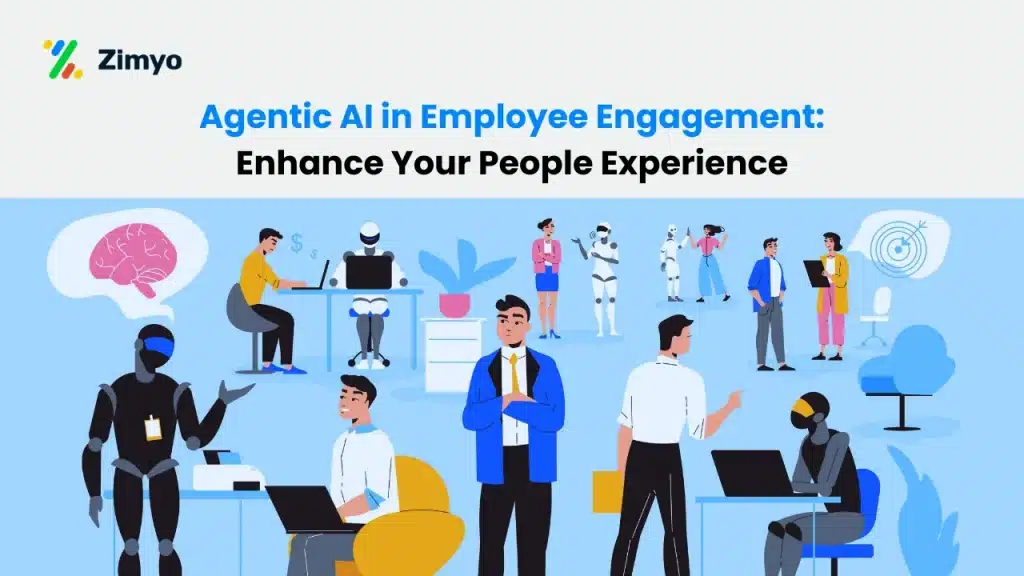

Lest we beat around the bush, most employee engagement strategies are nothing more than after-the-fact responses to problems that have already snowballed. A survey gets sent out, results trickle in a few weeks later, and by the time anyone does anything about it the damage has already been done.
Agentic AI is turning all that on its head.
This isn’t about replacing HR teams or turning the workplace into some kind of robotic nightmare. Actually, it’s the opposite of that. Agentic AI makes engagement feel a lot more human – timely, personal, and proactive – because it doesn’t just sit around waiting for instructions from on high. It observes, learns, & acts.
Here’s how its already changing the employee experience, and what it means for organizations like those using Zimyo.
Why Traditional Engagement Tools Are Lagging Behind
Before we dive into what Agentic AI can bring to the table, let’s take a look at why old approaches are starting to hit a brick wall.
Gallup’s 2024 State of the Global Workplace report found that shockingly, only 23% of employees worldwide are actually engaged at work, while the rest are either coasting or quietly checking out. And it’s costing businesses around $8.9 trillion in lost productivity every year.
The problem isn’t that HR teams don’t care – it’s that they’re working with outdated information. By the time a pulse survey flags up a problem or a manager notices someone disengaging, the damage is often already done.
What organizations need isn’t more data – they’ve got that in spades. They need systems that can actually make sense of that data and act on it quickly. That’s where Agentic AI comes in.
What Agentic AI in Employee Engagement Does
To put it simply, traditional AI tells you what’s happened. Agentic AI, on the other hand, decides what to do and then does it.
In agentic AI in employee engagement, this means the system isn’t just spitting out a report that says “Team B saw a 12% dip in engagement this quarter” – it’s actively pinpointing the cause, suggesting an intervention and in some cases even triggering it automatically. Whether that’s scheduling a manager check-in, nudging a peer recognition or sending an anonymous concern to the right person, the system is actually acting on the data in real time.
It transforms engagement from some kind of scheduled activity to a live, dynamic process.
6 Ways Agentic AI Is Revolutionizing Employee Engagement
1. It Spots Disengagement Long Before It Turn Too Late
One of the most expensive – and also one of the most predictable – HR problems is employee disengagement, and agentic AI is on the case.
It tracks tiny changes in behavior: someone stops showing up to meetings, drops out of collaboration tools, starts scoring lower on pulse surveys. Each one of these tiny changes might not seem like much on its own, but taken together they paint a clear picture of someone who’s about to check out.
Research from MIT Sloan found that employees usually show signs of disengagement for 6-12 months before they quit. That’s a whole window of time to intervene – if you’ve actually got a system that can pick up on those signs in real time.
With Zimyo’s tools feeding into an AI layer, that window is suddenly wide open.
2. Recognition That Actually Means Something
There’s a huge difference between a computerized “Happy Work Anniversary!” notification and a genuinely heartfelt shout-out. Most employees can spot the difference in a heartbeat.
Agentic AI helps bridge that gap by actually making recognition meaningful. Rather than just triggering milestone alerts, it can actually surface why someone deserves recognition in that moment – a project they just nailed, some behavior that shows company values etc.
This makes recognition feel real and timely, which is what actually makes it land. A study from Deloitte found that companies with strong recognition cultures see a 31% lower voluntary turnover.
Zimyo’s Rewards & Recognition module becomes way more powerful when it’s Agentic AI is in the loop, helping to decide how and when to recognize people for a job well done.
3. Feedback That Actually Gets Used
The old feedback loop is broken. People fill in surveys, data gets exported, slides get made – and then nothing happens. By the time the next cycle comes round, everyone’s forgotten what was flagged months ago.
Agentic AI speeds up that loop no end. It can analyze all the open-text responses, anonymous submissions, and mood check-ins in real time, identify recurring themes, flag up what needs urgent attention, and route insights to people who can act on them. More importantly, if sentiment around a specific manager or team is consistently dropping, the system doesn’t just wait for someone to spot the pattern – it jumps in to prompt a conversation, surface some helpful resources, or flag it with HR, depending on how it’s set up.
Zimyo’s Agentic AI in combination with its Anonymous Feedback and Helpdesk & Ticketing features is designed to catch closed-loop issues dead in their tracks.
4. Learning & Growth That Actually Matters
Generic L&D programmes are basically the definition of an engagement killer. Who in their right mind wants to sit through a pointless online module that has zero relevance to where they want their career to be?
With Agentic AI, individual skill gaps, career interests and performance trends get mapped and matched up to some real learning paths that are actually going to help people. And this happens all the time – not just some big annual appraisal.
McKinsey found that companies with strong L&D cultures are 92% more likely to innovate and have way better employee retention rates. And you know what’s missing from most of them? Personalization on a massive scale. Agentic AI makes that possible – and that’s huge.
Zimyo’s Learning Management agentic AI features, combined with AI in performance, give the engagement agent the context it needs to actually make some decent recommendations.
5. Manager Effectiveness Just Got a Whole Lot Better
This gets under-engaged most people’s radar: the quality of the manager relationship is basically the one thing that most drives employee engagement. But managers are always the last to know when things are going off the rails on their team.
Agentic AI flips this on its head by giving managers some real-time nudge – not some sort of micromanagement, but just a gentle reminder when something might be going wrong. Things like: “Three members of your team have gone two weeks without interacting with a colleague” or “Sentiment in your team’s check-ins has been dropping for the last two weeks – maybe schedule a catch-up?”
This is basically coaching in the background, so managers can be proactive without having to micromanage. Zimyo’s One-on-One and Continuous Feedback modules are a natural place for this sort of AI-assisted nudge to live.
6. The Inclusion Gaps You're Not Even Seeing Are Now Visible
This one often gets overlooked. Though disengagement doesn’t always affect everyone the same way – it tends to cluster on team lines, seniority levels, whether people are in or out of the office, or even some harder-to-track demographics.
Agentic AI can spot these patterns without needing to manually go through the data. And if a particular group is less visible in team discussions, they are less likely to get recognized by their colleagues or consistently scoring lower on the sentiment checks – the system flags it.
This means HR and leadership can actually take some real action to address inclusion concerns before they start eroding culture or triggering attrition. Zimyo’s Communities feature and Discussion Forums are great places to get the kind of interaction data that makes these insights possible.
What You Get Back
This isn’t some “nice to have” – the business case is pretty clear:
- Less money spent on turnover. Replacing someone typically sets your company back 50–200% of their annual salary. Keeping just a handful of avoidable exits pays for the tech many times over.
- Boost your productivity. Employees who are actually engaged at work are on average about 17% more productive than their mates who are pretty checked out (Gallup up with that fact).
- Get your managers on top of things. When managers get a heads up on what’s going on, they make better decisions and their team notices the difference.
- Speed up your HR response times. Let AI deal with the ‘ admin’ and the hot mess of survey results, and your HR team can get back to things that actually matter.
Before You Bring Agentic AI in Employee Engagement
Switching to using an AI like this as part of your engagement strategy is more than just a tech upgrade, it’s a whole new way of thinking. So, what’s the difference makers?
Be upfront with your staff- If they have a clear idea of what’s going on and how the AI is helping them, they’ll be way more willing to work with it. Confusion makes people suspicious.
Focus on the problems you already know are a problem- No need to try to roll out the whole package at once. If its retention that’s killing you, start there. If your feedback loop is broken – fix it before you move on.
Keep human in the loop- AI should be used to help make decisions, not replace them. The best results come from when HR and managers use the AI data to have a real conversation, not just as an ‘oh, and by the way’.
Review and iterate- What works for the 50 person office in Bengaluru is going to be different from the 2000 person operation in multiple locations. Make sure to build in ways for people to give you feedback so this thing evolves.
Conclusion
Employee engagement all comes down to one thing: making people feel like they are worth something at work. And what Agentic AI does is lets you do just that – at scale and speed that would be impossible for humans to achieve on their own.
It doesn’t replace the personal touch – it just amplifies it. When your HR system can tell you that the quiet one on your team is on the verge of burning out before they even say anything – you have a fighting chance at keeping them. When you can give recognition that is actually meaningful, rather than just because its time to do so… that is actually a real shift.
Thats what Agentic AI is all about. And if you are already using a system like Zimyo that has all the core features like pulse surveys, mood tracking and all that jazz – then all you need to do is add some smarts to make it work.
Frequently Asked Questions (FAQs)
What is Agentic AI in employee engagement?
Agentic AI doesn’t just analyse engagement data — it acts on it. It can automatically trigger interventions, route feedback, or nudge managers in real time, without waiting for a human to interpret a report first.
Will Agentic AI replace HR teams?
No. It handles the signal-detection so HR can focus on the actual conversations and decisions. The human element doesn’t go away, it just gets better-informed.
How is Agentic AI different from regular AI in HRMS tools?
Standard AI tells you what happened. Agentic AI decides what to do next, and can act within set parameters automatically. That’s the core difference between a dashboard and an engine.
What data does Agentic AI use to track engagement?
It pulls from pulse surveys, mood check-ins, recognition patterns, feedback frequency, and performance trends, and connects the dots across all of them simultaneously.
Is employee data secure with Agentic AI?
It depends on the platform. Always look for transparent data policies, role-based access controls, and clear employee communication about what’s being tracked and why.