


What is the meaning of talent?
A natural aptitude or expertise in a certain field that can solve problems and make jobs easier or better in a system is referred to as talent. Employees with special skills are very vital for business growth. These employees not only make work easier but also improve a company’s operations. Depending on the industry, a person uses his or her skills to improve work, increase revenue, or improve the organization’s public image. Employers must establish their own strategies for attracting and developing people in order to meet their business objectives. Company to company, talent selection changes.
What does talent mean in the workplace?
In the workplace, talent refers to a natural strength or ability of a person, such as creativity, analytical reasoning, or social intelligence, that gives them an edge. Although these abilities can be honed and developed, it usually has a natural origin; it is not like skills someone learns through training or experience.
So, all in all, workplace it may mean:
- This is an individual’s natural capability
- A standout strength that enhances job performance
- Collective term for employees or groups of candidates
Importance of talent acquisition
A sufficient pool of competent and talented personnel can streamline the process of reaching the organization’s goal and assist in focusing on issues that are truly important to the organization’s success. As a result, the overarching goal of talent management is to keep the organization’s staff skilled and productive.
The significance in today’s enterprises is unrivaled. Even if a company has other resources, infrastructure, and technology, it will not be able to achieve its goals unless it has the necessary talented personnel. In truth, it is people who propel a company to new heights of success.
Synonyms of Talent
How does HR define talent?
HR professionals look at talently from many operational angles to support hiring, development, and retention.
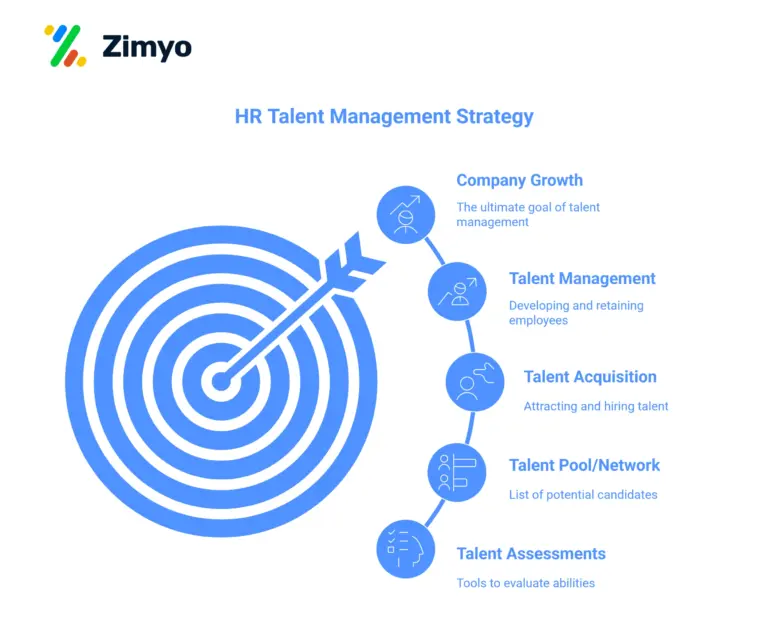
- Talent acquisition –This is the continual process of attracting and hiring people who can help grow the company.
- Talent management- This covers how employees are developed and retained through training programs, performance appraisals, learning pathways, succession planning, and career development opportunities.
- Talent pool (or talent network)- A pool is a selection of high-potential people, internal employees, or external candidates who could be appropriate for future roles.
- Talent assessments- These assessments help HR evaluate qualities beyond a resume or interview. They can test cognitive aptitude, personality traits, leadership style, or job-specific competencies.
How to Spot Talent
To identify Talent, human resources teams should start with defining what characteristics are required to excel in that position, and then look for people who exhibit qualities such as:
- Self-driven: They are proactive; they require minimum supervision and push themselves to maintain standards high. They are collaborative, meaning they generally work well with others, communicate clearly, and help elevate team performance.
- Results-oriented: They always meet goals, set standards, and show accountability.
- Leadership ability: They command trust, make the right decisions, and lead others to achieve success almost by instinct.
- Inventive mindset: exploring new avenues, solving problems creatively, and adapting swiftly to novel challenges.
What are some examples of talents?
Companies often appreciate like strong analytical thinking for process development and solving logical problems. The emotional intelligence of a leader ensures that can connect with the team and manage them, while fast situational judgment allows rapid decision-making in dynamic situations. The other is visual thinking: any person able to turn ideas into diagrams, concepts, or models often helps teams clarify and innovate more.
FAQs
What is a talent?
A talent can be described as a natural ability or something that one can naturally do well, which may or may not have been developed over time.
What is talent? Provide an example.
It means the special skill or strength that a person has, such as musical ability, logical reasoning, or athletic performance. For instance, someone can have a it in painting or public speaking.
What is a talent in a person?
When it comes to a person, is basically an area he naturally excels at or learns extremely fast in. It often feels effortless or intuitive compared to others.
What is tillent?
Tillent is an apparently common misspelling of the word talent. If you meant to say something else, please do explain!
What is corporate talent?
In the corporate context, it implies employees having the skills, competencies, and potential that drive business success. Companies focus on attracting, developing, and retaining such high-value individuals.