Every employer that deducts tax from salaries or payments has to deposit that tax with the government on time, and the TDS challan is how that money reaches the right account. Getting it wrong is easy and expensive: a wrong code, a missed date or a challan that never makes it into the quarterly statement can lead to interest, fees and notices.
This guide explains how TDS challans work today, after the Income-tax Act, 2025 replaced the 1961 Act from 1 April 2026, and answers the questions payroll and finance teams ask most often.
Note: tax rules, forms and portal screens change. Treat this guide as an overview and check the Income Tax Department's e-filing portal, TRACES or your tax adviser before you pay or file.
What is a TDS challan?
A TDS challan is the payment form an employer or other deductor uses to deposit tax deducted at source with the government. When the payment goes through, the bank and the department record it against your TAN (Tax Deduction and Collection Account Number). You then quote the challan details in your quarterly TDS statement, which is how the tax gets credited to each employee or payee.
For many years this form was known as Challan ITNS 281. Payments are now made online through the e-Pay Tax service on the income tax e-filing portal.
What changed with the Income-tax Act, 2025?
From 1 April 2026, the Income-tax Act, 2025 applies, and the main changes for TDS are:
- Tax year instead of assessment year. The new Act uses a single "tax year" in place of the old previous year and assessment year.
- New section numbers. TDS on salary is now covered by section 392 (it was section 192), and most other TDS provisions are brought together in section 393.
- New forms. Quarterly statements and TDS certificates have new form numbers (see below).
- Choosing the Act on the portal. When you pay, the portal asks which Act the payment relates to. Deductions up to 31 March 2026 stay under the 1961 Act; deductions from 1 April 2026 fall under the 2025 Act. The portal then shows the challan and payment codes for that Act.
If you are paying arrears or interest for older periods, pick the 1961 Act. For current deductions, pick the 2025 Act.
When is TDS due?
| TDS deducted in | Deposit by |
|---|---|
| April to February | 7th of the following month |
| March | 30 April |
Government offices that pay tax by book entry follow different rules. Some deductors with specific permission from the department can deposit quarterly; check whether this applies to you before relying on it.
How to pay TDS online, step by step
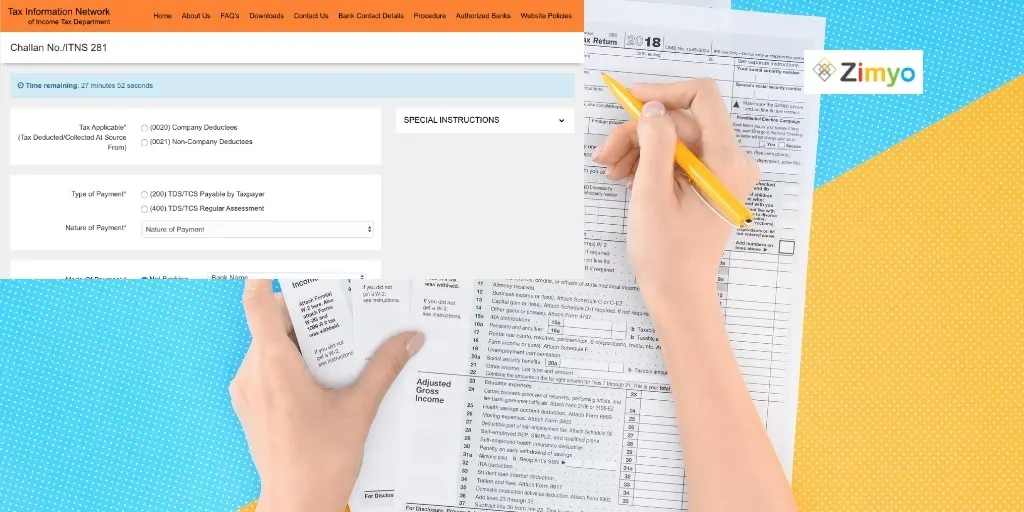
- Open e-Pay Tax on the income tax e-filing portal. You can use it after logging in with your TAN, or without logging in by verifying your TAN and mobile number with an OTP.
- Choose the TDS/TCS payment option and select the Act and tax year the payment relates to.
- Select the deductee type: company deductees (major head 0020) or non-company deductees (major head 0021).
- Select the type of payment: "TDS payable by taxpayer" (minor head 200) for regular monthly deposits, or "TDS regular assessment" (minor head 400) when you are paying a demand raised by the department.
- Choose the nature of payment from the list, for example salary, contractor payments, professional fees or rent. Under the 2025 Act the portal shows new payment codes instead of the old section numbers, so read the description carefully.
- Enter the amounts: tax, and any interest, fee or other component you are paying.
- Pick a payment method: net banking, debit card, UPI, a payment gateway, NEFT or RTGS, or payment at an authorised bank counter.
- Download the challan receipt. It shows the Challan Identification Number (CIN), made up of the bank's BSR code, the date of deposit and the challan serial number. Keep it safe; you need it for your quarterly statement.
What to do after paying
Paying the challan is only half the job. The tax reaches employees' and payees' records only when you file the quarterly statement and quote the challan correctly.
| Purpose | New form (2025 Act) | Earlier form |
|---|---|---|
| Quarterly statement, TDS on salary | Form 138 | Form 24Q |
| Quarterly statement, other payments to residents | Form 140 | Form 26Q |
| Quarterly statement, payments to non-residents | Form 144 | Form 27Q |
| Annual TDS certificate for employees | Form 130 | Form 16 |
| TDS certificate for other payments | Form 131 | Form 16A |
Quarterly statements are generally due by 31 July, 31 October, 31 January and 31 May for the four quarters. Check TRACES for the current dates and any extensions.
Common mistakes and how to avoid them
- Wrong Act or tax year. Paying a current deduction under the old Act, or the other way round, causes mismatches. Check the period before you pay.
- Wrong deductee type. Company and non-company payments go under different major heads.
- Wrong nature of payment. Choose the code that matches the payment exactly; the description matters more than the old section number you remember.
- Wrong TAN. A typo sends the money to another account and can take months to sort out.
- Paying but not reporting. If the challan is not quoted in the quarterly statement, employees will not see the credit and you may get a notice.
- Combining unrelated payments. Keep payments separate where the portal requires it, and match each challan to the right statement.
What happens if TDS is paid late?
Interest applies when tax is deducted late or deposited late. Long-standing rates are 1% per month (or part of a month) when tax was not deducted on time, and 1.5% per month (or part of a month) when tax was deducted but not deposited on time. A late fee also applies for each day a quarterly statement is filed late, and penalties can follow if statements are not filed or are filed with wrong details. Check the current provisions under the 2025 Act for exact amounts before you calculate.
Can a TDS challan be corrected?
Yes, within limits. Some details of an online challan, such as the tax year, major head, minor head or nature of payment, can be corrected through the correction service on the e-filing portal within the permitted time, or with help from your assessing officer. Correct challan details quickly; the longer a mismatch stays, the more notices and follow-ups it creates.
For salaried employees: how to check your TDS
As an employee, you do not pay the challan yourself, but you can check that your employer has deposited what was deducted:
- Look at your annual tax statement (long known as Form 26AS) and your Annual Information Statement on the e-filing portal. Deposited TDS shows against your PAN once your employer files the quarterly statement.
- Compare it with your payslips and your annual TDS certificate from your employer (Form 130, earlier Form 16).
- If something is missing, raise it with your HR or payroll team first. Usually the statement has not been filed yet or a detail such as your PAN was entered wrongly.
Want to estimate how much tax will be deducted from your salary? Try our free TDS calculator.
How payroll software helps
Most TDS problems come from manual steps: copying amounts into the portal, picking codes from memory and matching challans to statements in spreadsheets. Payroll software with statutory compliance works out TDS each month, prepares challan and statement data, and keeps a record of every payment, so finance teams spend less time fixing mismatches.
FAQs
What is the difference between ITNS 281 and the new TDS challan?
ITNS 281 has long been the challan for depositing TDS and TCS. From 1 April 2026, payments for deductions under the Income-tax Act, 2025 are made through the e-Pay Tax service with the new Act's payment codes, while older periods continue under the 1961 Act. The portal asks which Act applies and shows the right challan.
What is the due date for depositing TDS deducted in March?
TDS deducted in March can be deposited until 30 April. For every other month, the deadline is the 7th of the following month. Government offices paying by book entry follow different rules.
Can I pay TDS for several employees in one challan?
Yes. A single challan can cover the salary TDS of all employees for a month. What matters is that the amount matches the total you report for that month in your quarterly statement, broken down by employee.
What is a CIN in a TDS challan?
The Challan Identification Number identifies each payment. It combines the bank's BSR code, the date of deposit and the challan serial number. You need it to report the payment in your quarterly TDS statement.
Where can I see TDS deducted from my salary?
Check your annual tax statement and Annual Information Statement on the income tax e-filing portal. The TDS appears once your employer deposits it and files the quarterly statement. You also receive an annual TDS certificate from your employer.
Do I need to log in to pay TDS?
No. The e-Pay Tax service can be used before logging in by verifying your TAN and mobile number with an OTP, or after logging in to the e-filing portal with your TAN.