
Manufacturing firms have payroll systems that must continue operating due to the fact that they don’t fit within the usual automated payroll system. The factory environment requires payroll systems that cannot be handled by normal software because of the unique demands for shifts, safety compliance, union policies, and operations management. This is made worse because the firm needs to pay taxes in several jurisdictions and has to integrate its enterprise resource planning system, thus making an expensive mistake that affects the employees and the bottom line.
The following table shows nine different systems that show their strengths and weaknesses, as well as the people for whom they are intended. All the enterprise systems require quotations for prices, and therefore, the figures below are estimates.
How We Chose (Research Methodology)
This list was not compiled based on marketing materials provided by vendors alone. To select platforms and define characteristics for each one, we:
- Aggregated verified reviews of users from recognized software review sites (G2, Capterra, TrustRadius, TrustPilot), giving the highest weight to the latest reviews and manufacturing reviewers.
- Examined manufacturing-specific fit rather than general payroll capability. This required a presence of native shift differentials, blended overtime, piece rate payroll, multiple shift scheduling, union compliance, and OSHA/certification tracking, rather than workarounds for these needs.
- Examined the extent of compliance support in multi-state and, where applicable, multi-country tax filing, wage-and-hour requirements, and audits.
- Checked connectivity to ERP, accounting, and time-and-attendance software through built-in connectors and APIs.
- Compared price and total cost of ownership based on publicly available information and third-party buyer reports, including per-employee fees, base fees, and implementation costs.
- The estimated quality of support and implementation experience, as account knowledge is as important as features for complex multi-site payroll.
- Given that many manufacturing-grade platforms have quote-based pricing, actual prices vary depending on the number of employees, the modules chosen, and the scope of implementation. The estimates provided should be taken as directional only. Always get a quote.
At a Glance: Comparison Table
| Software | Best for | Manufacturing strengths |
|---|---|---|
| Zimyo | Shift-based blue-collar workforces | Shift/attendance-driven payroll, biometric integration, statutory compliance |
| Paycor | Mid-sized, manufacturing-first | Blended OT, shift differentials, geofenced time clocks |
| Paychex | HR depth + payroll | Multi-rate hourly pay, training/compliance tools |
| ADP Workforce Now | Scale & complex config | 50-state + global, deep configurability |
| Rippling | Unified workforce system | Auto-synced differentials/OT, ERP + global |
| Paylocity | Multi-location & unions | Union rules, job costing, multi-site, EWA |
| Netchex | Purpose-built vertical fit | Piece rate, OSHA/cert tracking, multilingual |
| APS Payroll | Complex scheduling | Scheduling, labor management, ACA |
| Deel | Global workforces | Cross-border payroll in 130+ countries |
| RUN by ADP | Small manufacturers | 50-state filing, AI error checks, job costing |
1. Zimyo-Best for Shift-Based Blue-Collar Workforces
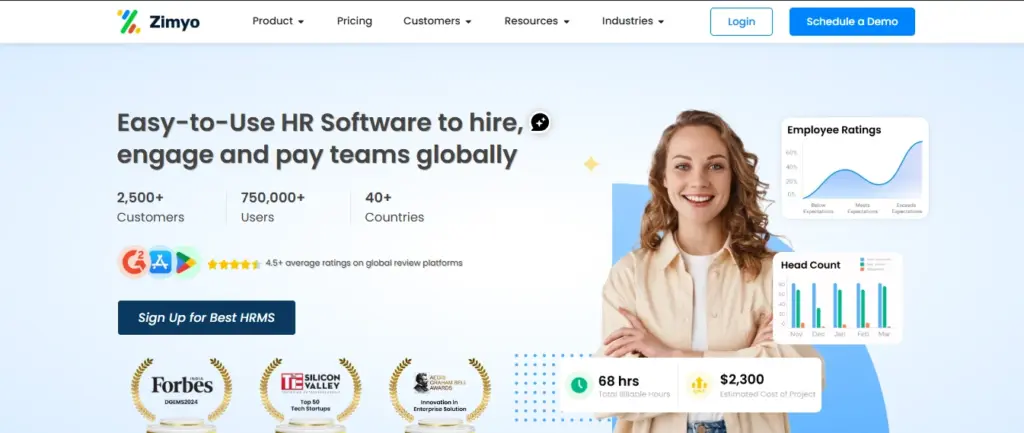
The Zimyo is an all-in-one HRMS and Payroll Solution tailored for manufacturing with the basic premise that wage payments in factories depend on working hours. Attendance and shifts in the system directly affect payroll calculations which take into account biometric and geographic location captures, ERP integration, statutory compliance and all other aspects related to payroll and attendance calculations in one integrated platform. This kind of automation was the key to success at Hillson Shoes (see the case study presented below). The solution performs exceptionally well in cases where the payroll process relies entirely on hourly wages.
Pros:
- Manufacturing-centric HRMS with time sheet-based payroll & biometrics integration.
- Lessens salary processing errors and labor; high compliance automation.
- Customer support rated responsive by several customers.
Cons:
- A few customers have complained about the learning process and complex user interface.
- The reporting module has a lot of work left to do as it’s still evolving, and timesheet is an extra.
- Ideal match for India and the Middle East but not for global US payroll; Pricing is on quotation basis (minimum starting at ₹4,000/month for 50 employees).
Best for: Manufacturers with large, shift-based blue-collar workforces (especially in India and the Middle East) wanting attendance, payroll, and compliance in one platform.
2. Paycor -Best Manufacturing-First All-in-One
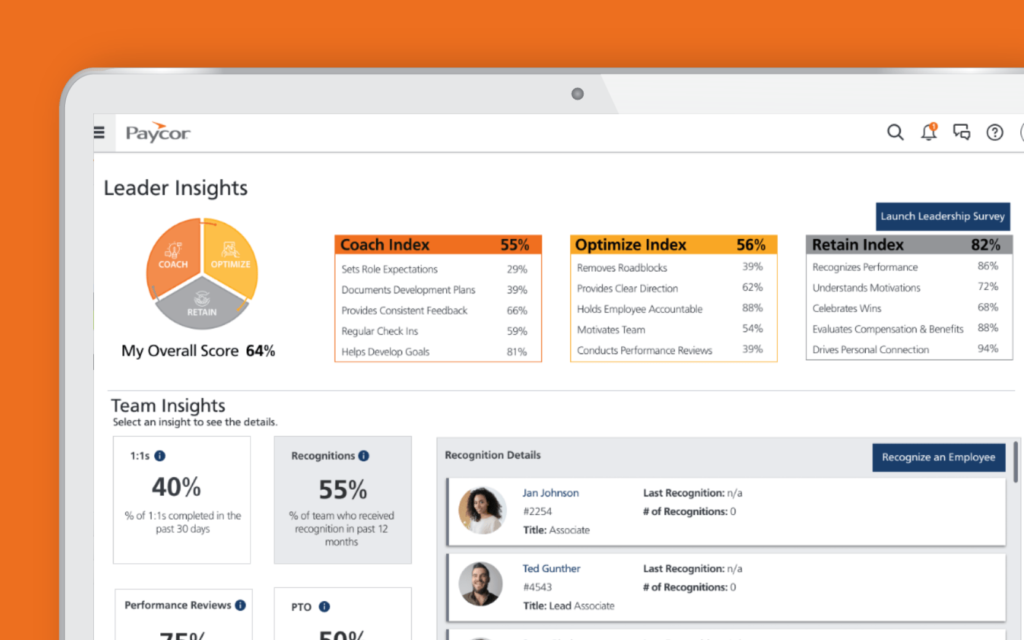
Paycor is one of those few companies that has a particular program that caters to the needs of the manufacturing industry instead of providing a custom-built one. Paycor manages all the complicated procedures that come with processing payroll at factories, such as automating the blended overtime process, handling shift differential, and geofencing of timekeeping. An on-site time clock with badge/PIN access and a dashboard showing details on hours, overtime, certifications, and pay information makes Paycor a good choice for a multi-shift/multi-factory work environment. Paycor was acquired by Paychex in 2025.
Pros:
- Dedicated manufacturing program with native shift-differential and blended overtime handling.
- Modern time-clock options (badge, PIN, Wi-Fi, mobile) plus geofencing.
- Strong workforce analytics tying hours, overtime, and certifications to pay.
Cons:
- Reviews frequently cite frustrating or inconsistent customer support.
- Quote-only pricing with implementation typically takes two to three months.
- Premium pricing that skews toward mid-market budgets.
Best for: Mid-sized manufacturers (50–1,000+ employees) wanting payroll, time-tracking, and compliance in one system.
3. Paychex-Best for HR Depth Alongside Payroll
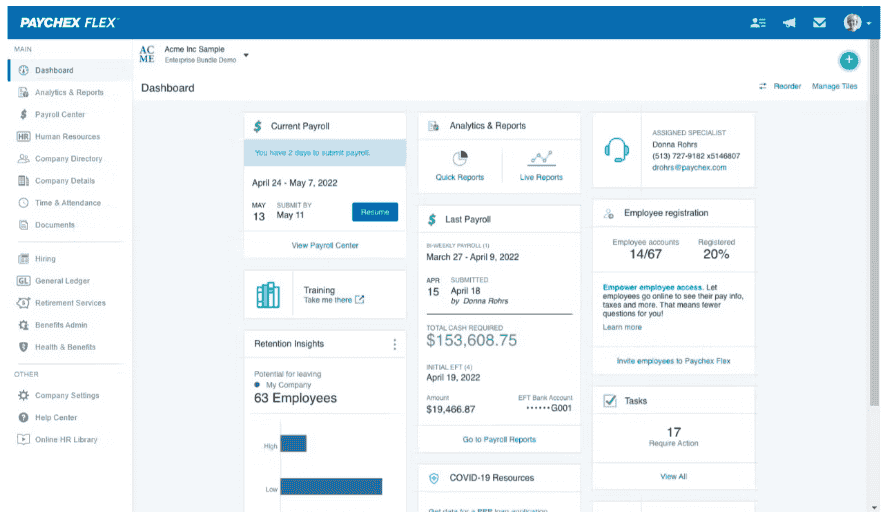
Paychex provides payroll software that is flexible, as well as HR software that suits the requirements of those businesses that have employees receiving variable pay along with hourly pay. In addition to providing basic payroll services, Paychex also provides time and attendance, training, recruitment, benefits management, and compliance services; these suit medium-sized factories.
Pros:
- Deep HR resources and benefits administration alongside core payroll.
- Reliable, well-established payroll engine with strong compliance support.
- Scales from small to mid-sized operations with optional HR outsourcing.
Cons:
- Some users report occasional slow loading and limited advanced features.
- Account manager turnover can disrupt institutional knowledge.
- Pricing requires a custom quote.
Best for: Mid-sized manufacturers that want payroll plus robust, layered HR resources.
4. ADP Workforce Now-Best for Scale and Complex Configuration
ADP has experience within the area that is being developed for organizations that need shift scheduling and need to be compliant in all 50 states and internationally. The distinguishing feature of ADP is configurability and scalability; when complex requirements need to be handled, where payrolls have to be managed in the US as well as internationally, very few systems can match ADP’s capability.
Pros:
- Enterprise-grade scale with deep U.S. and global payroll configurability.
- Decades of market experience and a very wide compliance footprint.
- Handles complex, high-volume, multi-scale pay structures.
Cons:
- Reporting can be siloed across modules, so cross-system reports may need support.
- Enterprise overhead can be overkill for smaller or simpler operations.
- Quote-based pricing that can carry premium costs .
Best for: Large or multinational manufacturers with complex configuration needs.
5. Rippling-Best Unified Workforce Platform
The reason behind the attractiveness of the program is that HR, payroll, IT, and finance are all part of one common platform. The software can control both the employees and the freelancers who have come from various parts of the world. In addition to that, it will calculate the shift differential, pay rate, PTOs, and overtime pay automatically.
Pros:
- Highly rated for intuitive design and fast, straightforward setup.
- Auto-syncs differentials, PTO, and OT; unlimited off-cycle payroll runs.
- Modular PEPM pricing (core from ~$8/employee/month) so you pay for what you use.
Cons:
- Some reviewers note scalability limits for larger organizations.
- Historically, fewer HR point-solution integrations (recently expanding via its API marketplace)
- Add-on modular pricing can add up as you layer on features.
Best for: Manufacturers wanting one connected system for the whole workforce, including cross-border teams.
6. Paylocity-Best for Multi-Location and Union Rules
Paylocity is the next-generation platform, which is an integrated solution that allows you to manage your payroll, HR, scheduling, and compliance from a single dashboard. Paylocity has the ability to handle multilocation, shift payroll, certifications, collective bargaining, job costing, and all other existing ERP systems integrations. Solutions like mobile self-service and earned wage programs will assist in employee retention.
Pros:
- Strong support for union rules, job costing, and multi-site operations.
- AI embedded across scheduling, benefits, and analytics for proactive insights.
- Praised for an intuitive interface and highly customizable reports.
Cons:
- Some users find report generation and setup more complex than rivals.
- Account manager turnover is reported, as with other large providers.
- Quote-based PEPM pricing with tiers that vary by module.
Best for: Multi-site manufacturers with union workforces and job-costing needs.
7. Netchex-Best Purpose-Built Vertical Fit
Manufacturing is considered by Netchex as one of its major verticals in relation to configurations. This solution offers the following features: shift differential pay, piece rate pay, OSHA certification management, and multi-language capability for manufacturing staff.
Pros:
- Manufacturing treated as a core vertical, not a configuration afterthought.
- Native piece-rate pay, OSHA/certification tracking, and multilingual support.
- Industry-informed customer support.
Cons:
- Smaller brand footprint than the enterprise incumbents.
- Quote-based pricing with limited public transparency.
- Less recognized ecosystem of third-party integrations than the largest players.
Best for: Manufacturers whose pay rules (piece rate, differentials, certifications) strain generic systems.
8. APS Payroll-Best for Complex Scheduling and Labor Management
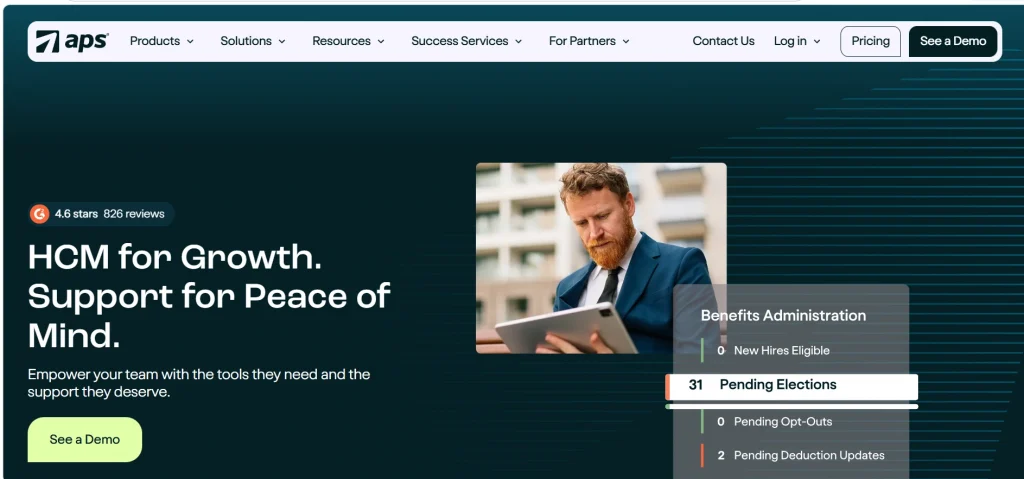
This solution encompasses all HR/Payroll capabilities including Paperless Payroll, Core HR, Benefits Administration, Performance Management, Attendance, Scheduling, and ACA Reporting. The unique feature that sets APS apart from its competitors is that it can handle complex labor/scheduling and employee classification.
Pros:
- Effective schedule and labor management capabilities.
- Adequate handling of diverse employee categories.
- All-encompassing feature list, including ACA compliance reporting.
Cons:
- Less known and fewer reviews compared to top-tier players.
- Needs a quotation for pricing information.
- Lacks some prominent features for manufacturing industry compared to its competitors.
Best for: Manufacturers with intricate scheduling and mixed workforce classifications.
9. Deel-Best for Global and Cross-Border Workforces
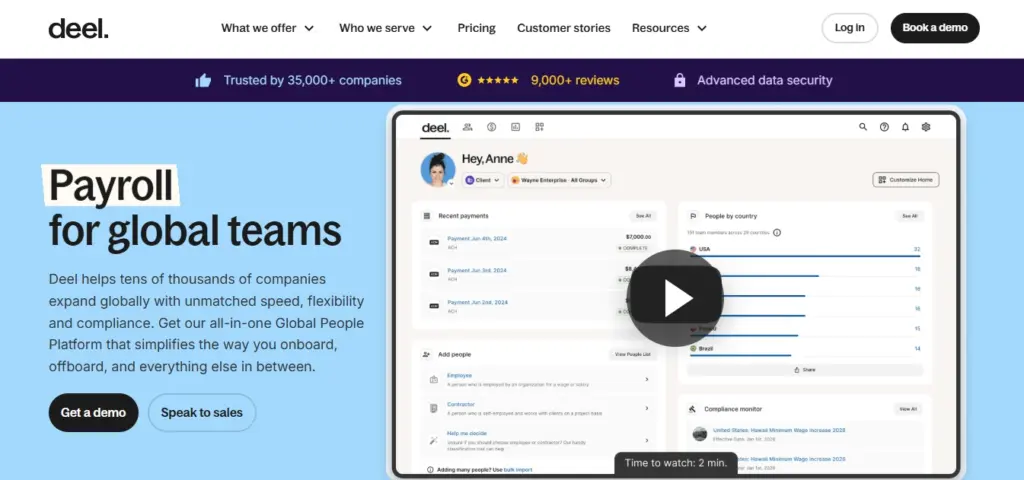
The Deel solution is perfect for those firms that want to hire, remunerate, and manage their employees and freelancers within an international setup but without necessarily establishing any operations abroad. Manufacturing firms doing business internationally can rely on Deel to sort out all problems of compliance.
Pros:
- Does not need legal entities to pay staff/contractors in 130+ countries.
- Automatically manages complicated gross-to-net processing and multi-country compliance.
- Real-time access to the cost of global payroll.
Cons:
- Too much for purely domestic manufacturers with only one facility.
- Less information on U.S. manufacturing floor operations (shifts, differentials) than domestic solutions.
- Emphasis on contractor/EOR requires less functionality of HR.
Best for: Manufacturers with international employees or contractors.
10. RUN Powered by ADP-Best for Small Manufacturers
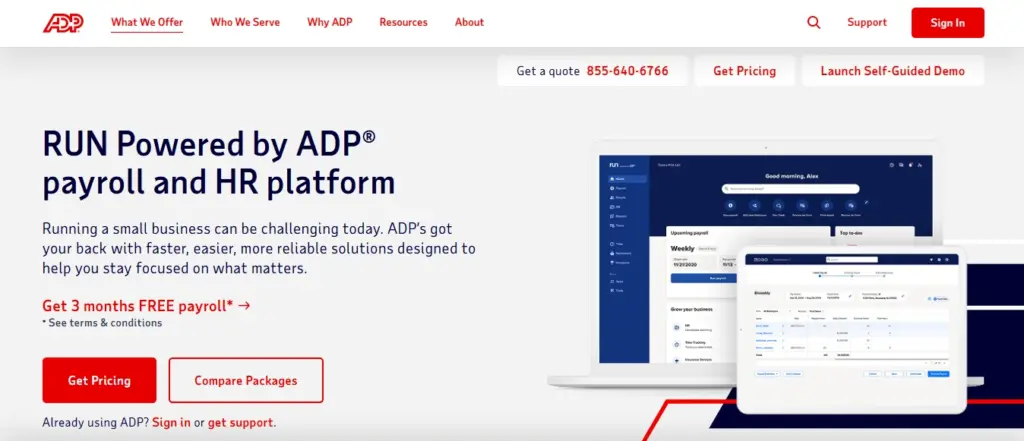
RUN can serve as a good pick for startups who want to go ahead from using spreadsheets but do not want to adopt enterprise software at the moment. The software will help file tax returns for all 50 states and also perform payroll calculations on a per project basis. There is also an option for AI-based alerts for any errors in payroll calculation.
Pros:
- 50-state multi-jurisdictional tax filing automated.
- AI identification of errors before submission along with job/production run costing.
- User-friendly interface that is fast and efficient for small teams.
Cons:
- Scaling problems will emerge rapidly with increased headcount.
- Fewer capabilities for advanced manufacturing than mid-level software.
- Accumulative add-ons when you grow.
Best for: Small manufacturers making their first move to dedicated payroll software.
How to Choose the Right One
A few questions cut through most of the noise:
- What are your pay structures? If you rely on shift differentials, blended overtime, or piece rate, prioritize platforms with native support (Paycor, Netchex, Paylocity) over ones where it’s a workaround.
- How many sites and states (or countries)? Multi-state compliance is table stakes; multi-country pushes you toward Rippling, ADP, or Deel.
- Do you need ERP integration? Confirm pre-built connectors or solid API/CSV support so hours, labor costs, and job codes flow into accounting and production.
- What is your size and growth path? Small operations are well served by RUN; mid-market fits Paycor, Paychex, and Paylocity; enterprise and global lean toward ADP.
- How much does support matter? For complex, multi-facility payroll, a knowledgeable account of contact is worth as much as any feature, and it’s a common pain point across the big providers, so weigh it heavily.
Cost aside for now, most industrial-strength applications work on a quoting model based on headcount, modules, and implementation costs.
Buying Guide for the Best Payroll Software for Manufacturing
All of the above questions should lead you to a short list. The following buyer’s guide will take you one step further by analyzing all the factors which will determine the difference between a successful and an expensive manufacturing payroll purchase.
Must-have features for manufacturing payroll
Not every payroll platform is built for the factory floor. Before you evaluate anything else, confirm the system natively supports:
- Complex pay rules: Shift differentials, blended and daily overtime, piece-rate pay, multiple pay rates per employee, and premium pay for weekends or holidays, calculated automatically rather than through manual overrides.
- Time and attendance capture: On-site time clocks (badge, PIN, biometric, or proximity), mobile and Wi-Fi punch-in, and geofencing, with clean data flowing straight into payroll.
- Multi-shift and multi-site handling: Support for rotating shifts, multiple facilities, and multiple legal entities without duplicating administrative work.
- Compliance automation: Federal, state, and local tax filing; wage-and-hour rules; union and prevailing-wage requirements; and, where relevant, multi-country compliance.
- Certification and safety tracking: OSHA certifications, licenses, and training expirations tracked at the employee level so nothing lapses.
- Job and labor costing: The ability to attribute labor costs to specific jobs, projects, or production runs for accurate margin of visibility.
- ERP and accounting integration: Pre-built connectors or robust APIs so hours, labor costs, and job codes sync into your production and finance systems.
How to evaluate vendors
Once a platform clears the feature bar, put it through a practical evaluation:
- Map your requirements first- Document your pay structures, your headcount by site, the states and countries you operate in, any union agreements, and existing ERP or accounting tools prior to taking a single demo. This will become your scorecard.
- Demo with your own scenarios- Ask the vendors to run your trickiest cases live, such as a blended-overtime week, a shift-differential calculation, or a multi-entity run. This will give you a better idea of the software’s capabilities than a canned demo would.
- Check manufacturing references- Ask to speak with existing customers of your size and complexity in the manufacturing industry. This will give you an idea of how the software performs for others like you.
- Scrutinize support- Ask if you will have a dedicated account contact who understands your configuration. Ask about response times and how account manager turnover is handled. Many of the large providers have this as a recurring pain point for their customers.
- Understand implementation- Ask about the timeline for implementation, which is often between two and three months for the mid-market platforms. Ask about data migration and who will perform the work. Get this in writing.
- Model the true cost- Look beyond the per-employee charges. Look at base fees, module add-ons, implementation charges (which are often 10–20% of the annual cost), and any first-year promotional pricing that will expire after the first year.
Common pitfalls to avoid
- Purchasing enterprise scale software when manufacturing depth is required. A large general-purpose platform may be able to process checks, but it may lack the capability to handle piece-rate or differential pay rates. Fit beats brand every time when choosing software for manufacturing companies.
- Underestimating the amount of effort required to integrate the software with existing systems. While the software may claim to integrate with the company’s ERP system, this could be through a polished connector or through a CSV export. It is crucial to verify exactly how the data will be transferred between the systems.
- Ignoring the experience of the employees who will be using the software. Features such as mobile self-service, multilingual interfaces, and earned wage access can have significant impacts upon employee retention and thus upon labor costs.
- Treating the price of the software as the headline information. Software manufacturers may charge fees for implementation, for additional modules, or for different support plans. It is critical to compare the total cost of ownership.
Manufacturing Case Study: How Hillson Shoes Cut Payroll Costs by 80% with Zimyo
There is theory and there is application. One company that provides evidence for how the right manufacturing payroll system can perform is Hillson Shoes, which is widely recognized for its operations in the manufacture and exportation of shoes.
- The challenge. The number of blue-collar workers Hillson has is also quite large, with over 700 employees on the payroll, and he also needs to deal with their attendance. This means that Hillson faces the exact type of problems mentioned in this guide: lots of HR paperwork, complicated payroll issues, and so forth.
- The solution. Hillson implemented Zimyo’s HR and Payroll software to streamline payroll for its workforce, standardize attendance management, and cut down the manual administrative load.
The results. According to the company, the outcomes were substantial:
- 80% reduction in payroll costs, with processing becoming smooth and efficient
- 88% of manual HR tasks eliminated, freeing the team from repetitive work
- Payslips generated in five clicks, simplifying a previously tedious cycle
- Expense reimbursements processed roughly twice as fast as before
- Streamlined attendance management across a 1,000+ person workforce
As quoted by Twinkle, the HR Manager at Hillson Shoes, the payroll process was successful after implementation, and she said that the process could be considered as a payroll system which can handle complex HR issues easily.
Why does it maps to the buying guide?
Hillson’s case study follows these priorities: local processing of large numbers of blue-collar workers’ paychecks, automatic input of attendance information into the payroll system, and the resulting reduction in costs and labor. It serves as a good illustration of how the most effective changes in manufacturing payroll usually don’t involve fancy technology but removing manual, error-prone steps behind the scenes. (Numbers are as stated by the vendor and client; check your own facts for your situation.)
Conclusion
The best payroll solution will always depend on what you need from a system in particular. Payroll systems designed specifically for manufacturers, such as Zimyo, Paycor, and Netchex, deserve a second look when you have a shift work force or complicated payroll regulations. Rippling and Paylocity will be great for consolidated multi-facility payroll operations, ADP and Deel will cater to scaling and international companies, while RUN by ADP should be where you begin if you have a smaller plant. You should start from your needs, test each vendor in your extreme scenarios and consider service as much as you do features. When done right, payroll stops being an issue for Mondays.
Prices and features details are based on public sources as of mid-2026 and may vary. Verify the current specifics from each vendor directly.
FAQs
What are the best payroll software options for manufacturing companies in India?
Payroll software solutions that work best for Indian manufacturing firms include Paycor, Paychex, ADP Workforce Now, Rippling, Paylocity, Netchex, APS Payroll, Deel, and RUN by ADP. Moreover, Zimyo is an effective solution for manufacturing firms, having helped Hillson Shoes cut down on payroll expenses by 80%.
Which payroll software solutions support compliance with Indian labor laws for manufacturing firms?
Payroll solution providers with good compliance features for manufacturing companies are ADP Workforce Now, Paychex, Rippling, Deel, and RUN by ADP. These software programs cover tax filing, wage and hour compliance, compliance across multiple states/countries, and other payroll requirements. They can thus be used by manufacturing companies that have high compliance requirements.
In addition, for Indian manufacturing companies, there is Zimyo with payroll automation and attendance management, which is successful in handling huge blue-collar workforces.
How to choose payroll software for a mid-sized manufacturing business?
While selecting the appropriate payroll software for mid-sized manufacturing firms, the considerations should include products that enable shift differentials, overtime processing, multi-location employee management, compliance assistance, attendance tracking, and ERP integration. Other factors to consider during the evaluation of payroll software include implementation assistance, scalability, cost, and experience of the vendor in addressing payroll issues of mid-sized manufacturing firms.